
Patsy Gallant, From New York To L.A. and the Untold Story of Canadian Disco
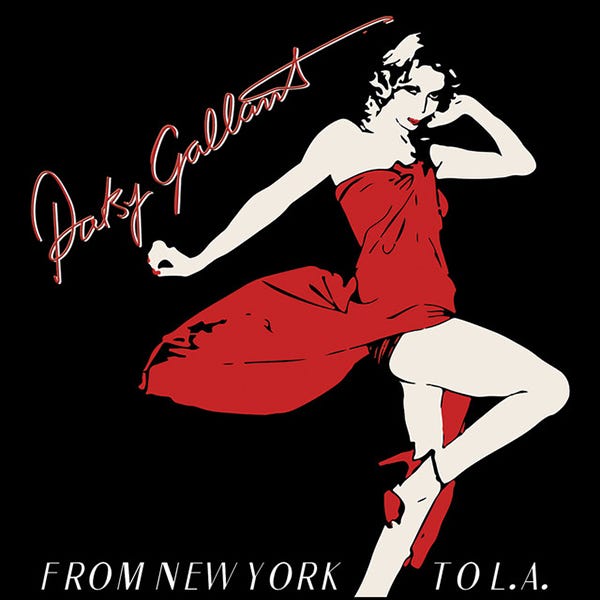
The Twelve Inch 221 - The A Side (Extended) : From New York To LA (Patsy Gallant)

So here we are.
The starting point of CanCon Month.
For the next three weeks we’re going to explore the story of Disco and Canada, but also Canada and Disco. And those really are two different stories.
I’ve mentioned it a few times over the past months, but one sentence kept coming back to me while researching this series. In 1979 a Billboard journalist described Montreal as the second most important disco market in North America.
Think about that for a second.
Not London, Philadelphia or Miami
Montreal.
Only New York ranked higher.
It’s one of those statements that immediately raises another question. How on earth did that happen? That’s exactly the story I’m about to tell.
The strange thing is that if you want to read about New York and the birth of disco, you can spend the rest of your life doing so. Books, documentaries, interviews, magazine articles... there’s an endless amount of material. Montreal is a very different story.
For a city that played such an important role in dance music history, remarkably little has been written. And I discovered fairly quickly why. Canada isn’t an easy country to understand. Being Belgian probably helped me a little 😁.
Like Canada, Belgium isn’t one cultural landscape. Living barely fifteen kilometres from the language border, I’m used to seeing two musical worlds existing side by side. They meet, they influence each other, but they don’t necessarily share the same artists or even the same conversation.
The more I researched Canada, the more familiar that felt. So, once those pieces began falling into place, something remarkable happened. I stopped reading a story about disco. And I started reading a story about identity, language, politics, clubs, producers and one country constantly looking in two directions at once, south towards America and across the Atlantic towards Europe.
That’s what makes Canadian disco so fascinating.
I’ll warn you in advance though. This has easily been the biggest research project I’ve undertaken for The Twelve Inch. Most of what you’ll read during the coming weeks comes from primary sources. Newspaper archives, trade papers, interviews and, inevitably, quite a few rabbit holes. Every time I thought I’d reached the end, another archive seemed to open another door.
Fortunately, that’s one of the joys of writing a newsletter: The story never really ends. If new information surfaces six months from now, I’ll happily revisit it. So if you have memories, records, old magazine clippings or simply grew up in this period, don’t hesitate to share them. That’s one of the nicest things about this community.
The B-Sides will tell the larger history.
This week we’ll travel back to Montreal during the 1920s and discover why the city was almost destined to become a disco capital. Next week we’ll spend an evening inside Lime Light, Montreal’s answer to Studio 54, although I’d argue it was even better. And in the final chapter we’ll explore why Canada experienced the disco backlash very differently from the United States.
The A-Sides tell that bigger story through individual records.
And there couldn’t be a better place to begin than with an artist whose career perfectly illustrates the opportunities and contradictions of Canadian music.
👋 Welcome, I’m Pe Dupre, thanks for stopping by.
This is The Twelve Inch, a community about the history of dance music from 1975 to 1995, told one twelve-inch record at a time.
If this landed in your inbox because a friend forwarded it, I’d love for you to subscribe so you don’t miss the weekly episodes. Each one dives into a track, its story, and the culture around it.
And if you’re already enjoying the free posts, would you consider becoming a paid subscriber? Your support helps me keep researching, writing, and unearthing the stories behind the music. And You’ll get access to the weekly B-side post: the full archive and extra Subscriber Only Posts
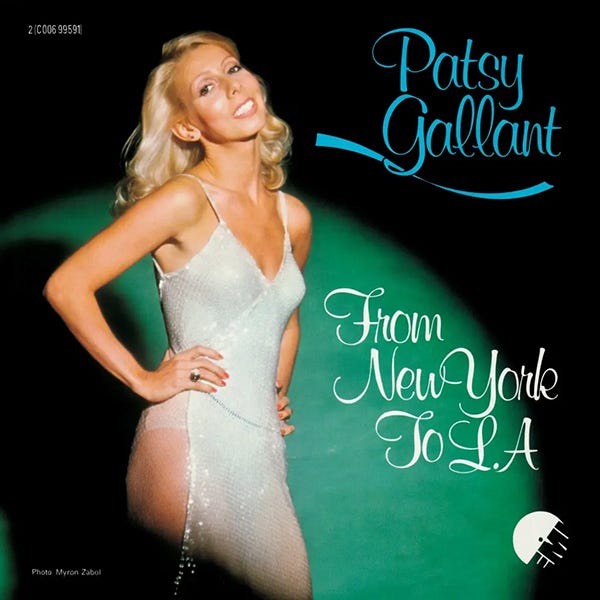
Who Is Patsy Gallant?
It’s actually a much less strange question than you might think. Outside Canada, most of us know exactly one Patsy Gallant record.
“From New York To L.A.”
Saying it was a “worldwide hit” might be stretching things a little. She reached the Top 10 in the UK, Ireland, Australia and South Africa. The single also became a respectable hit in Scandinavia and here in the Benelux.
But then things become rather odd.
Germany barely registers. France doesn’t appear at all, which feels strange considering Quebec’s cultural ties with France. While researching I came across the French chart website where German readers were fondly reminiscing about hearing the record on the radio. Talking about European integration... 😁
Apparently the song was remembered. Just not enough to become a chart hit. The biggest surprise, however, came when I looked at the American charts.
Nothing.
Not a trace.
C’mon...
With a title like “From New York To L.A.”? 😂
It certainly received club play and some radio support, but it must have been incredibly local. And in many ways that’s Patsy Gallant’s career in a nutshell. She always seemed one step away from something much bigger. Which is exactly why she’s such an interesting artist.
Because her story doesn’t just tell us about Patsy. It tells us an awful lot about Canada.
She was born Patricia Gallant on 15 August 1948. Not in Quebec, as many people assume, but in New Brunswick. She was Acadian.
That distinction matters.
Long before Canada existed, France established several colonies in North America. Quebec became one. Acadia became another. Even today Acadians have their own traditions and celebrate their national day every 15th of August with the Tintamarre, a wonderfully noisy parade where people bang pots, sound car horns and make as much noise as possible.
It’s their way of saying: “We’re still here.” And Patsy would spend much of her career doing exactly the same thing. 😁
And she started remarkably young. By the time her family had moved to Quebec she was only eight years old and already singing in striptease clubs with her aunt and uncle.
Then came the quote that completely won me over.
Now that’s an introduction.
You already know exactly what kind of person Patsy Gallant was.
At eighteen she left home and started building a career of her own. Initially she stayed close to the Quebec variété (MOR) tradition, releasing several singles before signing with CBS Canada, now Sony Music, in the early seventies. The label clearly believed in her.
Patsy was one of those rare singers who seemed comfortable singing almost anything, so CBS tried... almost everything. MOR, jazz, rock, country. Her 1974 album Power was even recorded in Nashville, which looked like a sensible move. Country was hugely popular in English-speaking Canada and it might open the door to the even larger American market. On paper it made perfect sense. But in reality it didn’t.
CBS eventually dropped her, leaving Patsy without a record company just as disco was beginning to emerge. But sometimes bad timing turns out to be perfect timing.
Dancing with a National Anthem
Around 1974 she met producer and manager Ian Robertson. “He was an English aristocrat. He didn’t speak a word of French. He was my lover, but he also taught me a great deal.” Together they came up with an idea that, depending on who you asked, was either inspired or outrageous.
They turned “Mon Pays” into a disco record.
Now, unless you’re from Quebec, that probably doesn’t sound particularly controversial. Trust me... It was.
The original was written by Gilles Vigneault, one of Quebec’s most respected singer-songwriters and a leading figure in the province’s growing nationalist movement. Mon Pays had become something close to an unofficial national anthem.
Its opening line says almost everything. “Mon pays, ce n’est pas un pays, c’est l’hiver.”(My country, it’s not a country, it’s winter)
I’ve always loved that sentence.
Without ever mentioning politics directly, it says something profoundly political. It defines Quebec not through borders but through a shared experience.
Turning that song into disco? You can imagine the reaction. Some people loved it. But others thought it bordered on blasphemy.
The original with a short introduction in Québécois
It’s one of those moments where music suddenly becomes much bigger than just music. I’ll return to that story in this week’s B-Side because understanding Quebec’s Quiet Revolution helps explain why Patsy’s version caused such a stir.
Ironically, the controversy also created her biggest opportunity. The record became such a success in Quebec that her producers suggested making an English version.
Patsy immediately objected. “They wanted me to do it as translation. I I saw two translation. It was just horrid. I said I’m not gonna sing that. If I do it in English, you gotta give me a totally different story” Fortunately, they listened.
The result became “From New York To L.A.”
A Window Opens... Then Closes Again
The record finally gave Patsy the breakthrough she’d been chasing. So why didn’t it become the start of a much bigger international career? I think several things happened at exactly the wrong moment.
The first is almost a cliché of the music business. An artist suddenly has an international hit. The following year disappears into airports, television studios and promotional tours. Exactly when you should be writing/recording the next great single.
The follow-ups simply weren’t as memorable.
The second reason was Attic Records, her new record company. It was an ambitious Toronto independent, but also a very young company. International success depended on licensing records territory by territory, and that’s much easier when every new single sounds like another hit.
Then there’s something that immediately caught my collector’s attention. There was never a proper twelve-inch club mix of From New York To L.A. That says quite a lot.
By 1976 disco producers were beginning to understand the dancefloor. Extended arrangements, longer breakdowns, more space for DJs, that language was still developing.
Ian Robertson was a perfectly competent producer. He just wasn’t one of disco’s great innovators. I’ve often wondered what would have happened if someone like Tom Moulton or Jacques Morali had been behind the mixing desk?
Would we still be talking about From New York To L.A. as one of disco’s essential records? Personally... I wouldn’t rule it out.
Caught Between Two Canadas
To be fair, Patsy’s Canadian career didn’t immediately stall. Are You Ready For Love became another Top 20 hit and Sugar Daddy even reached the Canadian Top 10. But disco itself was changing at breathtaking speed.
There’s a TopPop video of Are You Ready For Love so they expected it to be a Benelux hit also.
By 1977 Canadian producers were creating tougher, club-oriented records that were tailor-made for the dancefloors of Montreal and Toronto. Patsy’s records increasingly sat somewhere between disco and MOR. Perfectly enjoyable, but less essential on the dancefloor.
Her career also illustrates something I realised very quickly while researching this series. Canada isn’t one music market.
Quebec had developed a remarkably self-sufficient music industry. Artists could become enormous stars there without ever crossing into English-speaking Canada.
Looking from Belgium, I immediately understood that. Patsy found herself caught between those two worlds. Her English was flawless. Yet English Canada often saw her as a French artist. French Canada increasingly associated her with an English-language disco hit.
One journalist in RPM summed it up perfectly. “People from Quebec think she’s English. English Canada thinks she’s French.”
One sentence. One impossible position.
Patsy herself made exactly the same point when asked whether Quebec had embraced From New York To L.A. “There was no French Canadian reaction. How could there be? They never played it in Montreal. As far as I know, the French didn’t care at all.”
More Than One Hit
Patsy Gallant never became Canada’s Donna Summer. She never became the next Céline Dion either. But I don’t think that’s the right way to judge her career. If anything, the roads she didn’t take tell us more about Canada than the one she did.
Her story touches almost every theme we’ll encounter during CanCon Month. The relationship between French and English Canada. Montreal’s rise as a disco capital. The emergence of independent labels. The speed with which disco evolved, and how quickly opportunities could disappear again.
Looking back years later, Patsy remembered that period with obvious affection.
That’s a lovely quote.
Because over the next three weeks we’re going to discover exactly why Montreal deserved to be mentioned in the same breath as New York.
And I have a feeling a few surprises still lie ahead.
The Twelve Inch is a growing community of people who love disco, eighties, and early-nineties dance music.
If you know someone who would enjoy these stories, feel free to share this post with them or pass it along on Substack Notes. Every share helps the music, and the community, travel a little further. 💿✨
🎧 Next on the B-Side
This week’s B-Side starts long before disco.
We’ll travel back to Montreal in the 1920s and slowly build the city that would eventually become North America’s second disco capital. It’s a story of immigration, prohibition, nightlife, organised crime and a city that seemed destined to embrace dance music.
The B-side is where we go deeper.
It’s paywalled, but for the price of 8 premium coffees, you get:
a full year of B-sides
access to 150+ deep dives
future stories across genres
And yes, payment in beans is still impractical 😁
Join the club. I’d genuinely love to have you on board.
And now, it’s your turn:
Do you remember From New York To L.A. when it first came out?
Did Patsy Gallant ever have more than one hit where you lived?
And if you’re Canadian, I’d be especially interested to hear how you remember those years.
See you on the dancefloor.
So You Wanna Hear More ?
I thought you would !
It’s fun to write about music but let’s be honest. Music is made to listen to.
Every week, together with this newsletter, I release a 1 hour beatmix on Mixcloud and Youtube. I start with the discussed twelve inch and follow up with 10/15 songs from the same timeframe/genre.
Listen to the Soundtrack of this week’s post on MIXCLOUD
Or on Youtube :