The Twelve Inch

The Twelve Inch

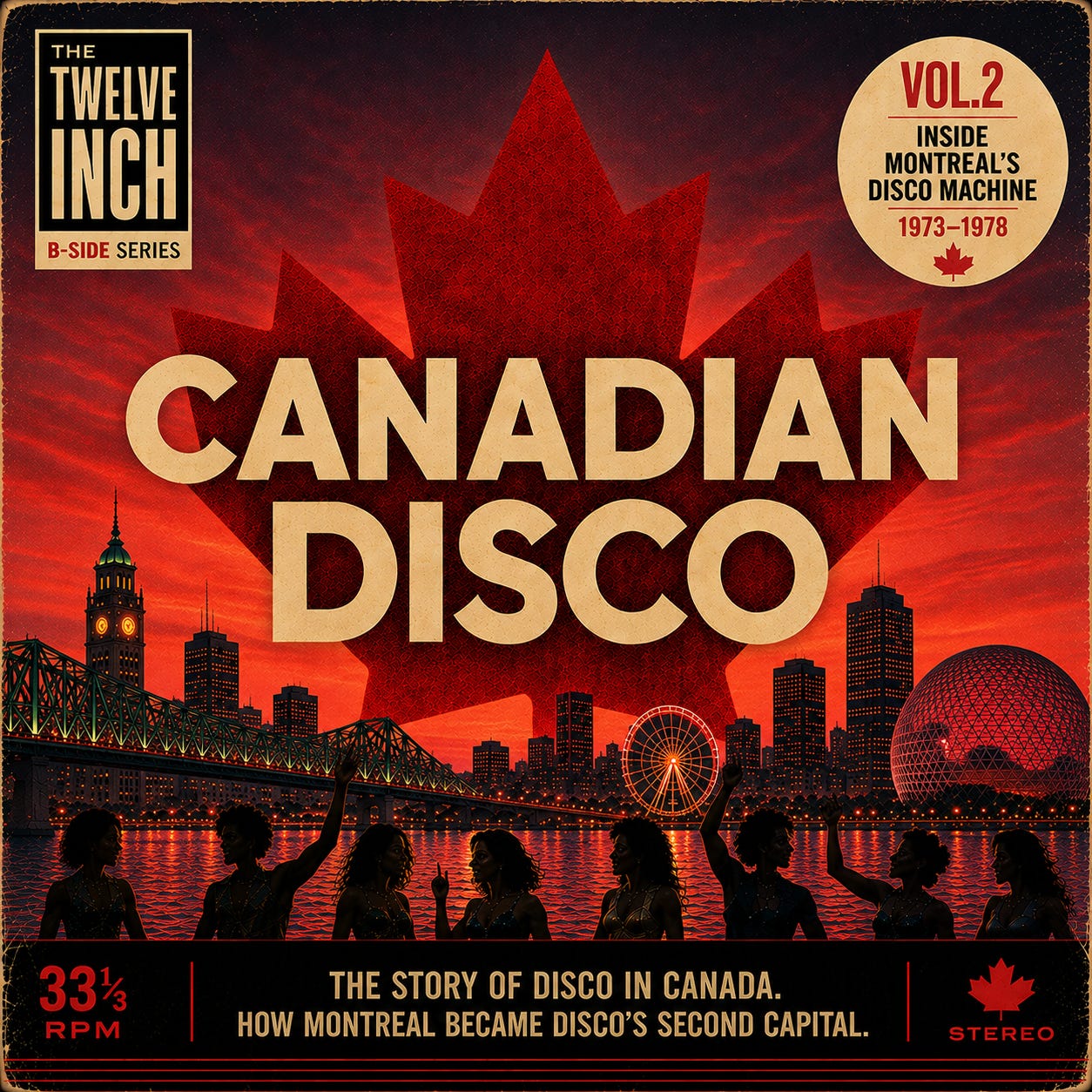
The Twelve Inch #222 - The B-Side : Inside Montréal’s Disco Machine 🪩🇨🇦

The Twelve Inch 222 : The Can-Con Series Part 2

The Twelve Inch (Disco/80s)'s avatar
The Twelve Inch (Disco/80s)
Aug 15, 2026
∙ Paid

Welcome to the B-side.

🇨🇦 It’s CanCon Month!

And we’re going to do things a little differently this week and over the coming weeks.

Instead of zooming in exclusively on the song from this week’s A-Side, the B-Sides will tell the bigger story of Disco and Canada, but also Canada and Disco. Two different, but closely connected and equally fascinating stories.

The A-Sides will provide the records that guide us through that history. Each week’s featured song illustrates something happening in the bigger story we’re exploring here.

So if you’ve read this week’s A-Side about the Bombers and (Everybody) Get Dancin’, you’ll recognise quite a few themes. The machine behind Montreal’s disco production and the Italian connection.

In other words, the A-Side gives us the record.

The B-Side takes us down the rabbit hole. 😁


But before we continue, if you wonder why I deactivate the AI scanning tool? Click here

🇨🇦 Montréal Takes the Dancefloor: How a City Became Disco’s Second Capital

Last week we left Montréal standing on the doorstep of disco.

The city had spent the sixties almost rehearsing for what was about to happen. It had imported the European idea of the discothèque, the Quiet Revolution had transformed Quebec society, Expo 67 had brought millions of visitors and a blast of modernism, and underneath all of that there was already a thriving soul and R&B culture.

So when disco arrived, Montréal didn’t exactly need an invitation.

And this is where our story really starts.

The Bastard Child of Soul

There are roughly two phases in the history of Montréal’s discothèque culture, and they divide rather neatly between the sixties and seventies. In the sixties, the discothèque still felt European. By the middle of the seventies, it increasingly looked towards New York.

The clubs themselves hadn’t necessarily moved. They still occupied much of the same downtown territory and attracted a familiar mixture of socialites, young club kids, Francophones and Anglophones.

What changed was the music.

In the sixties, Montréal DJs had relied heavily on seven-inches from elsewhere, particularly France. There simply wasn’t much of a Canadian recording industry supplying them. By the middle of the seventies, that was changing too. Quebec’s Quiet Revolution had helped create its own star system, and increasingly its own records.

And at almost exactly the same moment, something else was happening. The DJ was becoming more important, the twelve-inch was arriving together with the remix.

And the music itself was changing.

One of the people we’ll spend a lot of time with in this and the next episode is Robert Ouimet, resident DJ at the Lime Light and one of the central characters in Montréal’s disco story.

Ouimet remembered the city’s R&B roots very clearly:

“During Expo 67, there was a big party every Saturday or Sunday and the only thing they played there was soul music, anything on Motown, James Brown.. etc.. Everybody was there. It was packed, 5000 people everytime.”

What happened next wasn’t really a break with that music. It was an evolution.

Or, as Ouimet puts it rather more colourfully:

“I used to write for a magazine in the 70s. We used to take the bus to come to Montreal and listen to the latest soul stuff. At that time I was not yet (beat)mixing. It was the in and out stuff. One record was finishing, the other one was beginning. Disco started the same way. It was a continuation of all the the the R&B stuff from late 60s to early 70s. It’s like their child, their bastard child.”

I love that description.

Disco as the bastard child of R&B.

And it explains why Montréal was so ready for it. Disco wasn’t some strange American invention suddenly dropped onto an unsuspecting city. The clubs, dancers, DJs and record buyers were already there.

They simply moved with the music.

But there was one rather important problem.

User's avatar

Continue reading this post for free, courtesy of The Twelve Inch (Disco/80s).

Or purchase a paid subscription.
© 2026 Peter Soetewey · Privacy ∙ Terms ∙ Collection notice
Start your SubstackGet the app
Substack is the home for great culture