

Welcome to the B-side.
This is where things get a little closer to the source.
The parts of the story that don’t always make it into the main piece. The details behind the sound. The personal notes. And the versions that really tell you how a track worked on the dancefloor.
If you missed the A-Side story, you can read it here. 👇
Pet Shop Boys, Domino Dancing and the Album That Turned the Twelve-Inch Into the Main Event

Here’s the thing with the Pet Shop Boys.
Every twelve inch had a B-side where the DJs and collectors found the extra tools: beats, dubs and alternate versions.
This is the B-Side of this week’s episode, where we dig deeper into the story behind the record. Read it in one go or enjoy the different sections on different moments. The choice is yours
🥁 Mix 1 — The Beats
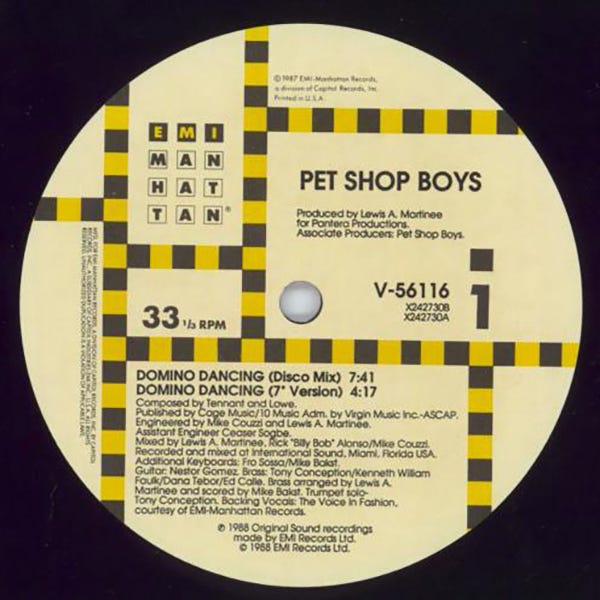
Did Domino Dancing Really End the Pet Shop Boys' Imperial Phase?
One thing kept nagging at me while researching this week’s episode. Did Domino Dancing really end the Pet Shop Boys’ imperial phase? Or have we all repeated that story for so long that it has simply become accepted as fact?
At first sight, Neil Tennant himself seems to settle the matter. Looking back in a 1996 documentary he recalled the moment the first chart position for Domino Dancing came through: “Domino Dancing” came in at No.9, and I thought, ‘Oh well, that’s it. That’s over.”
It’s such a wonderfully honest quote.
Neil wasn’t just a songwriter. Before the Pet Shop Boys took off he was a journalist at Smash Hits. He understood charts better than most artists ever will. He knew exactly what a lower entry could mean, not just for one single, but for the momentum of a career.
It was also when he later coined the phrase “the imperial phase”, that extraordinary run where almost everything they touched became a hit. Three UK number ones in quick succession, critically acclaimed albums, and the feeling they simply couldn’t put a foot wrong.
Then came Domino Dancing.
Number 7 in Britain.
Most bands would have celebrated. For the Pet Shop Boys it felt like the first crack in the armour. And when Left To My Own Devices followed, things became even more obvious. EMI, particularly in America, genuinely believed it could become another massive hit. Instead it stalled at No. 84 on the Billboard Hot 100. Continental Europe wasn’t particularly enthusiastic either.
Only Britain truly embraced it.
Looking back, it’s tempting to draw a straight line. Domino Dancing. Imperial phase over.
Case closed.
But…I’m not convinced.
