

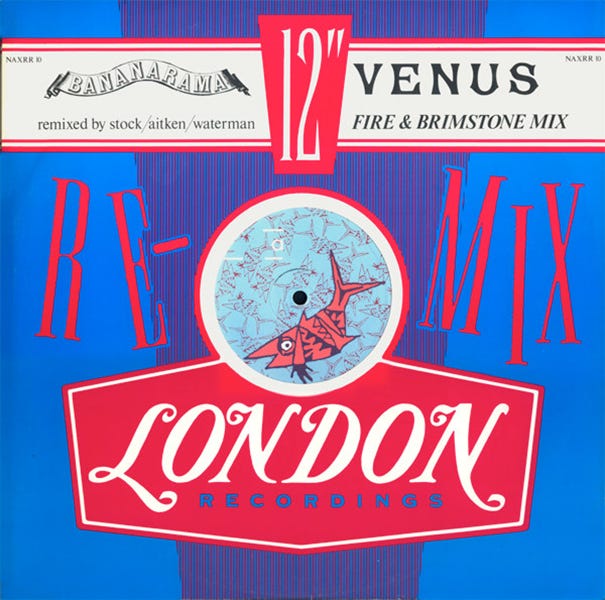
Welcome to the B-side.
This is where things get a little closer to the source.
The parts of the story that don’t always make it into the main piece. The details behind the sound. The personal notes. And the versions that really tell you how a track worked on the dancefloor.
If you missed the A-Side story, you can read it here. 👇
💃 Venus, Stock, Aitken & Waterman & The Moment Hi-NRG Took Over Pop, The Bananarama Story

At some point I knew it was coming.
Every twelve inch had a B-side where the DJs and collectors found the extra tools: beats, dubs and alternate versions.
This is the B-Side of this week’s episode, where we dig deeper into the story behind the record. Read it in one go or enjoy the different sections on different moments. The choice is yours
🥁 Mix 1 — The Beats

🥁 Inside The PWL Hit Factory, Why The SAW Sound Was Impossible To Escape
One of the funniest things about Stock, Aitken & Waterman is that almost everybody claims they hated them.
Until you put one of their records on.
Then suddenly the dancefloor fills up again 😁
That contradiction has always fascinated me. Critics rolled their eyes, serious music fans complained the songs all sounded the same, yet between roughly 1986 and 1990 you simply could not escape the PWL (Pete Waterman Limited) sound. It was everywhere. Radio, clubs, school discos, TV shows, shopping streets, gay bars, roller rinks, holiday camps, bedrooms filled with Smash Hits posters, literally everywhere.
And the strangest part?
A lot of it was built from the exact same ingredients.
That was not an accident. It was the whole point.
⚡ From Hi-NRG To The PWL Production Line
SAW didn’t invent dance music. They industrialized one very specific strain of it and turned it into one of the most commercially successful pop formulas ever created.
Their roots sat deep inside three scenes that were slowly colliding during the first half of the eighties:
American and European Hi-NRG
Italo disco and Eurobeat
early electronic club music coming out of Chicago and New York
Especially the Hi-NRG connection matters.
If you go back and listen to the early Divine or Hazell Dean productions, you can still hear SAW before they fully became SAW. The DNA is already there. Fast tempos. Relentless kick drums. Bright synth stabs. Music designed to keep bodies moving without interruption.
And importantly, music deeply connected to gay club culture.
That part often gets forgotten now because the later SAW productions became so mainstream, but the early momentum absolutely came from LGBTQ dancefloors. Pete Waterman himself has repeatedly acknowledged how important gay clubs were in breaking their records. Part of his early dj career was in gay clubs
By the time they hit with Dead Or Alive and later Bananarama, the formula started locking into place.
Fast BPMs, usually between 120 and 140.
Four-on-the-floor kick drums.
Punchy synth basslines.
Huge chorus hooks.
Bright keyboard textures.
Very little empty space.
Everything engineered for momentum.
The result became what people now simply call the PWL sound. And once you recognize it, you can hear it within seconds.
🎛️ The Secret Wasn’t Complexity, It Was Speed
One of the biggest misconceptions about SAW is that they were studio perfectionists endlessly sculpting sounds for weeks. In reality, speed was one of their biggest weapons.
Tracks were often written and assembled incredibly quickly. They worked inside a tightly controlled studio environment using familiar synths, presets, MIDI combinations and repeatable workflows. Instead of endlessly reinventing sounds from scratch, they focused on efficiency and recognizability.
That’s a huge part of why the records feel so connected to each other.
You hear the same sonic fingerprints constantly reappearing: Linn drum programming, DX7 textures, Emulator II sampling, gated snares, bright brass stabs, percussive synth chords and thick vocal doubling
A fun video that explains how SAW recycled the drum pattern for every production.
Today some people hear that as repetitive. But back then it created something incredibly powerful.
The moment a SAW record started, people immediately knew what kind of emotional experience they were about to get.
That matters enormously on dancefloors.
Especially in the eighties.
Because DJs were still working fully manually. No sync buttons. No visual waveforms. You were constantly looking for records that locked together naturally. And SAW productions were an absolute dream to mix.
I can still remember playing them in clubs and almost relaxing when one came on because you knew the transition would work. The rhythm tracks were so stable, so metronomic, so machine-perfect that you almost couldn’t fail.
“Right from day one, the records we were making had to be metronomic, because that’s what it was all about” would Pete Waterman later say in the legend of pop documentary
That mechanical precision became part of the addiction.
