đ Why The Isley Brothers Turned to Disco⌠Just as Disco Was âDyingâ
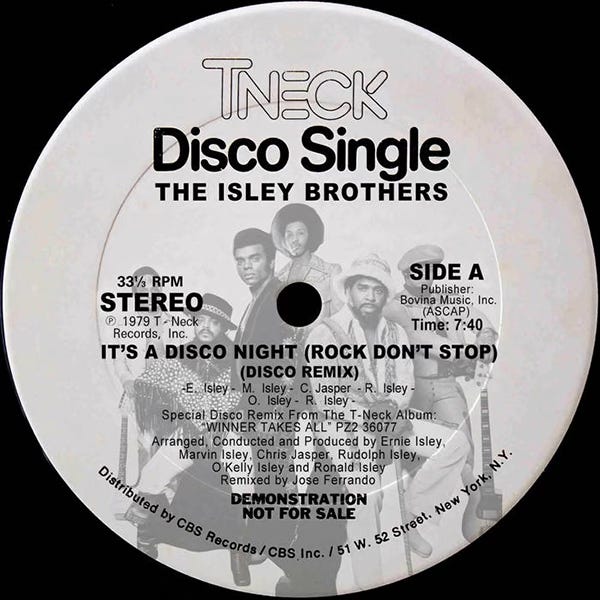
The Twelve Inch 206 - The A Side (Extended) : It's A Disco Night (Rock Don't Stop) (Isley Brothers)
When Kung-Fu Fighting by Carl Douglas ruled the summer of 1974, K-Tel jumped in with a compilation called Black Music. And yes, it was exactly that đ
It became my first real encounter with soul music. My ten-year-old self played that record endlessly. One track stood out immediately, apart from Kung-Fu Fighting of course, That Lady by The Isley Brothers.
At the time, they didnât register. They werenât even one of the featured names on the cover.
That would change five years later.
In 1979, my favorite radio show, The Soul Show, started playing Itâs A Disco Night. And thatâs when everything clicked. This track has pure drive, the kind that makes sitting still impossible. Every single time.
But hereâs the thing.
đ It didnât sound like disco.
No glossy Eurodisco sheen. No Giorgio Moroder pulse.
Instead, it was deeply funky. Driven by Marvin Isleyâs bass, elastic, rhythmic, almost slap bass in feel. Irresistible. And that raises a much more interesting question than just âgreat track, right?â
đ Why did The Isley Brothers make a âdiscoâ record in 1979âŚ
đ at the exact moment disco was supposedly collapsing?
Because if youâve followed this newsletter, you already know:
Disco didnât just fade away.
It fractured, evolved, and, on some dancefloors, refused to die.
So when I started building the shortlist for this episode, this track went straight to the top.
Not just because it works.
But because it doesnât quite fit the narrative weâve been told about 1979.
Before answering that question, I always zoom out.
Where does this track sit in the Isley Brothersâ story?
Itâs A Disco Night comes from the 1979 album Winner Takes All. At first glance, it feels like an outlier.
But as youâll see⌠that assumption doesnât really hold.
So letâs step into the time machine.
Destination: dancefloors of 1979.
đ Welcome, Iâm Pe Dupre, thanks for stopping by.
This is The Twelve Inch, a community about the history of dance music from 1975 to 1995, told one twelve-inch record at a time.
If this landed in your inbox because a friend forwarded it, Iâd love for you to subscribe so you donât miss the weekly episodes. Each one dives into a track, its story, and the culture around it.
And if youâre already enjoying the free posts, would you consider becoming a paid subscriber? Your support helps me keep researching, writing, and unearthing the stories behind the music. And Youâll get access to the weekly B-side post: the full archive and extra Subscriber Only Posts
đ Who Are The Isley Brothers, Really?
When I mentioned the K-Tel compilation where I first heard The Isley Brothers, and how they werenât even listed among the key artists, it feels almost unbelievable today. Because The Isley Brothers are easily one of the most important African American bands ever.
Their track record says it all.
In Joel Whitburnâs chart books, their hits fill an entire page in the Hot 100, and thatâs before you even open the R&B listings, where it stretches to nearly two pages. Even the dance charts list seven of their tracks.
Secondly, their longevity is extraordinary.
Their first hit dates back to 1959, and they were still scoring hits well into this century. Thatâs over 40 years of relevance. Not just impressive, but monumental.
Third, and perhaps most remarkable, is how they broke through.
They scored their first pop hits three years before they had success on the R&B charts.
Think about that.
At a time, when most African American artists depended on Black radio to cross over, the Isleys did it the other way around. An exception that tells a much bigger story, one Iâll return to later. So asking who The Isley Brothers are feels almost unnecessary. Itâs a bit like asking who The Jacksons are.
đ¤ From Gospel Roots to Chart Mainstays
Their story begins as a gospel quartet, with brothers Kelly, Rudy, Ron and Vernon Isley. Tragedy struck early when Vernon was killed in 1955 in a bicycle accident, leaving the group as a trio.
In 1957, they moved from Ohio to New York to pursue a career in R&B.
Early attempts in doo-wop brought limited success, until everything changed with the gospel-infused âShoutâ in 1959. Released on RCA Victor, it reached number 47 on the Billboard Hot 100 and went on to sell over a million copies.
Momentum followed:
âTwist and Shoutâ entered the Top 20 in 1962
âThis Old Heart of Mine (Is Weak for You)â became a Motown hit in 1966
Despite consistent success over all these years, a number one pop hit remained just out of reach. The closest they came was with their defining anthem âItâs Your Thingâ, which peaked at number 2 in 1969.
⥠Two Generations, One Sound
One of the secrets behind their longevity lies in their evolution.
The original trio was later joined by younger brothers Ernie and Marvin Isley, along with nephew Chris Jasper. By the time of the 3+3 album in 1973 (and now you know what that title stands for), the transformation was complete. That album marked a turning point.
One of its standout singles, âThat Ladyâ, became an international success, including in the Benelux.
đ The Seventies, A Golden Era
The 1970s were a peak period for The Isley Brothers.
Four number one hits on the R&B charts
Strong album sales throughout the decade
One of those R&B chart-toppers was âI Wanna Be With Youâ, the lead single from their 1979 album Winner Takes All. By then, they werenât just surviving the changing musical landscape.
They were shaping it.
𪊠Did They âGo Discoâ in 1979? Not Really
Letâs start with the most important answer first.
They didnât âgo discoâ at all.
While researching this piece, one thing stood out immediately, you hardly find any mention of Itâs A Disco Night, or even the album Winner Takes All, in later reflections by The Isley Brothers. That alone tells you something.
đ They didnât see it as a departure.
đ They didnât see it as âgoing discoâ.
đ§ They Were Already On The Dancefloor
If you listen closely to their 70s catalogue, the dancefloor is already there.
Not always labelled as disco, but:
Highly danceable
Groove-driven
Perfectly usable in a DJ set
Yes, the feel is more funk-oriented, but with the right build-up and curation, their tracks sit effortlessly alongside American disco and even Eurodisco.
If anything, Itâs A Disco Night is not a shift, itâs a continuation.
đĽ Funk First, Disco On Top
The second reason is even more telling.
This is not really a disco track. Itâs funk with a layer of disco on top.
It may sound like a subtle distinction, but in the late 70s American dance scene, it mattered. The groove, the bass, the musical DNA, it all comes from funk. The disco element is more of a surface texture. And that makes perfect sense when you look at the lyrics.
Because, quite simply:
đ Itâs A Disco Night is about⌠a disco night.
Going out.
Having fun.
Dancing with the person you love.
Disco was the setting, not the identity.
The lyrics are not in the same league as âFight The Powerâ, but itâs also not âLetâs All Chantâ.
Itâs exactly what The Isley Brothers had always done,
making great music you can dance to.
đ Influence, Already Embedded
If you go back to earlier albums, you can hear disco influences creeping in again and again. But always translated into their own language. A perfect example is âThe Prideâ from Go For Your Guns (1977), which even received a dedicated disco mix on twelve inch.
So the ingredients were already there, well before 1979.
đ§ Staying In Their Lane, And Winning
Where many artists fully jumped on the disco bandwagon in the late 70s,
đ The Isley Brothers took inspiration, but stayed in their lane.
They adapted, but never abandoned their identity. And that decision made all the difference. Because when the disco backlash hit, they were not swept away with it.
They didnât need to defend themselves in interviews. They didnât even need to mention it.
They didnât need to reposition.
They simply carried on.
âĄď¸ The Bridge to the Eighties
The clearest proof comes right after.
The title track from their 1980 album Go All The Way follows the exact same blueprint, arguably even leaning more into disco. But now something else is happening. You can already hear the early 80s.
đ This is the moment where American R&B-based disco starts evolving into synth-funk.
And The Isley Brothers are right there, at the transition point.
Their influence would soon echo in bands like:
Kool & The Gang
Slave
Atlantic Starr
The CommodoresâŚ
đĄ The Real Answer
So no, they didnât âgo discoâ.
They did something far more interesting.
đ They absorbed disco into their sound, without losing who they were.
And that is exactly why this record still works today.
đ A Modest Hit, But Not the Full Story
The Winner Takes All album was not their biggest commercial success. The album peaked at #14 on the Billboard Album Top 200, just outside the top 10. Thatâs a step down compared to:
Showdown (1978), which reached #4
Go All The Way (1980), which climbed to #8
The singles performed better. The lead single, âI Wanna Be With Youâ, became one of the four R&B number ones the Isleys scored during the seventies.
That alone confirms they were still very much in control of their audience.
𪊠A Disco Title at the Wrong Moment?
Itâs A Disco Night told a different story in the US.
#90 on the Hot 100
#27 on the R&B chart
Two main reasons explain this:
1ď¸âŁ Timing
The song was released in the immediate aftermath of the disco backlash. Radio had turned cautious, even resistant, to anything labelled âdiscoâ.
2ď¸âŁ Perception
As weâve seen, itâs not really a disco track. But the title alone, âItâs A Disco Nightâ, likely worked against it đ
đ When the Dancefloor Doesnât Follow
Whatâs more surprising is the performance on the dance charts.
The track only reached #44.
đ The dancefloor didnât amplify the record.
No extra momentum. No second life through club play. And thatâs unusual for a track with this kind of groove.
Across the Atlantic, things looked very different. In the UK, the track reached #14 on the pop chart.
đ Beyond 1979, A New Chapter Begins
The success story of The Isley Brothers didnât end in 1979, far from it. The immediate follow-up, Go All The Way (1980), already showed they were still evolving and staying relevant. The albums that followed were a bit less successful commercially, but that changed again in 1983 with Between The Sheets, actually the only Isley Brothers album I owned on vinyl back then.
đ Quiet Storm, A Different Kind of Power
The title track, âBetween The Sheetsâ, is now one of their most recognisable songs. Itâs also a perfect example of the Quiet Storm style, a smoother, more sensual side of R&B that Iâll explore in full on this weekâs B-Side.
Between The Sheets sold two million copies, marking a major late-career success. It would also be the last album recorded by the six-man line-up. After that, the younger generation, Ernie and Marvin Isley along with Chris Jasper, went their own way and formed Isley, Jasper, Isley.
They would go on to score a major international hit with âCaravan Of Loveâ.
đ Crossing Over, Without Crossing Out
A few weeks ago, I wrote about Tina Turner and how difficult it was to move from R&B radio to rock radio. Or, put more bluntly, from Black radio to White radio.
In many ways, The Isley Brothers operated in that same space. But their path was different. đ They didnât try to become a rock act. đ They stayed firmly rooted in R&B.
But just the kind of R&B that could cross over.
đ Built for Both Worlds
As mentioned earlier, they scored their first pop hits years before breaking through on the R&B charts. That alone is extraordinary.
Their albums tell the same story:
4 gold albums
6 platinum albums
Sustained success from the late 60s through 1983
They never quite reached number 1 on the Hot 100, but they did hit the top with the 1975 album The Heat Is On. And its lead single, âFight The Powerâ, became their biggest dance chart hit, reaching #13.
đŽ Control Through Independence
One of the key drivers behind that success was control. After a turbulent early career, moving between labels and even spending time at Motown,
đ they decided to take matters into their own hands.
They launched their own label, T-Neck Records.
That decision gave them the freedom to:
Develop their sound
Build their audience
Define their direction
Without compromise.
đ¸ Expanding the Palette
That independence also allowed them to stretch beyond the expected boundaries. They could record material, others might have avoided. Like covering Stephen Stillsâ âLove The One Youâre Withâ, almost immediately after the original. It became their fifth US Top 40 hit, transformed into a rich, gospel-infused version that feels entirely their own.
𪊠The Lesson, Adapt Without Losing Yourself
The Isley Brothers are a perfect counterexample to the idea that disco ended careers.
Unlike what we saw with Chic,
đ they never became a disco group.
They simply absorbed discoâs rhythmic vocabulary into their existing mix of funk and rock. They adapted, but never abandoned their identity.
And thatâs why it sounds natural.
đĄ The Bigger Picture
Itâs A Disco Night is more than just a great track.
đ Itâs proof that evolution in dance music rarely happens through clean breaks.
More often, it happens through subtle shifts. Through overlap. Through what we might call⌠happy accidents.
Exactly the kind of story The Twelve Inch loves to tell.
đ B-Side, Going Deeper Into The Groove
On this weekâs B-Side, I take the story a step further and dig into some fascinating questions:
Why did we call it âsoulâ in the 70s, and why do we now call it R&B?
What exactly is Quiet Storm music, and where does the term come from?
Why are The Isley Brothers among its defining artists?
đ§Š The Details Behind The Music
Iâll also explore:
The origins of their label T-Neck Records, and the story behind the name
+ That question Iâve always had, when looking at their releases,
đ whatâs with âPart 1 & Part 2â on almost every track? đ
đ§ Weekend Listening, Handpicked Gems
And of course, thereâs a curated playlist waiting for you.
đ My 10 favorite Isley Brothers tracks, carefully selected
Not just the hits. Some deeper cuts as well. There are real gems in there.
đ Now Paywalled, ButâŚ
From this week on, the B-Side becomes paywalled.
But hereâs the good news:
đ The 20% discount is still available
You can get a full year of The Twelve Inch for 40 euro/USD, including all B-Sides and upcoming extra articles.
If youâve been enjoying the B-Side so far, now is the moment to jump in.
The Twelve Inch is a growing community of people who love disco, eighties, and early-nineties dance music.
If you know someone who would enjoy these stories, feel free to share this post with them or pass it along on Substack Notes. Every share helps the music, and the community, travel a little further. đżâ¨
đŹ Letâs Keep the Conversation Going
Iâd love to hear your take:
Do you hear this as disco or funk first?
Does the title âItâs A Disco Nightâ help or hurt the track?
Are there other artists who navigated the disco backlash this smoothly?
And⌠what is your favorite Isley Brothers track?
Letâs talk đ
So You Wanna Hear More ?
I thought you would !
Itâs fun to write about music but letâs be honest. Music is made to listen to.
Every week, together with this newsletter, I release a 1 hour beatmix on Mixcloud and Youtube. I start with the discussed twelve inch and follow up with 10/15 songs from the same timeframe/genre. The ideal soundtrack forâŚ. Well whatever you like to do when you listen to dance music.
Listen to the Soundtrack of this weekâs post on MIXCLOUD
Or on Youtube :
Remember the Pete Shelley episode, and how Martin Rushent became one of the key architects of early 80s synth-pop?
So what happened next?
đ The next chapter is the story of a song, and an album, that took that initial spark and turned it into one of the defining synth-pop hits of the era.
Thatâs the story Iâll tell you next week.


More Isleys? Bring it on!
While I know I heard "That Lady" on the radio as a kid â just the sound of Ernie's guitar intro immediately gives me flashbacks of going with my parents to our local ice cream parlor â the Isleys got surprisingly little pop radio airplay in the US after 1975. Not sure if T-Neck didn't have the promotional muscle (or payola budget) to get their singles played on the big AM stations, or if they were just focusing on the R&B market... but while I was a big fan of Chic, the Commodores and Earth Wind & Fire in the late 70s, I didn't actually become an Isley Brothers fan until 1989, when a friend of mine convinced me to buy a copy of 3+3.
That album completely blew my mind, and I promptly set about trying to grab as many of their 70s albums as I could find â but I avoided Winner Takes All for years, largely because I assumed from the title of "It's A Disco Night" that the whole thing was a disco cash-in. It wasn't, of course, for all the reasons you lay out here, and I regret missing out on it for so long.
Whoo, K-Tel! đ¨đŚ