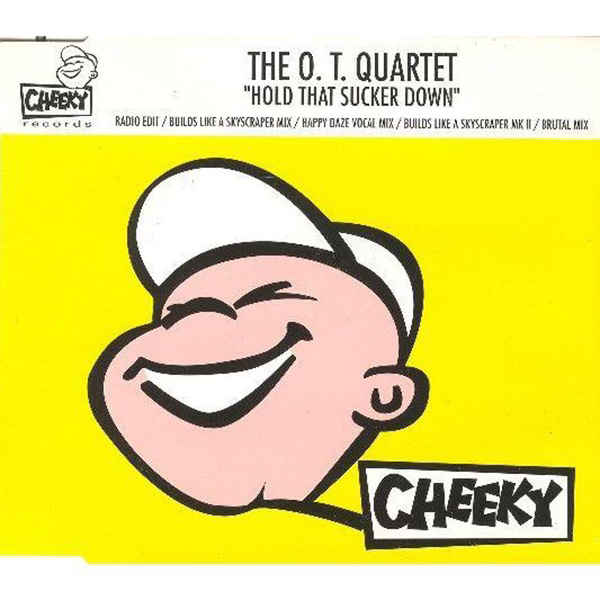
The Twelve Inch #205 - The A-Side : OT Quartet - Hold That Sucker Down, When Dance Music Started Building Skyscrapers
The Twelve Inch 205 : Hold That Sucker Down (O.T.Quartet)
By the early nineties I had stopped buying twelve inches.
The vinyl to CD transition of the late eighties had been a slightly traumatic affair for me. I wasn’t DJ-ing frequently anymore, so I didn’t feel the need to keep up with every new release. Instead, I could simply focus on the music I loved.
Marketing was doing its job extremely well. We were told that vinyl meant problems, and CD meant perfect sound forever. No more wow and flutter, no more dreaded ticks in the groove.
There was only one small issue for people like me.
They made CD versions of almost every vinyl format… except the twelve inch.
Yes, I see you raising an eyebrow and saying:
“But Pé, what about the CD single?”
Indeed, they existed. In fact there were two versions at first, the CD single and the CD maxi.
But there was one big problem.
There was no CD player that could replace the DJ workhorse turntable, the Technics SL-1200. Or rather, there were attempts, but they were unusable for DJs.
Why?
Two simple reasons.
They were extremely expensive
The pitch control was poor, and you had none of the creative possibilities of vinyl, scratching, manual beat matching, or manipulating the groove.
The technology simply wasn’t ready yet.
The infamous and very Expensive Technics SL P 1200
It would take until 2001, when Pioneer finally released a CD player that could properly rival the Technics turntable. Technics tried to enter the market later, but by then Pioneer had already won the field.
So by the early nineties I found myself in something like dance music purgatory.
I still loved club music, but I didn’t want to invest in vinyl anymore. So I began buying CD maxis instead.
And when you stop DJ-ing actively, dance music starts playing a different role in your life.
It becomes less about the dancefloor and more about listening, atmosphere, and discovery. It might also have something to do with age. But you certainly wouldn’t have heard me say that at the time. 😁
Around that moment I became fascinated by a British producer named Rollo Armstrong.
The name might not immediately ring a bell.
But if I say Faithless, you immediately know what I mean.
Rollo, together with Sister Bliss, created the unmistakable Faithless sound and produced their biggest hits. He also worked extensively with his sister Dido, producing several of her records.
But before all that, there was an earlier track.
One that, to this day, still gives me goosebumps.
The track was Hold That Sucker Down by O.T. Quartet.
An absolute energy bomb.
The record sits in a fascinating stylistic moment. You could call it Hi-NRG, but it isn’t quite that. You could call it progressive house, but it isn’t fully that either. It arrived at the moment when the UK club scene was moving beyond rave music, experimenting with longer builds and deeper emotional tension.
Later, when Faithless became huge, people began calling this kind of sound “stadium house.”
But that label doesn’t quite fit the O.T. Quartet either.
And that mystery only deepens when you try to research the man behind it. Because Rollo Armstrong is probably the most elusive producer in dance music history.
Almost no interviews.
Hardly any photos.
Very little documentation.
Try writing about someone like that.
I dare you.
Yet the questions remained. Where did this peculiar sound come from? What exactly did the song mean? And what on earth did they mean by “sucker” in this song? I even wondered if it had a slightly naughty meaning. A dirty mind is a terrible thing to waste. 😁
But don’t worry.
This week’s story remains firmly within family-friendly territory.
So it’s time for our weekly journey.
Time travel destination, early nineties England.
Ready?
Let’s go.
👋 Welcome, I’m Pe Dupre, thanks for stopping by.
This is The Twelve Inch, a community about the history of dance music from 1975 to 1995, told one twelve-inch record at a time.
If this landed in your inbox because a friend forwarded it, I’d love for you to subscribe so you don’t miss the weekly episodes. Each one dives into a track, its story, and the culture around it.
And if you’re already enjoying the free posts, would you consider becoming a paid subscriber? Your support helps me keep researching, writing, and unearthing the stories behind the music. And You’ll get access to the weekly B-side post: the full archive and extra Subscriber Only Posts
Who Is Rollo Armstrong? 🎹
Rollo Armstrong was born in 1966 to an Irish publisher and a French-English poet. Music played a huge role in his upbringing. Partly because something else didn’t.
Television.
It was banned in the Armstrong household.
As Rollo once explained:
He later studied at the University of York, where he became active at the student radio station URY.
Another intriguing detail about Rollo : He has synaesthesia.
He literally sees music as colours.
A Studio Night That Changed Everything 🎚️
Rollo’s first steps into the music business happened almost by accident. While travelling in Australia he met a future collaborator: Rob Dougan.
Rollo later explained:
The studio session quickly turned surreal.
But the morning after was less glorious.
A Lucky Break 🎧
Rollo kept the advance money and returned to the UK. With it he bought a sampler, a machine that would become central to his sound.
Soon afterwards a friend offered him £300 to produce a single for a singer called Felix. The result was Don’t You Want Me.
The record became a European No.1 hit and launched Armstrong’s career.
Rollo later summed it up with disarming honesty:
Following the success he founded the Cheeky Records label in 1992.
Hold That Sucker Down would become the fourth release on that label.
Enter the O.T. Quartet 🎤
The O.T. in O.T. Quartet stands for Our Tribe, one of several project names used by Rollo and Rob Dougan during the early nineties.
Why “Quartet”?
Most likely because four people worked on the record.
• Rollo Armstrong
• Rob Dougan
• London singer Colette Van Sertima
• Lyricist Percival Trollope
Van Sertima’s powerful voice became one of the defining elements of the track. Despite that, she remained largely anonymous. She later appeared on Sister Bliss club hits like:
• Can’t Get a Man, Can’t Get A Job (Life’s A Bitch)
• Oh What A World
And there is even a surprising connection to last week’s story. She wrote a song recorded by Tina Turner called Open Arms.
So What Does “Hold That Sucker Down” Mean? 💬
The phrase comes from Black American colloquial speech. It simply means keeping your partner committed and grounded.
In the song Van Sertima sings:
“You can lift your man up, give him more than he want, it don’t mean a thing if you can’t hold him down.”
And later:
“You got to hold that sucker down.”
Here “sucker” simply means “guy” or “man”, said with a slightly teasing tone.
So despite my earlier suspicions, the title is not some hidden rave code. It’s simply relationship advice wrapped in a house anthem.
Why The Record Worked So Well 🏗️
The main mix carries a perfect title.
“The Builds Like a Skyscraper Mix.”
And it really does.
The track:
• starts minimal
• slowly adds layers
• builds tension through long breakdowns
• finally releases into huge piano and synth stabs
The vocal style also plays a key role.
Van Sertima sings with a preacher-like intensity, clearly influenced by the great house vocalists such as Loleatta Holloway. But unlike many gospel-trained singers she keeps the delivery clean, direct and rhythmic. That precision works perfectly with the long architectural build of the track.
Another ingredient is the cinematic sound design, largely influenced by Rob Dougan’s love of film scores and classical composition.
Rollo later explained the philosophy behind his productions:
A Crossroads in Dance Music 🚦
Looking back, the record sits at a fascinating moment. It still carries the DNA of rave culture, but it also points toward the epic emotional club anthems that would dominate European dancefloors later in the decade. And like many great twelve inches, it proves something important.
Sometimes the most powerful moment on the dancefloor isn’t when the beat drops.
It’s the long climb before it does.
Soon afterwards both producers moved on. Rollo formed Faithless, one of the biggest dance acts of the decade. Rob Dougan released the cinematic masterpiece Clubbed to Death, later featured in The Matrix.
The cover of Rob Dougan’s later solo album.
Dougan would later say about his early dance productions:
The Record That Kept Growing 🔁
As the record became a club classic, new versions kept appearing. Remixes and reissues followed through the late nineties and early 2000s, adapting the track to evolving dancefloor styles:
• harder progressive
• trance-influenced house
• large festival club sounds
But for many DJs the original mix remained the definitive version, precisely because of its slow architectural build. And that brings us back to the central thread that runs through this entire series.
The Twelve Inch is the story of how dance music kept reinventing itself, often by accident.
Tomorrow On The B-Side 🎚️
Tomorrow we go deeper.
On the B-side I’ll explore:
• the explosion of UK dance styles after rave
• why so many DJs released one-off projects under temporary names
• the original twelve-inch and CD-maxi editions
• the studio gear likely used to build the track
• and of course, a fresh weekend playlist
Don’t miss it.
The Twelve Inch is a growing community of people who love disco, eighties, and early-nineties dance music.
If you know someone who would enjoy these stories, feel free to share this post with them or pass it along on Substack Notes. Every share helps the music — and the community — travel a little further. 💿✨
Let’s Talk 💬
Now I’m curious about your memories.
Do you remember the first time you heard Hold That Sucker Down?
Did it feel like progressive house to you, or something different?
And what other early-90s tracks gave you that same slow-building goosebumps moment?
Tell me in the comments.
Because after all,
The Twelve Inch is the story of how dance music kept reinventing itself, often by accident.
So You Wanna Hear More ?
I thought you would !
It’s fun to write about music but let’s be honest. Music is made to listen to.
Every week, together with this newsletter, I release a 1 hour beatmix on Mixcloud and Youtube. I start with the discussed twelve inch and follow up with 10/15 songs from the same timeframe/genre. The ideal soundtrack for…. Well whatever you like to do when you listen to dance music.
Listen to the Soundtrack of this week’s post on MIXCLOUD
Or on Youtube :
“It’s A Disco Night” may sound like one of the cheesiest disco titles ever, but in reality it’s one of the finest disco-funk records of 1979,
driven by a killer bassline and created by a band of three brothers whose career had begun many years earlier.
The full story comes in next week’s episode.