The Twelve Inch #204 - The B-Side : Beats, Acapella & Dub: šæ Tina Turnerās Dancefloor Story
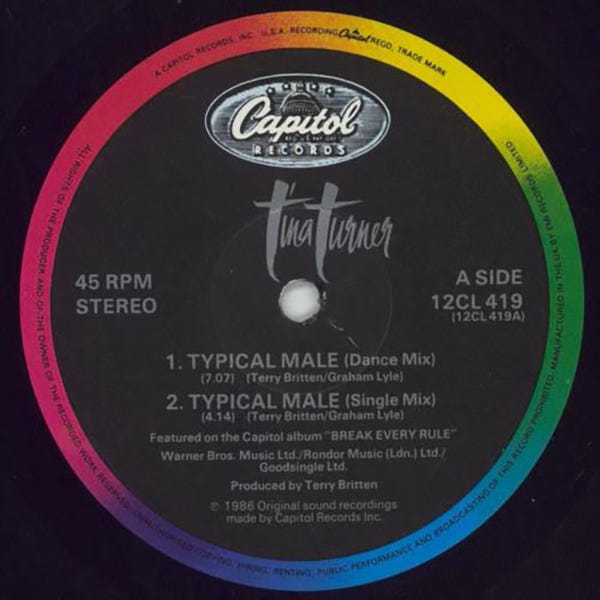
The Twelve Inch 204 : Typical Male (Tina Turner)
Every twelve inch had a B-side where the DJs and collectors found the extra tools: beats, dubs and alternate versions.
This is the B-Side of this weekās episode, where we dig a little deeper into the story behind the record. You can read it all in one go, or explore the different sections at your own pace. The choice is yours.
If you missed the A-Side story, you can read it here. š
Or better still listen to/watch it š
š„ Section 1 ā The Beats
š§ Rock Meets the Dancefloor : How Tina Turnerās comeback quietly embraced the club
Tina Turner may not have been a natural fit for disco, and by the early eighties she deliberately chose a grittier rock and blues direction. That did not mean dance music disappeared from the picture.
We already know that she released twelve-inch mixes of almost all her non-ballad singles, and those twelve inches were clearly designed for the dancefloor, not simply as another release format.
We also know that Tina and her manager strategically pushed her comeback in Europe first. Europe was far more open to artists who crossed genres. At the same time, a new sound was reshaping pop music in the UK, synth-pop, which would become a major framework of eighties pop.
Another key factor was the launch of MTV in the United States in 1981. British synth-pop artists quickly forced their way into the American market because they embraced the visual language of video far earlier than most American labels or artists.
At the same time, rock audiences were aging, and the influence of the clubs on the charts had not disappeared after the disco backlash. Au contraire
Just like algorithms and DSP platforms shape music today, MTV also reshaped the structure of songs.
Traditional rock songs usually evolved in a linear form, verse ā chorus ā bridge ā resolution.
Dance music thinks differently. Repetition creates hypnosis.
So, in many MTV-era eighties tracks you hear hooks repeated longer than expected, a groove that continues under the vocals and a chorus that functioned as a rhythmic anchor. The result is dancefloor predictability, even when the track still feels like a pop or rock song.
For record labels this created a new requirement. Artists had to live in three worlds at once
Radio, adult mainstream credibility
MTV, visual identity and style
Clubs, where trends gained legitimacy
That is precisely why the twelve-inch format became important for rock and pop artists as well.
And to make that work, productions had to change.
In the late seventies, many rock artists experimented with disco by remixing existing recordings. The results were rarely ideal for clubs. Instrumentation was often too dense, arrangements muddy, and live drummers almost guaranteed timing drift.
The eighties changed that.
Because of electronic instruments and drum machines, songs became far easier to translate into club-friendly versions.
Traditional rock placed the focus on guitars, storytelling vocals, and the energy of a live band. Disco and dance music shifted the priorities. The rhythm section moved to the foreground. Record companies understood that the dancefloor could extend the life of a hit, so they kept remixers on speed dial. You can hear this shift clearly in eighties productions. Basslines are more forward, drums are punchier and more aggressive.
That is exactly how Tina Turner, Capitol Records and her management approached her comeback. They made sure the productions were tight, modern and rhythm-driven.
Rock tempos traditionally fluctuated, but the disco and dance framework relied on a stable groove dancers could follow. Many of Tina Turnerās eighties tracks maintain an unwavering rhythmic grid, even when her vocals explode emotionally.
That is not rock tradition. That is dancefloor engineering.
The strategy worked because each platform played a specific role in her career.
Radio delivered rock credibility, an older audience trusted her
MTV amplified her identity and style, she looked fierce and contemporary
Clubs extended the life of the records, remix culture brought younger audiences
This three-way model dominated the eighties for many rock and pop artists.
But the system began to break when house music arrived at the end of the decade, changing the club landscape completely. Thatās why itās no surprise that her biggest success came before house music arrived. It was then that the conditions were perfect for Tina Turnerās comeback. She stepped directly into a system designed for artists like her.
Her success sat inside a perfect triangle
MTV visual power
Adult contemporary radio
Dancefloor adaptability
Most artists managed two of those elements.
Tina Turner managed all three.
The twelve-inch versions were never accidental extras.
They were structural pieces of her reinvention.
I always go āall the wayā for the weekly episodes š
šāāļø The Power of the Wig : How a practical solution became one of the most iconic images in pop and rock history
The story of Tina Turnerās wigs is both practical and symbolic. What began as a necessity eventually became one of the most recognizable visual trademarks in pop and rock history.
During the Ike & Tina Turner Revue years in the 1960s, Tinaās stage image was carefully controlled by Ike Turner. Big hair, glamorous outfits and dramatic movement were all part of the show.
At first, the hair was mostly her own, styled into high, teased stage hairstyles that could survive the intense dancing she delivered on stage. But constant touring and aggressive styling slowly damaged her hair.
In the late 1970s, Tina had a chemical hair treatment that went wrong. The treatment severely damaged her hair and large sections broke off.
Instead of trying to rebuild it slowly, she chose a practical solution.
She started wearing wigs permanently.
Later, she joked that the decision was actually liberating. Wigs allowed her to change her look instantly, without spending hours in hair salons.
When Tina reinvented herself in the early 1980s with the album Private Dancer, the famous spiky, wild rock hairstyle appeared almost by accident. A stylist once cut one of her wigs shorter to refresh it. Instead of the traditional smooth wig style, the hair became jagged, layered and messy.
Tina loved it.
The look perfectly matched the raw rock energy she projected on stage. From that moment on, the wild lion-mane wig became part of the brand. For Tina, wigs eventually became more than a styling choice.
They represented control over her image, something she had not always had during the Ike years.
She owned dozens of wigs and often traveled with several on tour. They were designed so she could shake, spin and dance without the hair losing its shape, perfectly suited to her explosive stage performances.
šØšFrom Tennessee to Switzerland: Why Tina Turner chose a quiet Swiss life over the spotlight of America
It may surprise you, but when she died, Tina Turner was officially a Swiss artist, not an American one.
She not only lived in Switzerland, she also became a Swiss citizen in April 2013 and gave up her American passport in October of the same year. By then she had already spent many years living there.
Tina had moved to Switzerland after meeting Erwin Bach, a German music executive who later became head of EMI Switzerland. The couple settled near Zurich and bought a home together.
But why would a woman born in Tennessee decide to give up her American citizenship and live in a country so different from the United States?
Was it simply love?
Love certainly played a major role. Tina and Erwin Bach had been together since 1986, and eventually married in 2013, after more than twenty-five years as a couple.
Another important reason was her remarkable success in Europe.
In an interview with Tony King on CNN, Tina explained that she had always felt more appreciated in Europe than in the United States. The European audience embraced her comeback in the eighties with enormous enthusiasm.
Whenever artists move abroad, people often assume tax reasons are the main motivation. That may play a role in some cases, but becoming a citizen of a country also means paying taxes like any other citizen. Switzerland may be known for financial discretion, but it is not necessarily a tax haven, and there are many countries that are far more advantageous in that respect.
The famous CNN interview starts with Tina explaining why she preferred Europe!
The deeper reason Tina loved Switzerland was something else entirely.
Discretion.
In a way, it reminds me of the story I told two weeks ago about Michel Polnareff. One of the reasons he chose to live in the United States was that he could live a relatively normal life there. For Tina, Switzerland offered the same freedom.
People knew who she was. They admired her. But they respected her privacy. She could go to a restaurant without being harassed and became part of the local life in Küsnacht, the town where she lived.
In other words, she could live a life that looked surprisingly normal, something we often forget is extremely rare for an artist of her stature.
And perhaps the best proof of her affection for the country is a humorous commercial she later recorded for Switzerland, showing just how comfortable she had become in her adopted home.
š¦šŗThe Nutbush Dance: How an Australian school exercise turned Tina Turnerās song into a national tradition
A line dance to the sounds of Nutbush City Limits, PĆ©?
You must be kidding.
No, actually Iām not.
When Tina Turner released Nutbush City Limits in 1973, the song was successful in several countries. Australia was not one of them at first. Curiously, about eighteen months later the record suddenly climbed the Australian charts, eventually reaching number 27.
Around that same time, something unexpected was happening in schools.
The New South Wales Department of Education had encouraged teachers to introduce simple choreographies in physical education and creative arts classes. The idea was practical. Teachers needed group dances that were easy to learn, required no partner contact and worked well in school halls.
Somewhere along the line, teachers began using Nutbush City Limits.
The reason was simple. The song had a steady, clearly defined beat, perfect for a structured dance routine.
What started as a school exercise quickly became a tradition. Generations of Australian children learned the dance during school activities. Those children eventually grew up, and the dance followed them into adult life. Before long it appeared at weddings, parties and community events.
And just like that, the āNutbushā became an Australian cultural ritual.
Interestingly, Tina Turner herself never performed the dance. She was aware of it, but it was not part of her stage act. š
The choreography is actually inspired by an older American line dance called The Madison, which also uses simple, repeating steps that groups can easily follow.
And if you want to try it yourself, here are the basic steps
If you are like me and love the B-side of every twelve inch with all itās different mixes than go get that special offer
š 20% off all paid subscriptions during March
After next weekās episode the B-side will be paywalled
š¤ Section 2 ā The Acapella
š¦A Warehouse Full of Tina Turner: How one soundtrack reminds me of the chaos of the CD boom years
I actually started my career in music retail.
Same record company, different artist. Me and Soulsister and a strange š¶ back in those days.
After university and the then obligatory military service, I began looking for a job and ended up managing a shop for one of the larger Benelux music retailers. My real goal was always to work for a record company, and at the time music retail was the classic route to get there.
You had to work hard, get noticed, and eventually move to head office as a buyer, where you could impress record company representatives with your knowledge of music, their catalogue and how to market it.
When I set my sights on something, I usually got there, although it didnāt happen the way I initially planned with my first retailer. That is a story for another time.
Luckily there was competition, and with retailer number two I eventually made it all the way to Head Buyer.
The company was called Superclub.
Superclub was not just active in Belgium and it was not only a music retailer. The company had originally started as a video rental chain. Its founder, Maurits De Prins, a former fast-food entrepreneur, had built a surprisingly large business with the support of Philips as a major shareholder. At one point the American branch of the company was even rivaling Blockbuster.
So we are not talking about a small business here.
I was responsible for the music departments of the Belgian operation, which meant more than one hundred stores. Not small either.
The problem was that the whole system was incredibly disorganized.
We knew what went in, meaning the initial presale orders for a release, but once the CDs left for the stores we immediately lost track of them. We often had no idea where stock was until months later, when unsold copies started returning to the warehouse. There was no reliable way to follow sales.
We knew the bigger stores needed restocking quickly, but beyond that we were mostly guessing. We had a computer program, but it was not designed for fast moving goods like CDs.
It was chaos, and I was right in the middle of it.
On one side there were the stores, constantly dealing with too little stock or far too much. On the other side there were record companies pushing hard for large presale numbers.
With more than one hundred stores, I was one of their biggest retail clients. When international headquarters told them to push numbers, they pushed them very hard.
It was in their DNA.
Sony Music was probably the most aggressive, but EMI was a very close second.
And that is where Tina Turner enters this story.
When I started at Superclub, EMI was preparing the release of the soundtrack to Whatās Love Got to Do with It, the album connected to Tina Turnerās autobiographical film that I discussed in the Side A of this weekās episode.
The sales pitch was excellent.
The album contained a few new tracks, but most of it consisted of previous material. That allowed EMI to sell it both ways.
A new album and a Best Of.
In theory you could not go wrong.
Except that the record eventually did go wrong.
At first everything looked promising. The movie did reasonably well at the box office and Tina Turner was hugely popular in Belgium.
Remember the situation with our stock system.
I placed a very large presale order. The big stores started asking for additional copies almost immediately, often redistributing stock that was sitting unsold in smaller stores. To keep up, I kept reordering from EMI.
This continued until the moment the album suddenly stopped selling. When that happened I was left with a massive overstock sitting in our warehouse.
Of course this was not the only title that caused problems, but it is one of the ones I remember most clearly.
You see, Superclub never really made money. In many ways it resembled Casablanca Records in the United States, ambitious, chaotic and constantly burning cash. Just like Casablanca, Superclub had Philips to cover the losses.
The difference was that we were much closer to Eindhoven, Philipsā headquarters, which meant they kept a much tighter grip on the operation.
That resulted in regular restructurings.
And when restructuring happens, stores close and stock comes back.
The logo of Superclub was a pyramid, and Maurits De Prins had big architectural ambitions when building the headquarters. Instead of one large office building, five blocks were constructed around a central space where a large glass pyramid was supposed to rise.
The pyramid was never built.
The five office blocks were.
At our peak we occupied barely one and a half of them.
The remaining three and a half buildings slowly turned into storage space for everything returned after store closures. Pallets stacked with boxes of CDs, and because our computer system was so inadequate we had to physically check what was inside them.
Shortly after the Whatās Love Got to Do with It soundtrack stopped selling, another restructuring happened. The two events were completely unrelated š, but the timing was memorable.
When I walked through those half empty office blocks filled with returned stock, it was pallet after pallet of Tina Turner CDs that I kept finding.
Music is a powerful repository of memories.
Every time I hear the song or see that album cover, that chaotic warehouse immediately comes back to mind.
Superclub eventually went bankrupt. The scale was smaller than the legendary collapses of Casablanca or RSO in the United States, but I do know that Philips lost a significant amount of money.
What ultimately happened to the mountains of CDs stored in those office blocks, I honestly do not know.
By that time, I had already left the company.
šæ The 12-Inch Versions: An extended mix built for radio first, the dancefloor second
Tina Turner has several singles where the extended version was created by the producer himself. Typical Male is one of those cases.
The twelve-inch mix is certainly not bad, but it is not among her strongest extended versions. The structure feels a bit awkward for DJs. There is no long, clearly defined breakdown, and the best break in the track appears very early in the mix, which makes it less practical when building a dancefloor moment.
The good news is that there is also a dub version.
Again, nothing particularly spectacular, but it does offer enough space to work with inside a DJ set. With a bit of creativity it allows you to create a different break later in the mix, something the original twelve-inch version does not naturally provide.
Chart highlights
#2, Billboard Hot 100
#1, Billboard Adult Contemporary
Top 5 in several European countries
On the Billboard Dance chart the single reached #11, slightly lower than some of her other twelve-inch releases.
Could it have gone higher if one of the big remixers of the era had taken a shot at it?
Probably.
With a BPM of 106, the track sits right in the sweet spot of the mid-tempo synth-funk groove that dominated dancefloors in the mid-eighties.
The Twelve Inch is a growing community of people who love disco, eighties, and early-nineties dance music.
If you know someone who would enjoy these stories, feel free to share this post with them or pass it along on Substack Notes. Every share helps the music, and the community, travel a little further. šæāØ
š§ Section 3 ā The Dub : This Weekās Listening Crate
1ļøā£ Companion Mix
While writing this weekās piece, I realised once again how perfectly Tinaās twelve inches from the eighties, along with those of several other pop and rock artists from that era, fit into the DJ sets I played back then.
Those twelve inch mixes could easily slide into almost any set, from synth-pop and new wave to (synth)funk.
The latter is exactly the direction I took this week.
We start with the Twelve Inch Mix of āTypical Maleā, then move effortlessly into dancefloor versions of pop records from the same era, like The Blow Monkeysā āDigging Your Scene,ā Humpe Humpeās āCareless Love,ā and Climie Fisherās āI Wonāt Bleed For You.ā
Along the way thereās work from some of the great new pop bands the eighties gave us, including Love & Moneyās āCandybar Expressā and The Lover Speaksā āEvery Loverās Sign,ā in the Bruce Forest remix.
In the first half hour of pop-inspired dance, I dig a little deeper with two more unusual examples, Siouxsie & the Bansheesā āPeek-A-Booā and even a dancefloor moment from Lou Reed with āThe Original Wrapper.ā
The second half of the set turns much funkier, with Blue Moderne, Cashflow, and Collage, before closing with Princess and āSay Iām Your Number One.ā
The whole mix sits on a steady mid-tempo groove around 106 BPM, but the energy is anything but laid back.
Sitting still is simply not an option. š§
Find the Mixcloud set here
Or if you prefer Youtube :
2ļøā£ Discovery Crate
š§ This Weekās B-Side Playlist: Exploring Tina Turnerās dancefloor moments across the decades
Every week on the B-Side Iāll prepare a special playlist hosted on my YouTube page. It is only accessible through the link here, which means it is exclusively for you, the B-Side reader.
This week Iām diving deeper into Tina Turnerās twelve-inch history, with a few great examples from different stages of her career.
The first two tracks connect directly to songs mentioned earlier in the episode.
The opening track is her collaboration with BEF and Heaven 17, the cover of āBall Of Confusion.ā Interestingly, no twelve-inch version was ever released, probably because the single wasnāt a big hit. Still, it feels like a perfect Tina Turner record, and it is one that many listeners surprisingly donāt know.
One of my personal favorites in the playlist is the Steve Thompson and Michael Barbiero remix of One Of The Living. The track was the second single from the Mad Max soundtrack. The single itself was not a major hit, but interestingly the twelve-inch performed better on the US dance charts than Typical Male.
I also included āLove Explosion,ā Tinaās only true disco twelve-inch. Produced by Alec R. Costandinos, it is pure peak Euro-disco. You may even feel that Tinaās voice was not designed for disco.
Except that it was.
If you listen to her version of Disco Inferno, released in 1993, you hear a performance that is every bit as powerful as the original by The Trammps.
Tina also recorded the theme song for the James Bond film GoldenEye, produced by U2. The twelve-inch version is remarkable. Mixed by David Morales, it became one of the strongest house remixes of that period.
Although Tinaās commercial momentum slowed once house music started dominating the clubs, there are still some excellent later remixes, including the Shep Pettibone remix of Foreign Affair.
To close the playlist, I end with a burst of pure energy. The extended mix of What You See Is What You Get is the perfect way to finish this weekās selection.
I hope you enjoy listening to it as much as I enjoyed curating it.
Listen to it HERE
Letās Stay Together (12 Inch Extended Version)
Whatever You Want (Extended)
One Of The Living (Special Club Mix)
Unfinished Sympathy (Extended Olympic Mix)
Ball Of Confusion (featuring B.E.F.)
Goldeneye (Morales Club Mix)
Foreign Affair (Shep Pettibone One In A Million Club Mix)
Love Explosion (Extended Mix)
Disco Inferno (12ā Version)
What You See Is What You Get (Extended Dance Mix)
Next Friday a new record spins on The Twelve Inch A-Side :
Iāve touched the first year of my chosen era, 1975ā1995, a few times already, but Iāve never gone all the way to the endpoint, 1995. Next week weāll go there and explore the sound connected to one of the most important dance producers of 90s dance music.
Subscribers get the full crate every weekend. Sio claim your


Gosh Pe this was so informative. Your industry knowledge knows no bounds. Iāve learnt so much ā not just about Tina, an artist I love and thought I knew well ā but also about strategy, industry trends, record sales, and the life of the humans behind the songs! You rock!!
First rate dissection of how TT conquered the dancefloor, MTV and adult radio; very illuminating.