š³š“ The Spy Who Missed the Beat: A-ha, John Barry & the Battle for a Bond Anthem
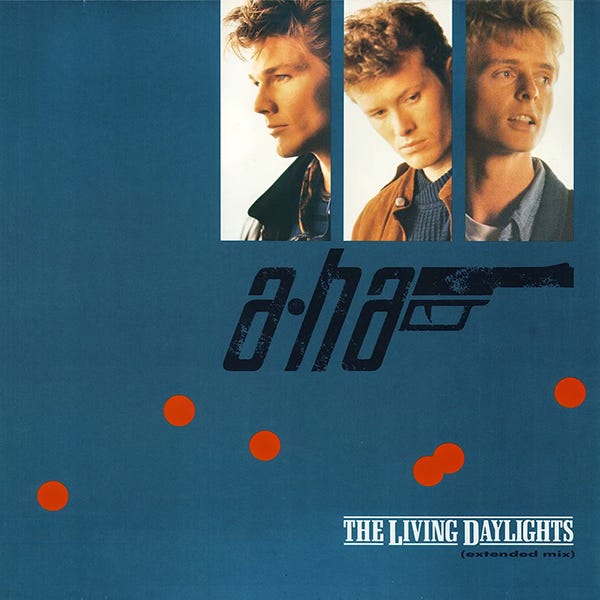
The Twelve Inch 197 : The Living Daylights (A-ha)
Letās start with a bit of housekeeping⦠again. After premiering the read-out-loud version of The Twelve Inch last week, I already have to announce that the read out loud version of this episode (and possibly the next) will be delayed.
In all honesty, I had such a good time recording the first one that I was genuinely excited to tackle the next. Sadly, my microphone did not share my enthusiasm. No matter how I pleaded, bargained, or even begged him to join me for round two, he refused to cooperate. (I assume itās a āheā, partly because of the shape, and partly because.. well you know āa dirty mind is a terrible thing to waste.ā š)
To make matters worse, he must have sensed that his replacement was already on the way. And hereās the catch: the new mic wonāt arrive for a few more days. He knew he had leverage and used it.
So, no read-out-loud editions yet. But they will arrive, loud and clear, once the new microphone settles in.
My name is DuprƩ, Pe DuprƩ.
Youāve probably gathered by now that I love dance music (I donāt know why⦠just a hunch š). But thatās not my only obsession. Iām also a devoted James Bond fan, a passion that took time to develop.
Iām an eighties kid, so my first encounters with 007 were the late-seventies Roger Moore films. Because Bond movies were age-restricted to 16, catching them in cinemas felt like contraband. Moonraker (1979) was the first I managed to see on the big screen. Fresh off the Star Wars craze, it left me slightly underwhelmed, more space opera lite than cosmic epic. I skipped For Your Eyes Only (1981) and found Octopussy (1983) merely⦠fine.
But back then, summers were dead months for European cinemas, and theatres often filled the gap by reviving older films. One Antwerp multiplex ran a full Bond retrospective, and thatās when I discovered the Sean Connery era properly, on a big screen where it belonged. I was instantly sold.
Good timing too, because in 1985 came the nadir: A View to a Kill. Mooreās seventh and final outing (one too many, frankly) gave us one of the worst films in the series, but an intriguing theme song. Duran Duranās A View to a Kill was unlike any Bond theme Iād known, modern, urgent, danceable. Before that, Bond themes were largely ballads, with the odd āuptempo-ishā exception like Wingsā excellent Live and Let Die or Luluās The Man with the Golden Gun. Pure pop, but pre-disco.
When disco took over the world, James Bond stayed at the baccarat table. Cubby Broccoli and Harry Saltzman clocked the Star Wars meteor but somehow missed the disco comet. Duran Duran were the first to drag Bond onto the dancefloor, and the result became the most successful Bond theme in the U.S. It proved Bond didnāt have to be all torch songs and big ballads. And yet, even after that triumph, dance beats were never fully embraced by the franchise.
In this episode I want to explore why. Why has Bond, a franchise steeped in casinos, cocktails, and glamour, never fully leaned into club culture and dance music? Weāll do that through the next film and theme after Duran Duran: A-haās The Living Daylights (1987). The film rebooted the series with a new 007, Timothy Dalton, and a soundtrack far more electronic than its predecessors. The Living Daylights was also the first Bond theme to get its own twelve-inch release and extended mix. And its creation was⦠letās put it politely⦠fraught.
So grab your tuxedo or evening gown. Weāre going on a mission to find out why 007 never really went wild on the dancefloor. Letās dive in.
š Welcome, Iām Pe Dupre, thanks for stopping by.
This is The Twelve Inch, my newsletter about the history of dance music from 1975 to 1995, told one twelve-inch record at a time.
If this landed in your inbox because a friend forwarded it, Iād love for you to subscribe so you donāt miss the weekly episodes. Each one dives into a track, its story, and the culture around it.
And if youāre already enjoying the free posts, would you consider becoming a paid subscriber? Your support helps me keep researching, writing, and unearthing the stories behind the music. Thank you!
š© Who Is James Bond, and Why Did the Franchise Endure?
Iām going to assume you havenāt been living under a rock, so youāre familiar with the Bond films. Itās the most successful and longest-running movie franchise in history, beginning in 1962 with Dr. No and reaching its 25th instalment in 2020/21 with No Time To Die. In that one (spoiler alert) Bond finally does find the time..to die, which makes the title unintentionally funny, but thatās neither here nor there.
Whatās remarkable is how the Bond franchise has stayed relevant for more than six decades. It survives through a balance of reinvention and continuity: each film updates the world around Bond while preserving the ācore formulaā, glamour, action, music, espionage fantasy, and a dash of absurdity.
A big part of that longevity comes from recasting. From Sean Connery to Daniel Craig (and whoever comes next), each new Bond reflects the anxieties and aesthetics of a new era, yet remains recognisably Bond: competent, unflappable, and just a little bit ironic.
šµ Why Music Became Bondās Most Powerful Branding Tool
A major part of Bondās enduring popularity is the music. Everyone knows the iconic James Bond theme by Monty Norman, and most of us can name at least a few of the singers whoāve performed the title songs. Dame Shirley Bassey reigns supreme here: three Bond themes to her name, with the first two, Goldfinger and Diamonds Are Forever, now absolute genre classics. Iāll come back to her third one shortly.
The dame and John Barry way back when when GOLDfinger got a GOLDEN record
But beyond the title songs, itās the score itself that gives Bond so much of its identity. Say āBondā and youāre automatically invoking one of cinemaās great soundtrack composers: John Barry. He scored eleven films and effectively created an entirely new genre, Bond Music.
āIt was a mix of all kinds of things,ā Barry explained many years later, ājazz, classics, pop. The approach was as much practical as it was creative: āIf you had a car chase, the damned car was right in your face; even the fistfights were noisy, so you had to come up with an orchestrational palette that would cut through all that. Big strong brass chords, sustained strings to retain the tension, and percussion, of course. It was the only thing that worked. You couldnāt put soft violins in thereā
Every Bond soundtrack has a recognisable theme song. And the brilliance of those songs lies in contrast. Bond is violent, cold, and professional; the music is sensual, lush, emotional, and often tragic. That play between danger and romance is what made the franchise feel grown-up.
From the 1960s onward, Bond title songs were conceived as miniature dramas, slow- to mid-tempo pieces with big orchestras, bold brass, and seductive vocals that mirrored the surreal, dreamlike title sequences.
Lyrically and musically, they dwell in seduction, danger, and fatalism, which naturally leads toward torch songs and power ballads rather than upbeat dance tracks.
šŗ Did Disco Influence Bond? Yes, But Bond Kept His Dinner Jacket On
Earlier I mentioned the influence Star Wars had on the Bond producers, so much so that by 1979 we ended up with āBond in Spaceā in the form of Moonraker. Critics found it both silly and entertaining, which is probably the only reasonable reaction. Whatās interesting, though, is that the film came out at the absolute height of disco. So why didnāt Bond embrace illuminated dancefloors and go full Saturday Night Fever for the theme?
Darth Vaderās shadow was everywhere in the late seventies, early eighties
The answer, I think, has to do with timing. The music was always the last to be added, often just before the release of the film. By the time Moonraker premiered in London, the disco backlash had already swept through America. You can almost hear the sigh of relief crossing the Atlantic: crisis averted!
The funny twist is that Moonraker technically did have a disco theme. The film uses two versions of the title song: a ballad version, Shirley Basseyās third and final Bond theme, opens the movie, but the closing credits feature a disco arrangement of the same tune. Not an especially good one, but itās there.
And it wasnāt even the first time Bond flirted with disco beats. Marvin Hamlisch, who scored the previous film The Spy Who Loved Me, reimagined the Bond theme as a disco track, Bond 77, for the spectacular opening sequence in which Bond skis off a cliff before deploying a Union Jack parachute.
Still, these moments were exceptions. With Star Wars, the producers could selectively absorb what they liked, gadgets, spectacle, cosmic ambition. Disco was a different proposition: you either embrace it or you donāt.
A Bond theme requires gravitas. Disco in the ā70s was ecstatic, communal, and embodied. Bond, by contrast, is solitary, tragic, and (very) masculine. Not exactly the same dancefloor energy.
š¤ So Why A-ha in 1987?
In the early eighties, the Bond franchise stayed on familiar ground. Sheena Easton delivered the ballad For Your Eyes Only in 1981, followed by Rita Coolidgeās All Time High for Octopussy (1983). But in 1985 the producers made a strategic shift: A View to a Kill was handed to Duran Duran, and they created a sleek hybrid of synth-pop and soundtrack, danceable, modern, and commercially explosive. It became the only Bond theme ever to hit No. 1 on the Billboard Hot 100.
The main reason Duran Duran was chosen was probably MTV. By the mid-80s every hit single needed a music video, and for film studios that video effectively became a miniature trailer or television campaign for the movie itself.
So it wasnāt surprising that the producers, along with John Barry, started looking for another contemporary (and visually savvy) act to headline the theme for the 1987 film The Living Daylights. A View to a Kill had closed the Roger Moore era; The Living Daylights introduced a new Bond (Timothy Dalton), and the producers wanted to reconnect with a younger audience.
The link came via Warner Bros. executive Ray Still, who had recently arrived from Parlophone, where heād been involved with the Duran Duran collaboration. He knew the Bond producers and suggested A-ha.
By then A-ha were already a proven pop force, with hits on both sides of the Atlantic.
āļø Who Wrote the Song, and How Was the Collaboration?
What made Duran Duranās A View to a Kill so successful, that sleek fusion of synth-pop and soundtrack, would become the exact source of conflict on the next filmās theme. John Barry returned for the eleventh time to score a Bond movie, and he too wanted to update the sound with more electronic elements, though the orchestra would remain the foundation. āThe Living Daylightsā was written by A-ha, with orchestration and dramatic architecture by John Barry.
But Barry was accustomed to having the final word. A-ha disagreed, and the collaboration began to fracture almost immediately. As Magne Furuholmen put it: āIt was great we were working with John Barry, but he was not working with usā. In a late-night interview in 1987, Barry admitted he found working with the band exhausting due to their insistence on releasing their own version of the song. At some point Barry reportedly referred to them as āhitlerjugendā. When asked later, Morten Harket replied: āI didnāt hear him say that, but apparently he did, yeah. He was not an easy guy to like, quite honestly. He was very strange in that he started to befriend us by talking bad about Duran Duran. He made some degrading comments about them and what theyād been doing and that didnāt sit well with any of us.ā
There was also a dispute over credits. A-ha later claimed that Barry had only made minor changes and they didnāt understand why he had to be credited so prominently. Tensions werenāt limited to Barry, they reached the producers as well. Producer Michael G. Wilson admitted: āWe were somewhat disappointed with the result.ā For Barry it marked the end. He had introduced a fourth James Bond musically, but this time he was done. As he would later say: āIām not going to go through this again. That was the end of it.ā
The album version of the song. Which of the two is your favourite?
Things deteriorated further when A-ha skipped the royal premiere in London. They were in the middle of a Japanese tour and refused to interrupt it, leading to the song being removed from the initial American theatrical release of the film.
In the end there were two versions: a soundtrack version partially produced by Barry, and a band version with no Barry/orchestral elements for A-haās third album.
Not that A-ha disliked the outcome. PĆ„l Waaktaar later reflected: āI loved the stuff that Barry added to the track. Thatās when it started to sound for me as a Bond trackā
š Why Did It Take Until 1987 for a Bond Theme to Get a Twelve-Inch Mix?
It may come as a surprise, but Duran Duranās Bond theme never officially received a twelve-inch release. There is, however, a twist. Michael Barbiero and Steve Thompson, who were remixing half the rock and pop universe in the mid-eighties, did create an excellent twelve-inch mix of A View to a Kill. It just never saw daylight because John Taylor reportedly didnāt like it. (Bootlegs circulate on YouTube, Iāve Included one here.)
The Living Daylights isnāt the first Bond theme to be remixed, but it is the first to be officially released in twelve-inch form. And itās a tricky one. A-ha were no strangers to remixes, Barbiero and Thompson also worked on The Sun Always Shines on TV and Train of Thought. But for their Bond theme they skipped specialist remixers entirely. As far as I know, Alan Tarney produced the extended version. Heās a brilliant producer, but heās not a remixer in the club sense.
And you can hear it. There are several issues that make the twelve-inch hard to use in a DJ set. The intro is basically unmixable, thereās no proper break, and the structural logic never quite commits to dancefloor functionality. Listen to this weekās mix, youāll hear exactly what I mean.
š¬ How Successful Was the Film and the Song?
The Living Daylights performed well at the box office, especially in Europe, helped by Timothy Daltonās more serious interpretation of Bond, which suited late-Cold-War melancholy far better than Roger Mooreās raised-eyebrow suavitĆ©.
On the charts, the theme song landed strongest in Scandinavia (what a surprise š) and Western Europe (top 5 across the Nordics, top 10 in Belgium and Germany). In the UK it cracked the top 5 and became the third most successful Bond theme to that point. But in the U.S. the gamble didnāt pay off: the song didnāt chart at all. This had less to do with the track itself and more with A-haās deteriorating relationship with their American label. After pushing through single choices that the U.S. market didnāt suppor, and that didnāt wor, whatever momentum Take On Me had created evaporated. They never recovered the American market.
From a career perspective it may have looked like the wrong move, but The Living Daylights became (and remains) one of A-haās most beloved songs, appearing on every tour and setlist since.
Among hardcore Bond fans it now sits in a surprisingly strong mid-table position, much better than pop culture assumed at the time. Crucially, it avoids both camp and karaoke Bassey cosplay, and itās one of the few Bond themes that genuinely feels Cold War in both sound and lyric.
The Living Daylights soundtrack was far more electronic than itās predecessors without losing the core elements of the āBond Musicā, as I explained
š What Happened to Bond Music After A-ha?
Ballads have remained the Bond franchiseās default mode. Licence to Kill (1989) put Gladys Knight front and centre, and when Bond returned from a long hiatus with a new actor (Pierce Brosnan), it was Tina Turner who delivered GoldenEye, one of the strongest Bond themes ever. GoldenEye will get its own episode at some point, and youāll see thereās more to it than the version most people know.
The major exception to the ballad tradition came with Brosnanās fourth and final outing, Die Another Day (2002), when the producers handed the theme to Madonna. It stands as the only pure techno-dance Bond theme in the entire franchise. It was a global hit, but Bond aficionados never warmed to it. The reason is fairly obvious: Madonna didnāt collaborate on the score, so the song remains disconnected from both film and soundtrack. Her brief cameo as a lesbian fencing instructor didnāt exactly smooth things over.
Excellent twelve inch mix of the Madonna Bond theme Die Another Day!
This one falls outside the scope of this newsletter, but itās worth noting that Die Another Day probably boasts the best twelve-inch remix treatment of them all.
āSo Would a Disco or Dance Song Ever Work for Bond?
Absolutely, with the right tension. Bond needs dark glamour, fatalism, and emotional stakes, not just BPM. Think Giorgio Moroder meets Shirley Bassey. Not The Village People go to MI6. In other words: Bond + club = after midnight, never brunch.
The disco touches that did creep into the soundtracks leaned more Village People than Moroder, which in hindsight might have been a blessing. In the 70s and early 80s, Bond scoring still operated under an older model: the composer had real authority and there were no musical consultants or distribution executives trying to steer things toward synergy or playlist strategy.
And we can safely say that neither John Barry (nor the other composers) nor the producers had much of a feel for what was actually happening on the dancefloor. From the third Bond film, Goldfinger, onward, the musical template became a proven success formula. The theme song evolved into a crucial marketing tool, from the announcement of the singer, to the single release, to its function as a companion trailer for the film.
Thatās ultimately why most Bond title songs gravitate toward dramatic ballads: the producers prioritized mood, romance, and danger over dancefloor energy, and sought to preserve a recognizable āBond soundā built on lush orchestration and big vocals rather than club-style beats.
š¬ Your TurnāLetās Talk Bond, Dance Music, and A-ha
Were you in the cinema for The Living Daylights?
Did you buy the twelve-inch?
Where do you rank A-ha in the Bond pantheon?
Further reading (or should I say watching)
There are a number of interesting videoās/links :
So You Wanna Hear More ?
I thought you would !
Itās fun to write about music but letās be honest. Music is made to listen to.
Every week, together with this newsletter, I release a 1 hour beatmix on Mixcloud and Soundcloud. I start with the discussed twelve inch and follow up with 10/15 songs from the same timeframe/genre. The ideal soundtrack forā¦. Well whatever you like to do when you listen to dance music.
Listen to the Soundtrack of this weekās post on MIXCLOUD
Or on Youtube :
So whatās in this weekās mix ?
Just like John Barry, I had a few problems scoring this episode of The Twelve Inch š. A-haās twelve-inch mix of The Living Daylights has a peculiar intro, no real break, and a sudden cut-off in what should have been the breakdown, complete with a tempo shift. In other words: DJ nightmares. I love the track, but I hardly ever used the twelve-inch in my late-eighties sets for exactly those reasons. I did manage to make it work here by pairing it with another equally fraught 1987 release: Dalbelloās Tango. That twelve-inch is also⦠letās say⦠not professionally remixed. But thatās a story for another episode.
The rest of this weekās āsoundtrackā is split into two halves. The first focuses on pop and rock in their extended twelve-inch form, very much the norm in the latter half of the eighties. Expect excellent examples from Phil Collins, Little Steven, Foreignerās Lou Gramm, and Midnight Oil.
The second half tilts toward the early house influences that began creeping in circa 1987ā88. Youāll hear Information Society, The Jets, and Was (Not Was), before closing with Shep Pettiboneās stellar remix of New Orderās True Faith.
Enjoy the ride.
Next week, Iām zooming in on Jazz-funk via one of the best dance records of 1979: Players Association and āTurn The Music Upā.


Big Bond theme guy. Got the CD through Duran, Duran. Der der der der der der der der der Goldfinger Der Der Der... hooked me young. But the best is Satchmo "We Have all the time in the world" chilling as he was so close to the end but perfect as ever. Another banger! I'll listen when I get a minute but wanted to give you some due props. Ah-ha holds up better than most. California Dreams is in Chapter 2 prequel to Lost in Austin. got the green light for Mack the Knife for Feb 15th Big Band gig so staying busy and growing. Music is the only escape left.
Interesting post Pe! I've actually only seen a few Bond films. I've always been aware of the songs that became hits though. "A View to a Kill" and "Nobody Does it Better" are my favorites. I liked "For Your Eyes Only" at the time it was released because Sheena Easton was the "it" singer of the moment. I REALLY disliked Madonna's "Die Another Day." Most of the rest of the Bond songs haven't really resonated with me. Even though I'm a fan of A-ha, I feel I don't know their contribution at all. I don't think it hit the charts here. Cool song though.