

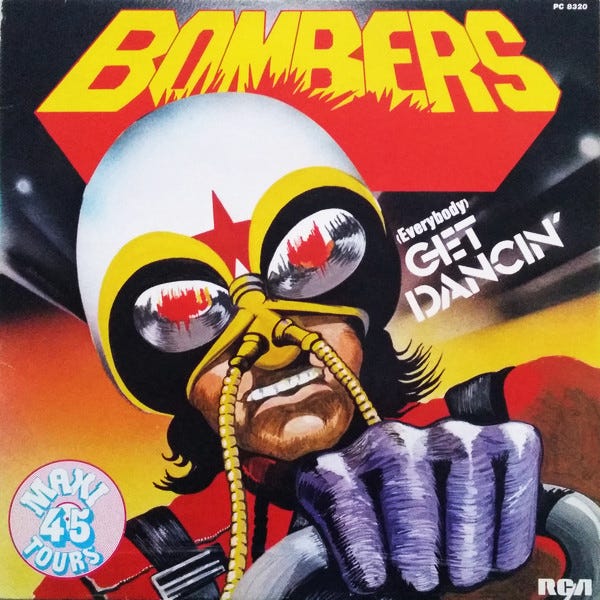
Some records come with their own little film in my head.
I can remember where I bought them, where I first heard them, what was going on in my life and, occasionally, even what the weather was like. Music is a wonderful repository of memories. In my case it seems to have considerably more storage capacity than the part of my brain that remembers why I walked into the kitchen. 😁
The Bombers’ “(Everybody) Get Dancin’” is one of those records.
I first heard it in late 1979 on one of my favourite radio shows. The next time I went to Antwerp, I had to find the twelve-inch. Remember, this was already after the American disco backlash had started and even the Dutch music magazines I was reading were becoming increasingly negative about disco.
It didn’t stop me.
“(Everybody) Get Dancin’” became one of my all-time favourite twelve-inches.
And there is something rather funny about that because, for more than forty years, I had absolutely no idea it was Canadian.
American? Well, not quite...
To my teenage ears, the Bombers sounded American.
The record has some of the qualities I loved in those first Chic productions. It is sometimes compared to “Dance, Dance, Dance,” and you can hear why. There’s that driving bass, the guitar that immediately makes you think of Nile Rodgers and, most importantly, the same energy.
I wasn’t the only one who liked it. The Bombers reached No. 3 on the US dance chart and “(Everybody) Get Dancin’” even became a small pop hit in the UK and Benelux.
And then, essentially, they disappeared.
Only much later did I discover that the Bombers weren’t from New York, Philadelphia or anywhere else in the United States.
They were from Montreal.
That makes this record almost too perfect for the second week of our Can-Con month.
Because one of the peculiarities I kept encountering while researching Canadian disco is that Canadian producers were not always particularly interested in advertising the Canadian part. If a record had a better chance of succeeding by looking American, European, French or Italian, why make life difficult?
As a European record buyer in 1979, I knew American disco. I knew France Joli and a handful of other Canadian successes, but I certainly didn’t think of “Canadian disco” as a recognisable category.
The Bombers slipped straight through that gap.
👋 Welcome, I’m Pe Dupre, thanks for stopping by.
This is The Twelve Inch, a community about the history of dance music from 1975 to 1995, told one twelve-inch record at a time.
If this landed in your inbox because a friend forwarded it, I’d love for you to subscribe so you don’t miss the weekly episodes. Each one dives into a track, its story, and the culture around it.
And if you’re already enjoying the free posts, would you consider becoming a paid subscriber? Your support helps me keep researching, writing, and unearthing the stories behind the music. And You’ll get access to the weekly B-side post: the full archive and extra Subscriber Only Posts
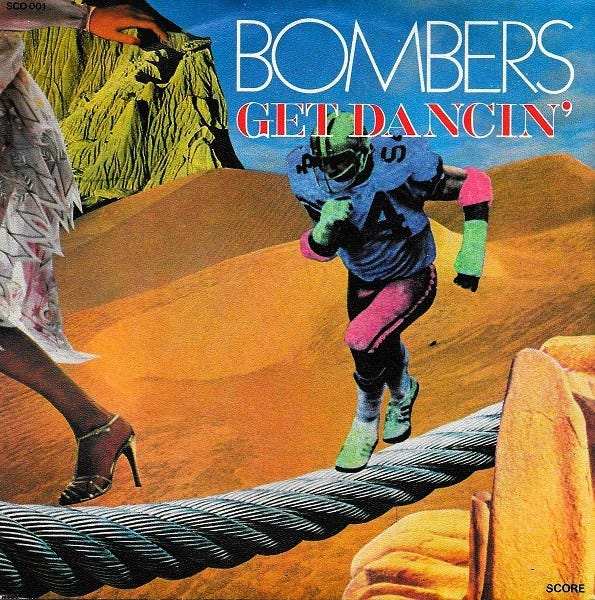
Who exactly were the Bombers?
On paper, the Bombers were a Montreal disco act fronted by vocalists Tamara Lorincz and Mack “BC” Jones, assembled in 1978 and gone almost as quickly as they arrived.
Two albums more or less tell the story.
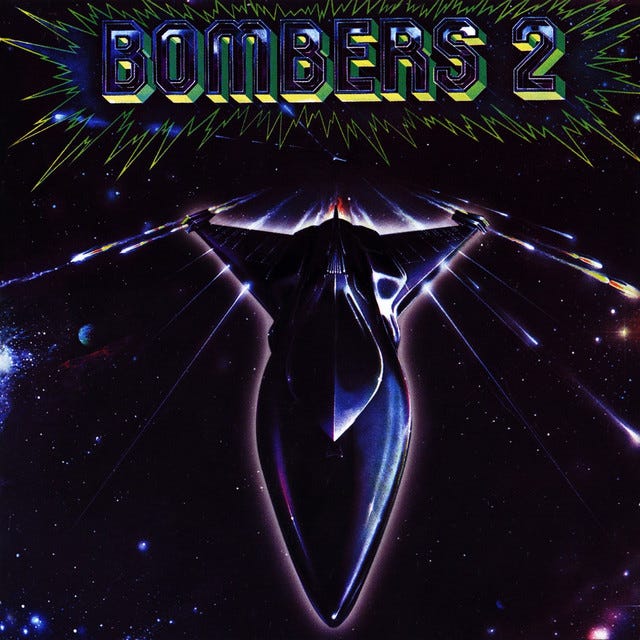
The first Bombers album from 1978 is spacey and more instrumental, a project still looking for its identity. Bombers 2, released the following year, is much more song-driven and contains the record that would define them, “(Everybody) Get Dancin’.”
Like so many disco acts from the period, however, talking about a “band” is slightly misleading.
The Bombers were really a studio construction.
There’s a television clip from 1979 that I’ve included here, made for one of the Dutch chart shows. Are these actually the people who played and sang on the record?
I have no idea. 😁
And in a way that is exactly the point.
Once you stop looking at the people standing in front of the television cameras and start looking behind the mixing desk, the Bombers become much more interesting.
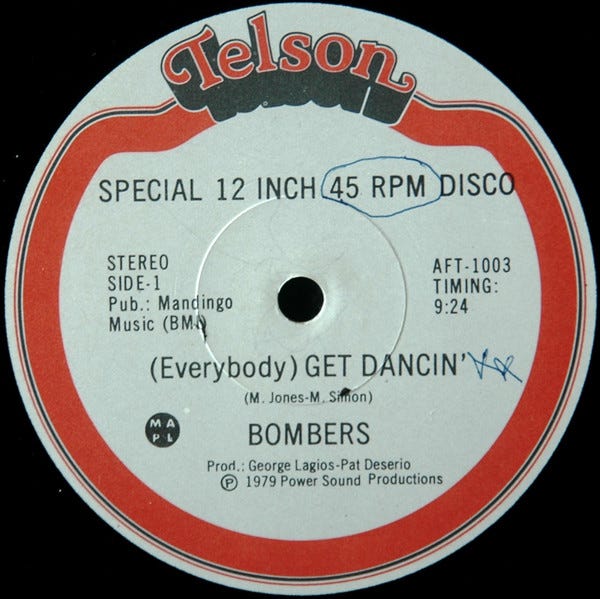
There you find two names: George Lagios and Pat Deserio.
And through those two men, particularly Deserio, you suddenly get a wonderful little window into how Montreal’s disco industry actually worked.
The men behind the curtain
George Lagios is the less famous half of the partnership.
On the first Bombers album he was credited as the main producer, with Pat Deserio assisting. Lagios had already been producing rock and pop before joining many of his Montreal colleagues in making disco.
Why?
Because by the late seventies that was where the opportunities were.
He also had something rather useful: a studio. It would become the home base for the productions Lagios and Deserio made together.
Pat Deserio’s story travels much further.
One of his most important achievements was helping bring Gino Soccio into disco. Soccio was then a University of Montreal philosophy student and keyboard player who apparently had no great affection for disco. Deserio heard something else.
Working on the Kébékélektrik project, Soccio effectively became a one-man band, playing across an arrangement of Ravel’s “Boléro,” a version of Space’s “Magic Fly” and two originals. Deserio supplied the vision and shared writing credits.
Then things started moving.
Tom Moulton remixed the album for its American Salsoul release, “War Dance,” a track Soccio himself apparently regarded as filler, caught fire on US dancefloors, while “Magic Fly” reached the Canadian pop chart.
That project helped open the door to Soccio’s own extraordinary run.
But what fascinates me about Deserio is what happened afterwards.
He didn’t cling to disco when disco started changing. He changed with it.
After several disco projects in 1978 and 1979, he moved directly into Montreal’s emerging synth underground, co-founding YUL Records in 1981 and becoming involved with records by Rational Youth, Monty Cantsin and Cham-pang.
That gives Deserio a rather wonderful career line: from disco into synthpop without really leaving the dancefloor.
And regular readers will know that this is exactly the sort of connection I love. Dance music rarely dies. It mutates.
But there is another connection here that immediately caught my eye.
Deserio was Italian.
Why are there Italians everywhere? 😁
Pat Deserio was born in Naples and moved to Montreal with his parents when he was very young.
Once I started digging into Canadian disco, Italian names seemed to turn up everywhere. And, of course, the same thing happens when you investigate European disco.
So why?
Montreal had, and still has, one of the largest Italian communities in Canada, second only to Toronto. Much of that community was built through two major periods of immigration, with the post-war wave between roughly 1950 and 1970 being especially important to our story.
By the disco years, there was therefore a sizeable generation of young Italian-Canadians growing up in Montreal, many still closely connected to Italian language, family and culture.
That matters more than it might initially seem.
Italian communities were concentrated geographically, which helped preserve language and cultural connections with Italy. And those connections weren’t merely sentimental. They could become commercial networks too.
Montreal was already unusually well positioned between Europe and North America, and Italian-Canadians could operate very naturally inside that network. Many were multilingual, moving between Italian, French and English.
If you’re importing European twelve-inches, dealing with American labels and working in Francophone Montreal, that isn’t a bad skill set to have.
Montreal meets Italy
There was something happening on the other side of the Atlantic too.
I’ve written before about Italy’s Years of Lead, particularly in the episode on Tantra and “Hills of Katmandu.” The 1970s were a difficult and sometimes frightening period, bookended by the Milan bombing of 1969 and Bologna in 1980.

And once again, dance music offered escape.
But there were practical reasons why disco suited Italian producers as well.
The music didn’t depend as heavily on English-language lyrics as traditional Anglo-American pop and rock. Melody, rhythm, instrumental passages and increasingly electronic instrumentation mattered enormously. That lowered one obvious barrier for producers working outside the English-speaking world.
Then Giorgio Moroder demonstrated what was possible.
By 1977, records such as From Here to Eternity had provided a template that would influence an entire generation of European producers. Synthesizers weren’t simply decorating disco anymore. They could be disco.
Now put these things together.
Montreal had a rapidly expanding independent music business, a huge disco market, close connections with New York and Europe, and a substantial Italian community that remained culturally connected with Italy.
Suddenly the number of Italian names in Montreal disco doesn’t look quite so accidental.
I’m not suggesting there was some secret Italian disco committee meeting every Tuesday evening over pasta. 😁
History is rarely that neat.
But the conditions were there.
And Pat Deserio is a wonderful example of somebody standing right at that intersection: Italian-born, Montreal-raised, producing disco, helping launch Gino Soccio and then moving naturally into the electronic music that followed.
Which brings us back to the Bombers.
Back to that twelve-inch
When I bought “(Everybody) Get Dancin’” in Antwerp in 1979, none of this mattered to me.
I didn’t know where it came from and I didn’t know Pat Deserio.
I certainly wasn’t thinking about Montreal’s Italian diaspora or the movement of records between Europe and North America.
I just knew it was a fantastic twelve-inch.
And perhaps that’s what makes rediscovering records you’ve owned for decades so much fun. You think you know them because you’ve played them hundreds of times, then many years later you turn the sleeve over, follow one name and discover an entirely different story hiding behind it.
In this case, that story leads directly into tomorrow’s B-Side.
Because the Bombers weren’t an isolated accident. They came out of a Montreal disco ecosystem that, by the late seventies, had become extraordinary.
The Twelve Inch is a growing community of people who love disco, eighties, and early-nineties dance music.
If you know someone who would enjoy these stories, feel free to share this post with them or pass it along on Substack Notes. Every share helps the music, and the community, travel a little further. 💿✨
🎁 B-Side, Going Deeper Into The Groove
We’ll go inside the Lime Light, meet Robert Ouimet, discover why American DJs travelled to Montreal to hear records they couldn’t get in New York, and see how the twelve-inch itself helped turn the city into a switching board between European and American disco.
And eventually everybody wants disco.
But what happens when everybody wants it?
That’s where this story starts getting really interesting.
The B-side is where we go deeper.
It’s paywalled, but for the price of 8 premium coffees, you get:
a full year of B-sides
access to 150+ deep dives
future stories across genres
And yes, payment in beans is still impractical 😁
Join the club. I’d genuinely love to have you on board.
Over To You !
Did you know the Bombers were Canadian?
Did “(Everybody) Get Dancin’” make it onto your dancefloor or into your collection?
And for the collectors among you, which record did you own for years before discovering that it came from somewhere completely different than you had always assumed?
So You Wanna Hear More ?
I thought you would !
It’s fun to write about music but let’s be honest. Music is made to listen to.
Every week, together with this newsletter, I release a 1 hour beatmix on Mixcloud and Youtube. I start with the discussed twelve inch and follow up with 10/15 songs from the same timeframe/genre. The ideal soundtrack for…. Well whatever you like to do when you listen to dance music.
Listen to the Soundtrack of this week’s post on MIXCLOUD
Or on Youtube :
Beautiful, Pe. I love how you connected your memory of the record with the story and history behind it. One never stops learning. Our records always have something to teach us. This is a powerful message.
Really enjoyed this track and reading the story behind it! Looking forward to the B Side!!