


Last week, I wrote about the stereo wars raging at my parents’ house, when I battled it out musically with the neighbours’ son across the street. “Hit ’n Run Lover” by Carol Jiani was my secret weapon because of the bass that is so hot & pumping it can move houses. 😁
I got a few lovely reactions. One of my friends on Mixcloud said he laughed his head off while reading it.
It made me realise again what a strong repository of memories music really is.
You must believe me when I say (or write, to be more precise) that when I start writing about a song, I don’t have a predestined set of memories ready to tap into. In fact, I had almost entirely forgotten the story of the stereo wars.
It’s simply the way I write.
When a song is on the list, I start researching it. But I’m not only interested in the facts. I also want to get back to what that song made me feel. That’s one of the ways I try to understand its importance at the time.
I’m not going to claim that “Hit ’n Run Lover’s” importance was enlarged or diminished by my terrorising the neighbourhood with its booming beat 😁, but remembering that story brought me closer to the record itself.
And ultimately, I always want to get into the studio at the moment the record was made.
What were they thinking? Why did they make it this way? And what did they expect would happen to it?
This week, those questions become particularly interesting.
Because Saga is no dance band.
And “Take A Chance” is no dance song.
Yet somebody decided it needed a twelve-inch dance remix. And a dub.
Three years later, that same record turned up on the dancefloors of a short-lived Western European dance movement that originated in my home country.
New Beat.
I’m not even sure I can get completely to the bottom of this one. That’s how strange the story is.
It’s also, in a peculiar way (fitting for a peculiar story 😁), one final illustration of the dance-music switchboard I’ve been describing over the past few weeks in my epic Canadian disco story.
Because, yes, Saga are Canadian.
And since I’m definitely not the person to explain the intricacies of Saga’s career, I called in someone who is.
My good friend Ken from Maple Mixtape.
👋 Welcome, I’m Pe Dupre, thanks for stopping by.
This is The Twelve Inch, a community about the history of dance music from 1975 to 1995, told one twelve-inch record at a time.
If this landed in your inbox because a friend forwarded it, I’d love for you to subscribe so you don’t miss the weekly episodes. Each one dives into a track, its story, and the culture around it.
And if you’re already enjoying the free posts, would you consider becoming a paid subscriber? Your support helps me keep researching, writing, and unearthing the stories behind the music. And You’ll get access to the weekly B-side post: the full archive and extra Subscriber Only Posts
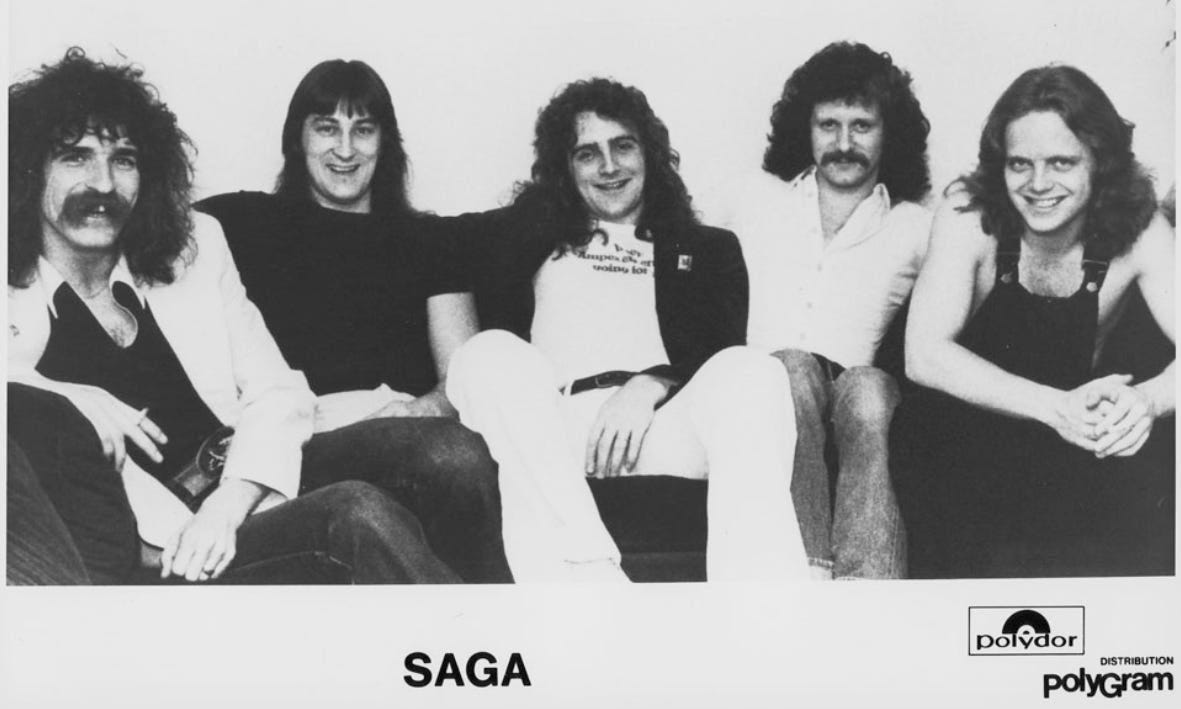
Saga an Introduction by Ken from Maple Mixtape 🇨🇦
The story of Saga begins in 1977 in Oakville, Ontario - part of the Greater Toronto Area. It is, in itself, a saga of its own.
Their music has the complexity you’d expect from prog, with the pop hooks you’d find in many synth and keyboard forward acts. Add often dramatic vocals and rhythmic guitars and you have a band that has plowed a unique furrow throughout five decades.
For most of their timeline, the core members of Saga are:
Brothers Ian and Jim Crichton, guitar and bass respectively
Steve Negus on drums
‘Daryl’ Gilmour on keys, and
Michael Sadler, lead vocals and keys
The band’s comercial heyday was definitely the 80s when Saga charted 5 singles (Wind Him Up reached #22 in 1981) and 7 albums (live album In Transit peaked at #10 in ‘82) on our national charts. But their story took an interesting turn that would see them attain popularity in Germany, where their self-titled debut LP was imported to the tune of 30,000 units and… Puerto Rico, where a local stereo chain used the tune Humble Stance in an ad campaign.
My favourite thing about Saga is their idea for The Chapters.
Only a prog band would have a 16-song cycle that is released out of order and across eight studio albums. There are multiple YT versions that compile The Chapters in order for your convenience. The story follows the protagonist and time traveller Albert, as he sends himself warnings, life lessons, and secrets from the future.
Saga also have something interesting in common with INXS - a search for a new vocalist. When Sadler took a hiatus in 2007 the band recorded backing tracks for some of their tunes and invited singers to audition via the internet. The winner, Rob Moratti recorded an album - The Human Condition - with the remaining group members before Sadler announced his return in 2011.
Saga won the Most Promising Artist Juno in 1982 and are estimated to have sold about 8 million records worldwide. Their most recent record was released in 2021 and the band played some dates in Canada this year in anticipation of a 50th anniversary tour in Europe during 2027.
The Mystery Unravels... Sort Of
After Ken’s excellent introduction, let’s zoom in on the song itself. Because the more I looked into this, the stranger it became.
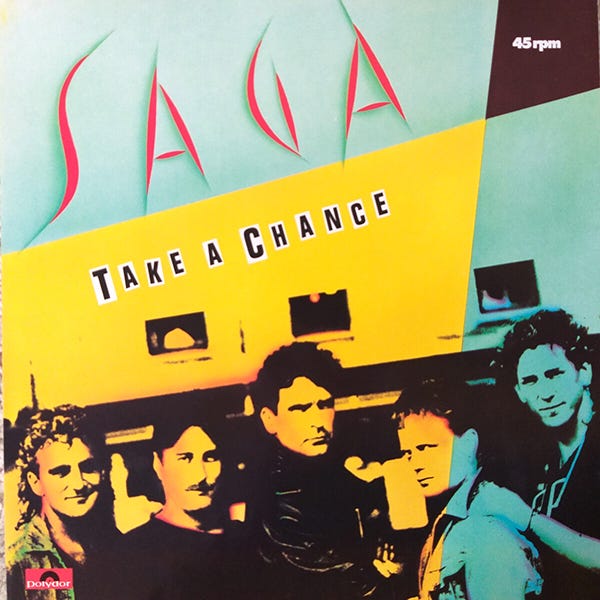
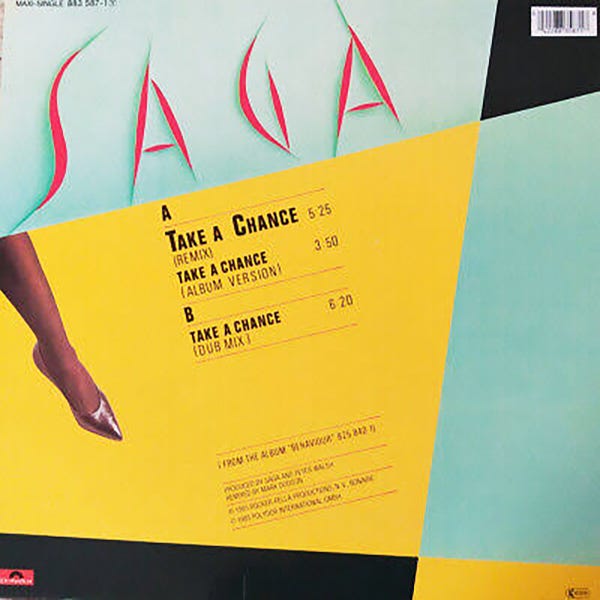
“Take A Chance” was released as a single in Europe only, as far as I can establish. The twelve-inch remix was done by Mark Dodson, a producer much better known for working with rock and metal acts.
And here’s the first collector detail that made me stop.
Dodson appears to have made only two remixes in his entire career.
This was the first.
Even better, he did it under the name “Dodgy Productions”. 😁
Maybe that was simply a bit of fun with his surname. Or perhaps it tells us something about how he felt about this excursion into remixing. I couldn’t find an interview in which he talked about his work on the record, so we may never know. But this is where my own years working in the record industry become useful, because I think I can reconstruct a good part of what happened.
The clue is Behaviour.
“Take A Chance” came from Saga’s sixth album, released in 1985. It did particularly well in several European countries, including Germany, Switzerland, Sweden and Norway. In Germany, it reached number two.
And that matters.
Saga were huge in Germany during the first half of the eighties. Their albums repeatedly reached the top three, but that elusive number one kept escaping them.
Now put yourself in the record company’s office.
You have a band with a very successful album. You’re sitting at number two. You want another hit single to keep the album moving.
And this is 1985.
By then, almost everything could get a twelve-inch release. It wasn’t restricted to disco, funk or electronic music anymore. Pop acts did it. Rock acts did it. And sometimes those twelve-inches came with special mixes designed to give a song at least a chance on the dancefloor.
Here’s where it gets interesting.
“Take A Chance” was the second German single from Behaviour. The first, “What Do I Know”, reached #65 on the German singles chart and also appeared on twelve-inch, with a slightly longer version.
So “Take A Chance” wasn’t the first track from the album, or even the first Saga song, to get the twelve-inch treatment. But this time they went much further. There wasn’t just an extended version.
There was a dance mix AND a dub.
That tells us something.
So here’s what I think happened.
Someone at the label expected “Take A Chance” to be a substantial hit and, perhaps more importantly, hoped it could give Behaviour the extra push needed to reach the number one spot that Saga kept missing. I’ve sat on the record-company side of that table. It’s exactly the sort of reasoning you use. The single doesn’t only have to sell itself. It has a job to do for the album.
Why Mark Dodson was chosen to do the remix is harder to explain.
He was, to put it mildly, not exactly a remix specialist. But looking at the artists he had already produced, Dodson was certainly known within the rock world and to Portrait Records, which released the twelve-inch in the UK.
Maybe allowing someone from within Saga’s own musical world to handle the remix was the proverbial spoonful of sugar needed to make the full “dance” treatment acceptable.
I can’t prove that.
But having worked around these kinds of decisions, I can certainly imagine the conversation. 😁
And then absolutely nothing happened that could possibly have been part of the plan.
From Canada to... Belgium?
Three years later, “Take A Chance” resurfaced on New Beat dancefloors.
In Belgium.
I couldn’t find any evidence that Saga were even aware of this, let alone that they ever reacted to it. And actually, I don’t find that strange. Even if someone had told them that a three-year-old remix was being played by DJs in Belgian clubs, I’m not sure they would have considered it particularly important.
But for us, it leaves one enormous question.
Why?
Why would a Canadian rock record from 1985 suddenly work within a Belgian dance movement in 1988?
And there’s another little problem.
New Beat was built around slowness. Records were manipulated, pitched down and made to crawl along at roughly 95 to 110/115 BPM.
Saga’s “Take A Chance”?
186 BPM. 😁
Now we have a proper mystery.
And the answer has everything to do with the way DJs heard records differently from the people who made them.
🎁 B-Side, Going Deeper Into The Groove
That’s where we’re heading on this week’s B-Side.
First, I’ll try to answer the obvious question: what exactly was New Beat? Why did this strange, slow, dark dance music explode in Belgium in the late eighties? Why Belgium, of all places?
And then we get to one of my favourite parts of the story, the peculiar way New Beat DJs manipulated records. Because the important Saga record for this story isn’t really the regular version of “Take A Chance”.
It’s the dub.
And once you start listening to that 186 BPM rock record differently, something rather wonderful happens. Suddenly, Saga starts making sense on a New Beat dancefloor.
If this story seems strange now, wait until we slow it down. 😁
The B-side is where we go deeper.
It’s paywalled, but for the price of 8 premium coffees, you get:
a full year of B-sides
access to 150+ deep dives
future stories across genres
And yes, payment in beans is still impractical 😁
Join the club. I’d genuinely love to have you on board.
Over To You !
I actually have two questions this week.
Did you know “Take A Chance” before reading this?
And for those who were around European dancefloors in the late eighties, did you ever hear Saga played as New Beat?
Because I’d love to know how far this very peculiar second life travelled beyond Belgium.
The Twelve Inch is a growing community of people who love disco, eighties, and early-nineties dance music.
If you know someone who would enjoy these stories, feel free to share this post with them or pass it along on Substack Notes. Every share helps the music, and the community, travel a little further. 💿✨
So You Wanna Hear More ?
I thought you would !
It’s fun to write about music but let’s be honest. Music is made to listen to.
Every week, together with this newsletter, I release a 1 hour beatmix on Mixcloud and Youtube. I start with the discussed twelve inch and follow up with 10/15 songs from the same timeframe/genre. The ideal soundtrack for…. Well whatever you like to do when you listen to dance music.
Listen to the Soundtrack of this week’s post on MIXCLOUD
Or on Youtube :
I loved this piece. For your amazing writing for sure, but also because I’m a big Saga fan and before Substack, thought I was their only fan in my universe. Now I’ve met several fans! I didn’t know anything about this 12 inch/dub remix and I have to admit I like it a lot better than the original. Looking forward to Side B! Great, concise overview from Ken!
The first time I heard Saga, it was On the Loose. Being a prog kid, I was smitten. I really liked the Worlds Apart album. I remember reading that they believed there was a perception in Canada that they were a German or European band, so somehow CanCon didn't work in their favor until On the Loose broke here. I didn't really keep up with them, but this is one of those things where I think "a dance mix? Saga? For real?" So I am tickled that you not only shared it, but brought in Ken to give it some added context. I am really delighted with this one!