

One of the criticisms often thrown at disco is that it was all rather artificial. All decor, no content. And one of the arguments used to prove this is that disco never really built artist careers. Not lasting ones anyway.
Except, of course, that’s not true.
Donna Summer. Grace Jones. Gloria Gaynor… And if we include the people behind the records, Nile Rodgers and Giorgio Moroder didn’t exactly disappear when disco supposedly died.
The more interesting question is another one.
Did disco produce more wasted careers than other genres? More artists who could have been huge, but somehow never were?
That’s much harder to answer. I’ll come back to it when we’ve studied a few more examples and perhaps we can find a common thread. But there are some obvious cases that have stuck with me for years. Artists where every time I pull out one of their records, I ask myself the same question:
Why didn’t it happen for her?
Madleen Kane is one of them.
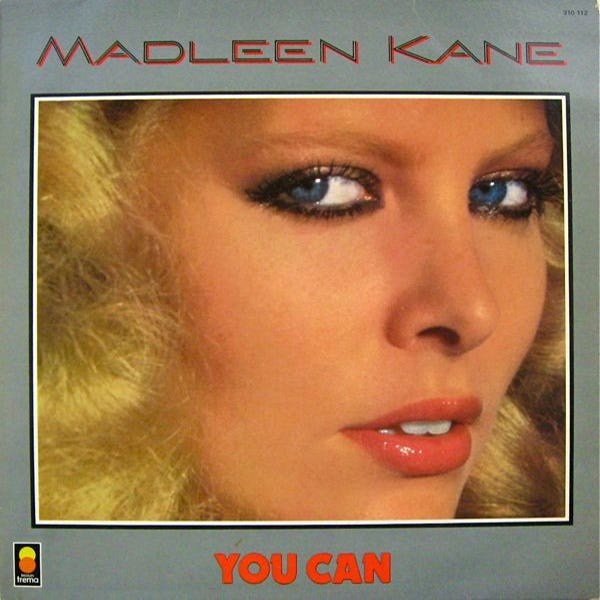
She released five albums between 1978 and 1985 and put five records into the US dance Top 10. Her first two reached No. 3. Then, in 1981, she finally went all the way to No. 1 with “You Can”, produced by Giorgio Moroder. It even sneaked into the Billboard Hot 100.
Everything seemed to be there.
Except.. the breakthrough.
Today Madleen Kane is probably known mainly by disco aficionados. Which is strange because she made some excellent records, worked with some of the biggest names in disco and was a stunningly beautiful Swedish model.
And I mean stunningly beautiful.
She could’ve turned me into a full-blown heterosexual 🫣. That sort of beauty.
So what happened?
👋 Welcome, I’m Pe Dupre, thanks for stopping by.
This is The Twelve Inch, a community about the history of dance music from 1975 to 1995, told one twelve-inch record at a time.
If this landed in your inbox because a friend forwarded it, I’d love for you to subscribe so you don’t miss the weekly episodes. Each one dives into a track, its story, and the culture around it.
And if you’re already enjoying the free posts, would you consider becoming a paid subscriber? Your support helps me keep researching, writing, and unearthing the stories behind the music. And You’ll get access to the weekly B-side post: the full archive and extra Subscriber Only Posts
A Rough Diamond
Madleen Kane was born in Malmö, Sweden, in 1958 and started modelling while still very young. Modelling eventually took her to Paris, and that is where our disco story really begins.
Because one of the surprises of researching Madleen Kane was discovering that her career is essentially a French disco story. A Swedish model, singing in English, later signed to Warner Bros. in America isn’t exactly pointing you towards France.
But France is where Rough Diamond came from.
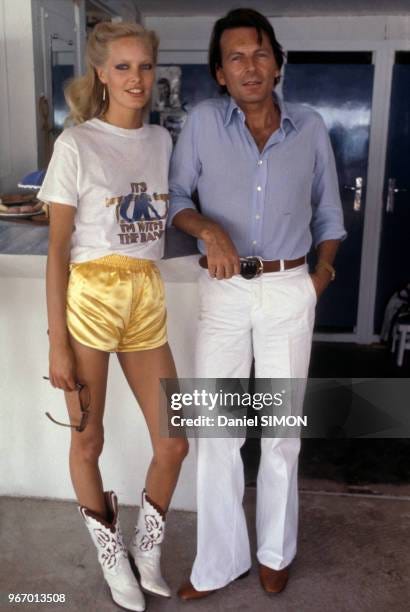
Kane became involved with producer Jean-Claude Friederich, who would play an important role in both her professional and personal life. And through Friederich we arrive at Paul and Lana Sebastian and lyricist Michaële.
Now these weren’t exactly beginners.
Paul and Lana Sebastian, together with Michaële, had written for some of the biggest names in French popular music. Among their credits was one of the great European earworms of the 1970s, Dalida’s “Gigi l’Amoroso”.
Try getting that one out of your head once you’ve heard it.
I dare you.
Like quite a few European songwriters and producers at the time, they saw what was happening with disco and decided to have a go themselves.
And suddenly a Swedish model in Paris was making disco for the American dancefloor.
That sentence alone tells you quite a lot about disco in 1978.
France to America
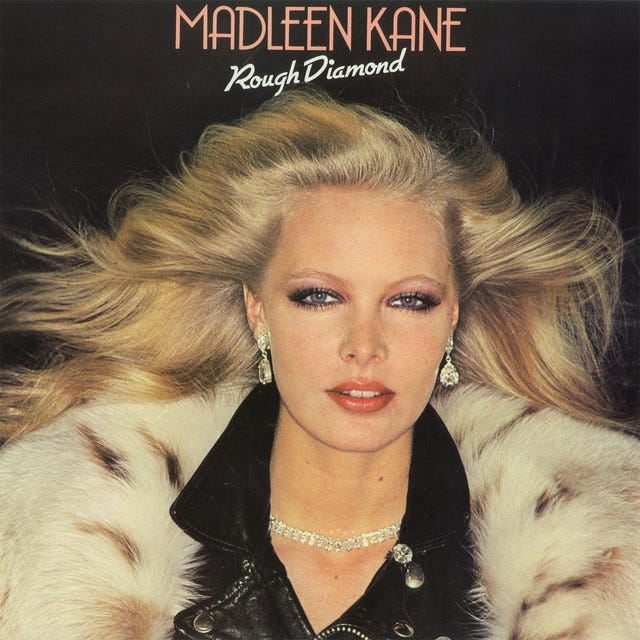
The resulting album was Rough Diamond, released in 1978.
And here’s a lovely little collector detail.
The album first appeared through CBS in France. In America it was picked up by Warner Bros. Contemporary reports from San Francisco were already talking about the French CBS import, before the domestic Warner release arrived.
We tend to tell the disco story as America exporting disco to Europe. But records were travelling in both directions, and European producers were already making music specifically with American clubs in mind.
Madleen Kane was right in the middle of that traffic.
And it worked.
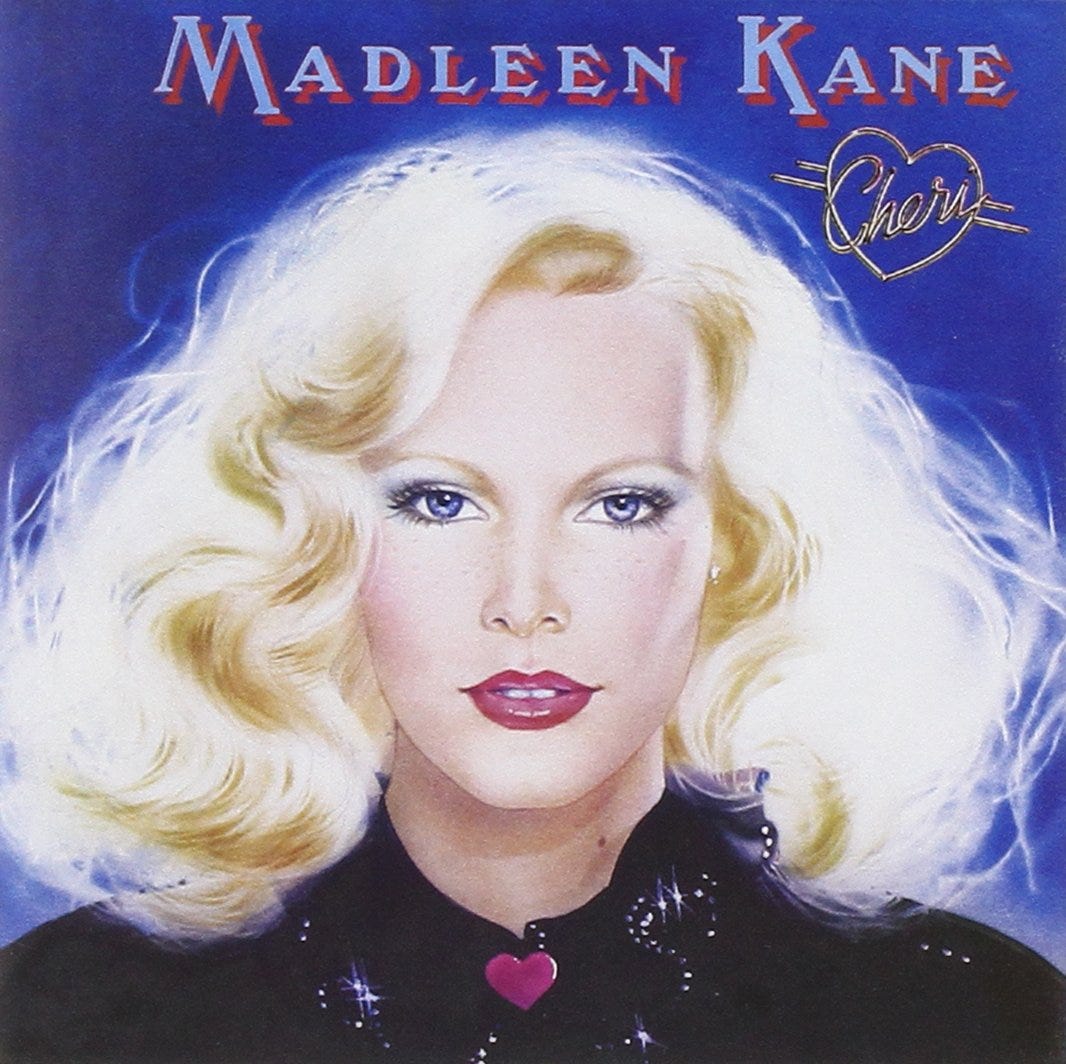
“Rough Diamond” reached No. 3 on the US disco chart. Her second album, Cheri, followed in 1979 and “Forbidden Love/Secret Love Affair” also reached No. 3.
So we’re not talking about some obscure European disco singer who released two singles nobody noticed.
American DJs noticed.
Very much so.
But here comes our old friend.
Timing.
1979
Kane had arrived in 1978, almost exactly when you would have wanted to arrive if your ambition was to make disco records. Unfortunately, she had also arrived almost exactly when you wouldn’t want to arrive if your ambition was to build a long-term career around them.
By 1979 the backlash was underway.
And Madleen Kane had another complication. Her records weren’t being handled by one company everywhere. CBS had her in parts of Europe, Warner Bros. in North America, with RCA releasing her in South America & Japan. That’s 3 majors, at the same time 👊
This was perfectly normal in an industry built around territorial licensing.
But I do wonder whether it helped Madleen. Or the opposite.
I’ve spent enough years working inside record companies to know how important that horrible little word “priority” can be. A major can have dozens of records it likes. That’s not the same as having a record it has decided it must break.
Was there ever one company looking at Madleen Kane and saying: we’re going to turn this woman into a worldwide star?
Probably not.
What we do know is that the dancefloor remained loyal.
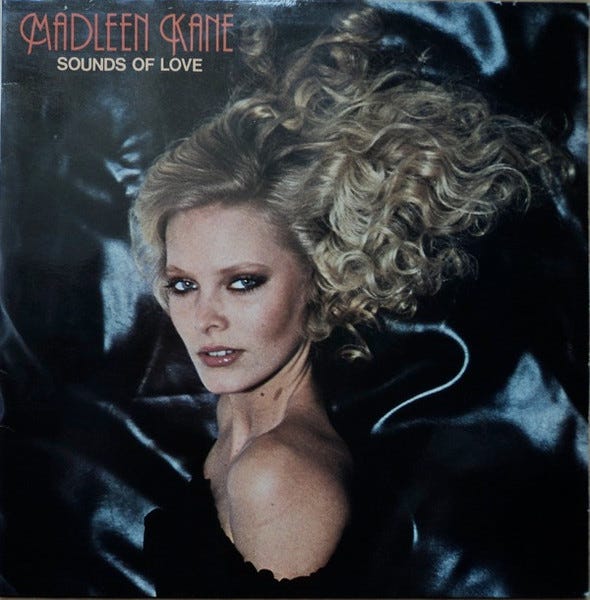
In 1980 came Sounds Of Love, including “Cherchez Pas” and “Boogie Talk”. Another US dance Top 10.
Three albums. Three substantial American club successes. Still no pop breakthrough. Something needed to change.
Enter Giorgio
The arrival of Giorgio Moroder looks almost too perfect when you tell the story backwards. Moroder had just spent the second half of the seventies helping turn Donna Summer into the biggest disco star in the world. Kane was beautiful, European, already successful in American clubs and looking for the next step.
But the connection wasn’t quite as miraculous as it sounds.
Look closely at Kane’s earlier records and you already find musicians from the Moroder universe. Keith Forsey, for example, had played drums, Thor Baldurson did the arrangements and Juergen Koppers, Moroder’s engineer, was also engineering the Madleen Kane recordings.
The worlds were already touching.
In 1981 they finally collided.
Moroder produced Kane’s fourth album, Don’t Wanna Lose You, and the musicians around it read like a snapshot of where sophisticated pop was heading: Keith Forsey, Harold Faltermeyer, Richie Zito, Greg Mathieson.
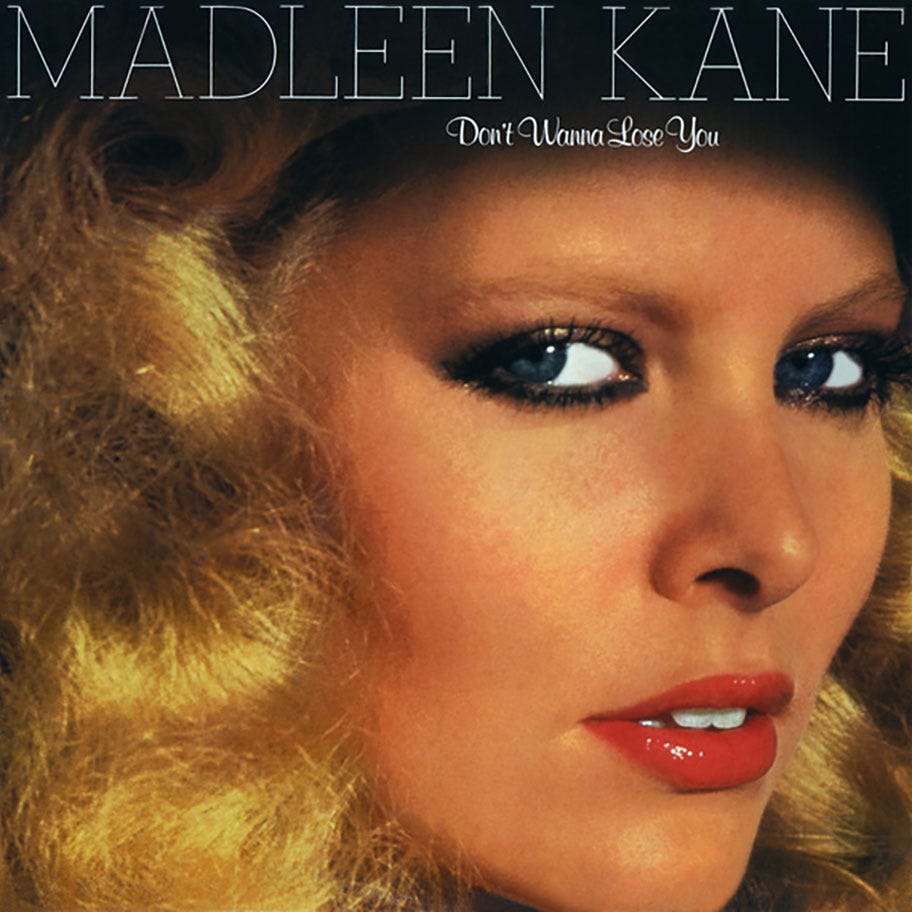
And then there was “You Can”.
You Can
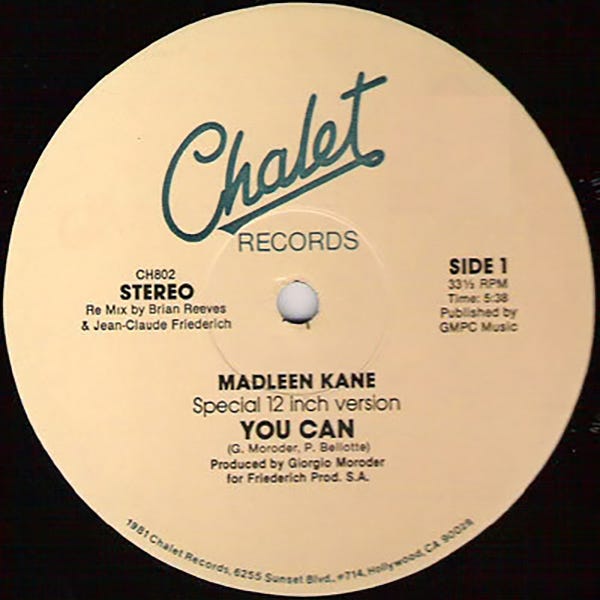
This is the record that makes Madleen Kane’s story so frustrating. “You Can”, coupled with “Fire In My Heart” for the American dance chart, went to No. 1.
Not No. 17.
Not “a club favourite”.
No. 1.
And it crossed into the Billboard Hot 100.
Finally.
Except it stopped at No. 77.
In Belgium it reached No. 32. In Italy, No. 23.
Close.
But no cigar.
And listen to “You Can” today and you can hear something else happening.
Moroder is moving.
This isn’t quite the lush, sensual disco world of “Love To Love You Baby” anymore. But we’re not yet fully inside the enormous cinematic eighties Moroder of Flashdance either. “You Can” sits somewhere in the hallway between Bad Girls and Flashdance.
The pulse is still disco, but the machinery of eighties dance-pop is already arriving.
That’s one of the reasons I still love the record. You can actually hear dance music changing underneath Madleen Kane.
And still it wasn’t enough.
So why didn’t it happen?
There wasn’t one catastrophic mistake.
That’s probably the answer.
Kane entered disco when competition was enormous. Then disco became commercially radioactive in America just as she was establishing herself. Her recording career was spread across different companies and territories. She repeatedly conquered the dance chart without convincing pop radio to follow.
And when Giorgio Moroder finally gave her the record that looked capable of changing everything, “You Can” became a No. 1 dance record and a No. 77 pop record.
That difference between those two numbers may be the entire Madleen Kane story.
She did return once more. After several years away she released Cover Girl in 1985, and “I’m No Angel” still managed No. 21 on the US dance chart.
But by then pop and dance music had moved on at frightening speed.
And eventually Kane moved on too.
She married again, started a family and largely disappeared from showbusiness. Years later she tried reconnecting with that earlier life, publishing her memoir Rough Diamond in 2018 and appearing online again.

Which leaves me wondering whether I’ve been asking the wrong question all these years.
Maybe “Why didn’t Madleen Kane become a huge star?” assumes that becoming one was always the destination.
Perhaps it wasn’t.
Perhaps she was a model who got an extraordinary opportunity, made five albums, had a string of American dance hits, worked with Giorgio bloody Moroder and then decided that there were other things she wanted from life.
There’s nothing particularly tragic about that.
It only looks like a missed career if we assume everybody who enters the music business wants to become Madonna.
And believe me, becoming Madonna requires wanting to become Madonna very, very badly.
What Madleen Kane did leave behind is a handful of fabulous disco records.
And the best, for me, remains “You Can”.
Not only because it was her biggest hit, but because it captures a moment when disco itself was trying to work out what it was going to become next.
Which brings us neatly to another question.
If Madleen Kane’s story was largely created in France, how much disco was France actually producing while everybody was looking towards New York, Munich and Philadelphia?
Quite a lot, as it turns out.
But that’s far too big a story for a B-Side.
We’ll get there.
For now, I’m curious.
Did Madleen Kane deserve a bigger career? Is there another disco artist who always makes you wonder, “Why wasn’t this person huge?” And which Madleen Kane record would you put on first?
The Twelve Inch is a growing community of people who love disco, eighties, and early-nineties dance music.
If you know someone who would enjoy these stories, feel free to share this post with them or pass it along on Substack Notes. Every share helps the music, and the community, travel a little further. 💿✨
So You Wanna Hear More ?
I thought you would !
It’s fun to write about music but let’s be honest. Music is made to listen to.
Every week, together with this newsletter, I release a 1 hour beatmix on Mixcloud and Youtube. I start with the discussed twelve inch and follow up with 10/15 songs from the same timeframe/genre. The ideal soundtrack for…. Well whatever you like to do when you listen to dance music.
Listen to the Soundtrack of this week’s post on MIXCLOUD
Or on Youtube :
This has SERIES potential, Pe!
Very interesting. Great write up. ✨