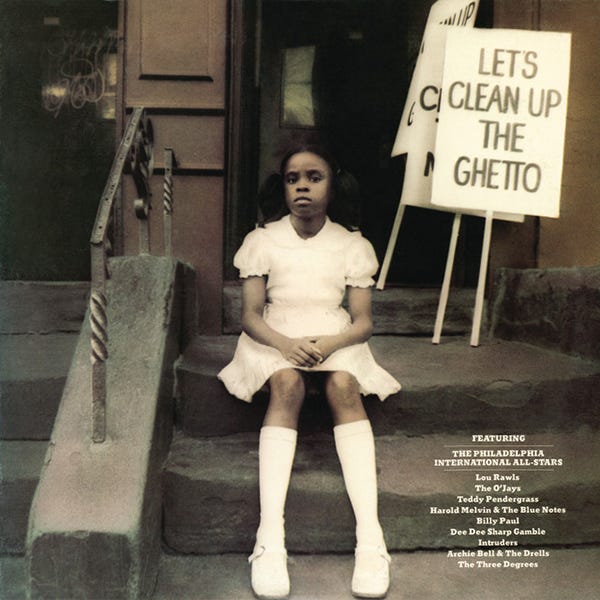
đ§š Letâs Clean Up The Ghetto, The Philly Soul Classic That Somehow Became a Benelux Phenomenon (and nowhere else)
The Twelve Inch 212 - The A Side (Extended) : Let's Clean Up The Ghetto (the Philadelphia All-Stars)
A forgotten chart mystery with one of the greatest bass lines in disco history
Researching The Twelve Inch sometimes delivers genuine surprises. This week gave me one of the biggest so far. I was absolutely convinced that this weekâs song had been a worldwide Top 10 hit in 1977. The moment I started assembling the shortlist for this first batch of episodes, it went in immediately.
âOf course this classic has to be in there,â I thought.
Because in my head, and probably in the heads of many people who grew up in Belgium or the Netherlands, this is one of the most famous Philly Sound dance records ever made.
Imagine my surprise when I discovered that âLetâs Clean Up The Ghettoâ by the Philadelphia All Stars was barely a hit anywhere except the Benelux, where it reached the Top 10.
To be fair, itâs not the first time this has happened while writing this newsletter. In the first season of The Twelve Inch I devoted an episode to Love Epidemic by the Trammps, another record that somehow only exploded commercially in Belgium and the Netherlands.
But this one felt different.
And that has everything to do with the way I first encountered the song.
đď¸ The stereo upstairs at my auntâs house
My nephew, eight years older than me, had a fantastic stereo system and a proper turntable. He had a weekend job, which meant he had both the money and the obsession required to buy quality equipment and vinyl records.
Whenever I stayed at my auntâs house, one of the things I looked forward to most was hearing the latest additions to his collection.
Now, our tastes werenât completely aligned.
By then I was already falling deeply in love with disco, as you probably know by now. My nephew wasnât exactly a disco kid. But he wasnât allergic to it either. We are talking about the years before Saturday Night Fever, when disco still existed in a more fluid form. As far as I remember, he only owned one twelve inch single.
That record was Letâs Clean Up The Ghetto by the Philadelphia International All Stars.
And the moment the needle dropped, I heard the sound that would forever define what Philly Soul sounded like in my head. That groove became my benchmark.
Years later, when I started DJâing, Letâs Clean Up The Ghetto became one of those records I could always rely on. In Belgium and the Netherlands, dropping this record on a dancefloor was one of the easiest ways imaginable to fill it instantly.
Because over here, this wasnât just another soul record.
This was quintessential Philly Sound. Quintessential disco.
And it stayed that way for decades.
Which immediately raises the big question at the heart of this weekâs episode.
â Why did this record become huge only in the Benelux?
Thatâs the mystery.
Why did this record resonate so strongly in Belgium and the Netherlands while barely making an impact elsewhere?
Finding an exact answer is difficult, but before we get there, letâs first talk about the song itself. Because even if you have never heard it before, Iâm fairly certain you are about to fall in love with that bass line and the sweet Philadelphia Soul Sound. And behind the groove sits a much bigger story.
A story about New York in crisis, socially conscious soul music, urban decay, Black America in the seventies, and the producers who helped shape disco into something far more meaningful than many people still assume today.
Because The Twelve Inch is the story of how dance music kept reinventing itself, often by accident.
đ Welcome, Iâm Pe Dupre, thanks for stopping by.
This is The Twelve Inch, a community about the history of dance music from 1975 to 1995, told one twelve-inch record at a time.
If this landed in your inbox because a friend forwarded it, Iâd love for you to subscribe so you donât miss the weekly episodes. Each one dives into a track, its story, and the culture around it.
And if youâre already enjoying the free posts, would you consider becoming a paid subscriber? Your support helps me keep researching, writing, and unearthing the stories behind the music. And Youâll get access to the weekly B-side post: the full archive and extra Subscriber Only Posts
â Message music on the dancefloor
Letâs Clean Up The Ghetto is not just a story about the Philly Sound. Itâs also a story about what was once called âmessage musicâ.
The Philadelphia Sound was smooth, lush and danceable, but its lyrics often went far beyond romance and escapism. Gamble & Huff believed soul music could carry social meaning without losing its groove. And Letâs Clean Up The Ghetto may be one of the clearest examples of that philosophy.
Released in 1977 on Philadelphia International Records, the song brought together a large group of artists from the label roster in what almost feels like a prototype for later charity records such as We Are The World or Do They Know Itâs Christmas? The Philadelphia All Stars included: Archie Bell, Billy Paul, Dee Dee Sharp Gamble, Lou Rawls, Teddy Pendergrass and The OâJays.
The message itself was simple but powerful.
The âghettoâ in the title was not presented as a place of shame, but as a community worth protecting, rebuilding and reclaiming. The song called for pride, solidarity and responsibility within Black inner-city neighborhoods.
Change begins with the people who live there.
And that immediately connects this record to one of the most important themes in disco history. Because one of the reasons New York became the epicentre of disco culture in the seventies was precisely the difficult situation the city found itself in.
đď¸ New York in the seventies, disco born from crisis
Thereâs often a connection between difficult economic times and the rise of dance music.
It makes sense.
If life is hard and the city around you feels like itâs collapsing, people need places where they can release pressure, forget reality for a few hours and feel alive again.
Dance music has always been incredibly good at providing that escape.
If time travel ever becomes possible, seventies New York would absolutely be one of the destinations I would want to visit. But I also fully realise that for somebody who grew up in a relatively quiet and provincial Antwerp, it would probably come as quite a shock. Because New York in the seventies was not an easy place.
The decade was marked by stagflation, the dreaded combination of economic stagnation and inflation. Prices rose while opportunities disappeared. At the same time, wealthier residents were leaving the city for the suburbs, shrinking the tax base exactly when social needs were increasing dramatically.
The city moved toward bankruptcy.
The federal government was reluctant to intervene.
Strikes became common.
One of them was the sanitation worker strike that left mountains of garbage piling up in the streets. And this is where the opening of Letâs Clean Up The Ghetto becomes fascinating.
Like many people, I originally assumed Lou Rawls was referring to the sanitation problems happening around 1977. But he was actually referring to the famous sanitation strike of 1968, the one that produced the notorious garbage crisis Time Magazine would later describe as âFragrant days in Fun Cityâ đ
Lou Rawls mentions a ârecent visitâ, which confused me completely at first. Unless he had access to an early prototype of the Twelve Inch Time Machine, that obviously makes little chronological sense đ
But ultimately, the exact timing matters less than the broader symbolism. Because the songâs purpose was much bigger than a single strike.
âLetâs Clean Up the Ghettoâ was built around the idea that communities needed both a physical and a mental cleanup.
And Philadelphia International Records went even further.
Proceeds from the record were directed toward real neighborhood cleanup programs in Philadelphia itself. That was highly unusual in 1977.
This wasnât just symbolic activism.
This was a major label directly connecting music, commerce and community action.
đš Gamble & Huff, the architects of Philadelphia Soul
Itâs impossible to tell this story without talking about Kenneth Gamble and Leon Huff. Together they created the Philadelphia Soul sound, one of the most influential styles in modern Black music. A lush, orchestral, groove-driven sound that shaped soul, disco, funk, R&B and eventually hip-hop.
Kenneth Gamble was born in Philadelphia in 1943. Leon Huff was born in Camden, New Jersey in 1942. They met in the Philadelphia music scene during the early sixties, where Gamble worked as a singer and Huff as a session pianist. Their chemistry clicked immediately.
What makes their story even more remarkable is that Kenneth Gamble could barely play guitar beyond a few basic chords and could neither read nor write music. Leon Huff was a brilliant pianist, but he also struggled with formal musical notation.
Yet together they built one of the most important Black-owned labels in music history.
In 1971 they founded Philadelphia International Records, distributed by Columbia Records. The label became home to an extraordinary roster: The OâJays, Harold Melvin & The Blue Notes, Teddy Pendergrass, Billy Paul, Lou Rawls, Patti LaBelle, Phyllis Hyman and MFSB, the legendary house band behind the Philly groove.
Their productions blended sophistication with accessibility.
Songs like Back Stabbers, Love Train, For The Love Of Money, If You Donât Know Me By Now and Me And Mrs. Jones became cultural landmarks.
But what separated Gamble & Huff from many of their contemporaries was their insistence on social consciousness. Tracks like Wake Up Everybody, Message In Our Music and Give The People What They Want openly addressed poverty, racism and social responsibility. Kenneth Gamble in particular believed deeply that music should be used as a force for positive change.
And Letâs Clean Up The Ghetto may be one of the purest examples of that belief.
đť So why did the Benelux embrace it so strongly?
This is where the story becomes especially interesting.
The song barely crossed over internationally. It reached only #34 in the UK. In the United States it stalled at #91 on the Billboard Hot 100 and only reached #26 on the Disco Action chart.
And yet in Belgium and the Netherlands it became a genuine classic reaching n°7 in the pop chart.
Why?
Part of the answer probably lies in the unique radio culture of the Benelux during the seventies. In episode 132, where I discussed Love Epidemic by The Trammps, I already explained how many Flemish listeners regularly tuned into Dutch radio stations.
And one name keeps appearing when researching this period:
Ferry Maat.
Ferry Maat became one of the most important djâs & ambassadors of soul and disco music in the Netherlands. Starting on pirate radio before moving to mainstream broadcasting, he hosted the hugely influential Soul Show every Thursday evening.
No, I have absolutely no idea how he came up with such a complicated title đ
While detailed playlists are difficult to reconstruct today, I strongly suspect Ferry Maat played a crucial role in pushing this record into the Dutch mainstream.
But it also landed on fertile ground.
Because in the Benelux, Philly Soul disco became the benchmark for what classic disco should sound like. Warm bass lines, lush strings, soulful vocals and a groove deeply rooted in Black American music. That sound connected immediately with audiences here.
And honestly, decades later, the reaction on dancefloors still proved exactly the same thing.
đ§ The strange American underperformance
What still genuinely puzzles me, though, is the muted American reaction.
Most of the artists involved had already proven multiple times that they could cross over commercially.
The record itself has/had an incredible groove.
The message was strong.
The production was classic Gamble & Huff.
And yet the song never really exploded outside the R&B market. It did reach #4 on the R&B charts, so it clearly resonated strongly with Black urban audiences. But the broader crossover never happened.
Why?
I honestly donât fully know.
Maybe the BPM was slightly too slow for certain disco clubs?
Maybe the socially conscious theme made it harder to market as pure escapist dance music?
Maybe the collaborative âall starsâ format made it feel less like a single artist event?
Or maybe some records simply arrive at exactly the right moment in certain countries and never fully connect elsewhere.
That happens more often than we think.
đ Why this record still matters
Even without massive American chart success, Letâs Clean Up The Ghetto remains hugely important in the history of dance music. Because this record showed that disco could carry social meaning without sacrificing pleasure.
It connected activism with the dancefloor.
It turned a commercial release into a tool for community action.
And in many ways, it anticipated later developments in conscious hip-hop, charity records and socially engaged Black music. At the same time, it built directly on the legacy of artists like Curtis Mayfield and Marvin Gaye. The Philadelphia International All Stars represented something bigger than entertainment.
They represented the idea that soul music itself had responsibilities.
That art and community should not be separated. And that dance music could still say something meaningful about the world around it.
The influence of Gamble & Huff remains enormous: Their orchestral arrangements helped shape disco itself and influenced producers like Giorgio Moroder and Nile Rodgers. Their catalogue became foundational material for hip-hop sampling. And they elevated the role of the producer into something far beyond technical supervision.
Gamble & Huff did not simply create hit records.
They built a sound.
A cityâs musical identity.
A philosophy.
Philadelphia gave the world soul.
And Gamble & Huff gave the world Philadelphia.
This Weekâs B-Side đ
This weekâs B-side goes deeper into:
Message Music, and how socially conscious Black music really was during the seventies
The crucial role Philadelphia International Records played in the evolution of disco
Why Salsoul and PIR are much more connected than most people realise
A guided listening dive into the Gamble & Huff catalogue for your weekend soundtrack
And trust me, once you enter that catalogue, it becomes very difficult to leave again đ
The B-side is where we go deeper.
It iItâs paywalled, but for the price of 8 premium coffees, you get:
a full year of B-sides
access to 150+ deep dives
future stories across genres
And yes, payment in beans is still impractical đ
Join the club. Iâd genuinely love to have you on board.
The Twelve Inch is a growing community of people who love disco, eighties, and early-nineties dance music.
If you know someone who would enjoy these stories, feel free to share this post with them or pass it along on Substack Notes. Every share helps the music, and the community, travel a little further. đżâ¨
đŹ Letâs keep the cleaning conversation going
Did Letâs Clean Up The Ghetto become a classic where you grew up?
Do you also associate Philly Soul with the âpurestâ form of disco?
And what do you think explains why some records become massive in one country while barely registering elsewhere?
Iâm also curious:
What is your favourite Gamble & Huff production?
And are there records you were convinced were worldwide hits, only to discover later they really werenât?
So You Wanna Hear More ?
I thought you would !
Itâs fun to write about music but letâs be honest. Music is made to listen to.
Every week, together with this newsletter, I release a 1 hour beatmix on Mixcloud and Youtube. I start with the discussed twelve inch and follow up with 10/15 songs from the same timeframe/genre. The ideal soundtrack forâŚ. Well whatever you like to do when you listen to dance music.
Listen to the Soundtrack of this weekâs post on MIXCLOUD
Or On Youtube


