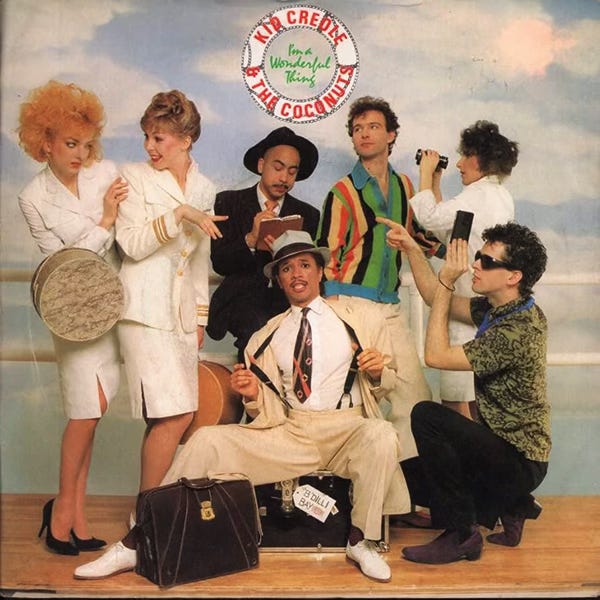
✨ Kid Creole: The Strange, Stylish Genius Behind “I’m a Wonderful Thing, Baby” ✨
The Twelve Inch 195 : I'm A Wonderfull Thing Baby (Kid Creole & The Coconuts)
Let’s start with a bit of housekeeping. Since launching this adventure in February 2024, I’ve been publishing new episodes every Friday at noon (CET). I began at episode 100, and this week we reach episode 195, that’s 96 episodes, plus a handful of extra posts: 126 pieces in total. With that, Season One is officially complete!
For the next few weeks, there will be no new episodes. I’m taking a short holiday break. Episode 196 will land on 9 January, kicking off Season Two of this newsletter.
It’s been quite a ride. I’ve loved writing and mixing every week, and I’m nowhere near finished. There’s much more to come, and I’ll be adding a few new features to the weekly episodes starting in January. More on that soon.
Over the past months I’ve been buried in research, uncovering some fantastic material for the long-promised extra episodes I originally planned for this fall. The research took a bit longer than expected, and, as you know by now, I refuse to publish anything that isn’t properly checked, sourced, and fully understood. The coming weeks will give me the time to wrap up the first part of that work and prepare those bonus episodes for January.
So yes, we’ll have plenty to talk about after the holidays. But first, let’s all enjoy some proper quality time with the people we love.
To all my readers: I wish you a very Merry Christmas and a Happy New Year. May 2026 bring you everything you hope for.
See you on the other side.
Love,
Pé
One of the things that always fascinated me in the comic books I read when I was young(er) 😁 was time travel. That moment when the story suddenly jumped backwards and everything changed. Time travel will never be possible, of course, but after reading those stories you couldn’t help wondering where you would go if it were.
Back then, my answer would probably have been Ancient Rome or the Middle Ages. But as comic books slowly gave way to the (dance) music I fell in love with, my idea of time travel shifted too. Ask me now, and there’s no hesitation: early-eighties New York.
The reason is simple. New York was the undisputed centre of the disco world. If your record didn’t work on a New York dancefloor, it didn’t really happen. For artists, labels, and DJs alike, the Billboard Dance Chart was the benchmark, and New York was the gateway. But what truly fascinates me is what happened after the summer of 1979, after Disco Demolition, when disco was supposed to be “over.”
Those moments just before a new genre fully takes shape are always the most interesting. Before the formulas harden. Before everyone starts making the same record because the market demands it. These are the true crossroads of music history.
In those in-between periods, there’s an unmatched sense of freedom. Styles collide. Past and present mix. Boundaries disappear. Originality explodes. That was exactly what New York felt like in the early eighties.
Disco didn’t die, mainstream, watered-down disco did. Long before the backlash, disco had already given birth to new forms: hip-hop and electro, New Wave and No Wave, and all the wild cross-pollinations between them. Someone even gave it the perfect name: Mutant Disco.
Today, I want to shine a light on two of its key architects: Kid Creole and Michael Zilkha. The first one you already know. The second, probably less so. He was Kid Creole’s label boss, and his story perfectly captures what was happening in New York at the time, and why it mattered so much.
Make no mistake: while New York may have been a musical paradise, everyday life there was anything but. I’m well aware that if time travel ever became possible, I might not leave that version of the city alive. Still, it wouldn’t stop me from going. It would have given me the chance to witness something extraordinary, and perhaps even to meet one of my musical heroes: Kid Creole.
Kid Creole & The Coconuts would go on to become a major success across the Atlantic. We couldn’t get enough of them, and nowhere were they bigger than in the UK. Why that happened is a fascinating question in itself.
But before Kid Creole strutted across European TV screens in a piña-colada-coloured zoot suit, before The Coconuts perfected their high-camp choreography, before Tropical Gangsters rewrote the rules of what dance music could be, there was August Darnell. A schoolteacher with impeccable grammar, a razor-sharp sense of humour, and a lifelong obsession with the rhythms of the city.
And that’s where our story begins.
👋 Welcome, I’m Pe Dupre, thanks for stopping by.
This is The Twelve Inch, my newsletter about the history of dance music from 1975 to 1995, told one twelve-inch record at a time.
If this landed in your inbox because a friend forwarded it, I’d love for you to subscribe so you don’t miss the weekly episodes. Each one dives into a track, its story, and the culture around it.
And if you’re already enjoying the free posts, would you consider becoming a paid subscriber? Your support helps me keep researching, writing, and unearthing the stories behind the music.
🌴Meet the Character: August Darnell Before the Zoot Suit
He was born Thomas August Darnell Browder in the Bronx in 1950. His mother came from South Carolina, with Caribbean and Italian roots; his father was from Savannah, Georgia. As an adult, Thom Browder chose to go by his two middle names: August Darnell.
Growing up in the Bronx meant growing up inside a cultural crossroads. Doo-wop harmonies, Latin boogaloo, jazz, calypso, everything bled into everything else. The streets themselves were polyglot, and New York’s music was no different. Before music fully claimed him, August Darnell worked as a schoolteacher. When he eventually left the classroom behind, it was the classroom’s loss, but dance music’s undeniable gain.
🎸 The First Mission: Dr. Buzzard’s Original Savannah Band
The first major adventure came when August teamed up with his half-brother, Stony Browder Jr., to create something decidedly different: a 1940s-inspired big-band disco orchestra called Dr. Buzzard’s Original Savannah Band. They broke through quickly, scoring a major hit with “Cherchez La Femme.” It marked Darnell’s first real experiment in blending tropical rhythms, swing-era nostalgia, sharp social commentary, and grooves built for the dancefloor.
The debut album performed extremely well, but the follow-up took two years, and an enormous amount of studio time, to materialise. By the time it finally arrived, the moment had passed. The world had moved on, and Dr. Buzzard’s was effectively over.
August, however, did not step away from music. Instead, he shifted gears, moving into production and arranging work for other artists.
🎧 ZE Records: The Oddball Powerhouse of Early-80s NYC
To understand Kid Creole, you first have to understand ZE Records, the label that became the mothership for New York’s post-punk, no-wave, disco-not-disco outsiders.
ZE was an extraordinary label, born out of a brief but intense period of creative fertility in New York. It captured a moment when white underground musicians began flirting with dance music, when disco was giving way to hip-hop and electro, and when Black and white pop were cross-pollinating at full speed. Art and music fed into each other, often indistinguishably.
The label was co-founded by Michael Zilkha and art provocateur Michel Esteban. They were young, restless, and deeply allergic to musical purity. These were fertile times indeed: post-punk pop, disco, funk, dub, and Latin influences collided with art-school pretension, all spiced with irony. Zilkha loved the fact that rules were being broken, and often ignored altogether.
Michael Zilkha
They didn’t have the money to compete for the artists everyone else was chasing. As Zilkha later put it, “I could only afford to sign people nobody else wanted,” a limitation that famously cost him the B-52s. Instead, ZE found its artists within the art-disco ecosystem circulating through clubs like Danceteria, the Peppermint Lounge, Club 57, and the Pyramid.
Considering that ZE would go on to become home to Was (Not Was), Suicide, Material, and Kid Creole & The Coconuts, they did rather well. They even coined a term for what they were doing:
🔬 Mutant Disco: When Genres Mutated, Not Blended
The term “Mutant Disco” first appeared on a ZE compilation released in 1981: Mutant Disco: A Subtle Discolation of the Norm.
It wasn’t a genre. It was cross-genre, more a worldview than a sound. Think disco with a hangover, funk with a French accent, punk that had learned how to dance, or jazz slipping into platform shoes.
Bob Blank, owner of Blank Tape Studios, captured it perfectly:
“Mutant Disco” described the mood of the moment. New York’s club scene was recovering from the so-called “death of disco,” but downtown dancers didn’t care. They mixed everything: loft jazz, Latin percussion, punk attitude, dub echo, and the early shapes of what would soon be called hip-hop.
ZE Records itself mirrored that spirit. It was creative, fertile, and chaotic. As Michael Zilkha would later admit, “It felt more like a repertory company than a record label,”
🪩 ZE Records Wanted a Star, Darnell Wanted a Solo Album
ZE Records quickly became the talk of the town. And because New York still mattered enormously in the dance-music ecosystem, the label was being watched closely. Distribution deals were secured with Sire Records in the US and Island Records for the rest of the world. Albums were released, and rave reviews followed.
Commercial success and meaningful income, however, did not.
By 1982, ZE found itself deep in financial trouble, much of it tied to its distribution arrangements. The label was looking for a way out.
Their signing with the greatest commercial potential was Kid Creole & The Coconuts. The first two albums had performed reasonably well, and the sense was that the world was ready for a more accessible, more commercial turn. There was just one complication: by then, August Darnell was working on a solo album.
When ZE pushed him to turn that solo project into a group release, and to make it more overtly commercial, it didn’t sit well with Darnell. A few months later, when it became clear that the record would no longer be a solo album and would differ significantly in style from its predecessors, Darnell publicly framed it as “a chance to do some other things.” Privately, however, he felt he was being forced into making “a cop-out album, an R&B album” to help ease ZE’s mounting financial pressures with its US parent label, Sire Records.
Tropical Gangsters (released in the US as Wise Guy) would go on to become their most successful album by far. It was also one of the most difficult to make.
Because it had started life as a solo project, August had written most of the material himself. His longtime collaborator Coati Mundi (Andy Hernandez) had been promised space for three tracks, but ultimately ended up with just one, recorded almost entirely as an instrumental. The episode created a rift between the two that never fully healed, and a few years later Hernandez would leave the band altogether.
Read about Coati Mundi in Episode 149 :
How a NYC Bilingual Latin Groove Shaped the Dance Floors in Europe but not in the US: The Story of Coati Mundi’s 'Que Pasa/Me No Pop I'
Disco’s Afterlife: A Teen’s Discovery in 1981 Antwerp
The accumulated tension from this period would eventually push Kid Creole & The Coconuts away from ZE Records as well.
💥 “I’m a Wonderful Thing, Baby”: the first single
“I’m a Wonderful Thing, Baby” is pure Darnell.
A tongue-in-cheek boast carried by a slinky Caribbean groove, soaked in wit and delivered with the confidence of someone who knows he’s both ridiculous and irresistible. It’s bravado played for laughs, but never without intent.
August Darnell himself tied the title directly to what he later described as his “egotistical period.” The very first line he wrote was “I’m a wonderful thing, baby,” and that mix of swagger, humour, and self-aware myth-making sat at the very core of the Kid Creole persona.
🌍 The Breakthrough
In the US, the record performed modestly. American radio struggled to categorise it. The dancefloors, however, responded immediately, pushing the track to a respectable No. 18 on the Billboard Dance Chart.
Europe understood it straight away, especially the UK. There, “I’m a Wonderful Thing, Baby” hit hard, climbing to No. 4 on the charts.
The album Tropical Gangsters reached the Top 3 in the UK and went on to sell over one million copies worldwide.
Two further hits followed, “Stool Pigeon” and “Annie I’m Not Your Daddy”. Combined with a formidable live reputation, they turned Kid Creole & The Coconuts into one of the most important bands of the early eighties.
“I made so much dough and wasted so much dough,” says Darnell.
🌐 Why Kid Creole & The Coconuts became such a big success in the UK (and Not at Home)
Tropical Gangsters and Kid Creole arrived at exactly the right moment. Dancefloors were ready for a band that could combine Caribbean rhythm, jazz sophistication, disco grooves, punk-era irony, Latin energy, and big-band theatricality. Kid Creole & The Coconuts found success across Europe, but nowhere more so than in the UK, where all three singles reached the Top 10.
The record offered a clear blueprint for what would follow. You can hear its influence in bands like Haircut 100, Matt Bianco, Carmel, Blue Rondo à la Turk, and Modern Romance. Even Boy George of Culture Club openly admired Kid Creole’s flamboyance, narrative approach, and multicultural vision.
So why did the UK embrace Kid Creole more deeply than other European countries, and why did they never receive the same recognition in their home country?
In 1982, Britain still understood the idea of pop as theatre: music as character and performance, not just sound. The tradition ran deep, Music Hall, glam rock, pantomime irony. Kid Creole & The Coconuts weren’t simply a band; they were a concept. A fictional Caribbean dandy. A narrator whose songs functioned as short stories, with irony layered over rhythm. British audiences were trained to read that code. American audiences, increasingly, were not.
The British music press played a crucial role as well. Publications like NME and Melody Maker framed Kid Creole as post-punk adjacent: a New York art-school project, a continuation of Warhol rather than disco. In the US, the framing was very different. There, Kid Creole was often dismissed as novelty, too theatrical, a leftover disco project. Labels like that proved fatal.
Visuals mattered too. Kid Creole & The Coconuts were made for television, and Top of the Pops still had enormous cultural power. Combined with UK radio support and a society already shaped by Caribbean immigration, the band connected on multiple levels. Pre-MTV America, by contrast, had a far less visual pop infrastructure and highly fragmented radio formats, still traumatised by the disco backlash. Kid Creole may have found pockets of support in urban centres, but rural America was another story altogether.
And finally, there was the broader cultural shift. Early-eighties America was pivoting towards heartland rock, authenticity narratives, and a new masculine seriousness. Kid Creole stood for the opposite: masks, narrators, role-play, elegance, and style over confession.
In Britain (and the rest of Europe), that wasn’t a problem.
It was the point.
📉 What Happened After Tropical Gangsters?
After the success of Tropical Gangsters, August Darnell suddenly had options. The tensions created by the abandoned solo album, and the resulting bad blood with ZE Records, only accelerated the moment of choice.
As Michael Zilkha later explained: “August’s manager felt he should be on a ‘proper label’,” he said. “Once they’re successful, they can go somewhere else for more money.” Kid Creole & The Coconuts therefore signed directly with Island Records, cutting out the middleman.
There were no doors slammed on the way out. On the contrary, August Darnell has often credited Michael Zilkha as “the angel” who gave the band total creative freedom up through Tropical Gangsters. He would later recall that no one at ZE attempted to streamline or soften their unusual blend of calypso, R&B, jazz, funk, Latin, and pop, at least not until major labels became involved.
ZE Records itself would not survive much longer. Zilkha and Michel Esteban parted ways over financial disagreements, and the commercial failure of John Cale’s rapturously reviewed 1982 album Music for a New Society left Zilkha feeling “gutted.”
Kid Creole & The Coconuts continued to release albums, Doppelganger, In Praise of Older Women, Private Waters, Too Cool to Conga!… but they would never again reach the level of mass success achieved with Tropical Gangsters.
🌞 Kid Creole’s True Legacy and why the experimentation ended
Darnell has consistently described Tropical Gangsters as the moment when Kid Creole & The Coconuts “came of age,”calling it their “pinnacle.” He has often stressed that the album was written and recorded in a relatively carefree, pre-calculated state, one they would never quite be able to return to once success arrived.
He would later reflect on that period in more personal terms. “I think it was because I was in a happy place,” he says. “I was living in Manhattan and I’m sure that the combination of my living experience there that everything was going swimmingly well. I was married to Adriana Kaegi, a Swiss woman who helped me to create Kid Creole with me, and we had this vision together.”
That sense of openness extended beyond the band itself. “It will never be like that again as it was in that period because, although it’s a cliché, it was a melting pot of many different ethnic groups and many different characters coming together: the wealthy, the poor, the middle class, all hanging out together at these clubs”
And that is precisely why, by 1983, the spirit of experimentation in New York was beginning to fade. Dance genres that had happily cross-pollinated only a few years earlier started retreating into stricter silos, each following its own trajectory. Experiments like Kid Creole had succeeded because they arrived at exactly the right place at the right time. With success came pressure, from record companies, from expectations, to stay within newly defined lanes.
The irony, of course, is that once too much calculation enters the process, success becomes harder to reach. Yet there was no going back either. The conditions that had made Tropical Gangsters possible no longer existed, and the wider world had already moved on.
Some critics argue that the seventies didn’t really end in 1979, but in 1983, and there’s a strong case to be made. Much of what happened musically in the early eighties was still deeply connected to the late seventies, far more than to what came after. It’s a timeframe I return to again and again, because so much of what followed was shaped in those few, extraordinary years.
💬 Your Turn — I Want to Hear From You!
Do you remember the first time you heard “I’m a Wonderful Thing, Baby”?
Did you discover Kid Creole on TV, in a club, on a compilation, or through a reissue?
What’s your favourite track from Tropical Gangsters?
Share your memories, stories, and favourite cuts below.
Further reading (or should I say watching)
There are a number of interesting video’s/links :
So You Wanna Hear More ?
I thought you would !
It’s fun to write about music but let’s be honest. Music is made to listen to.
Every week, together with this newsletter, I release a 1 hour beatmix on Mixcloud and Soundcloud. I start with the discussed twelve inch and follow up with 10/15 songs from the same timeframe/genre. The ideal soundtrack for…. Well whatever you like to do when you listen to dance music.
Listen to the Soundtrack of this week’s post on MIXCLOUD
Or on Youtube :
So what’s in this week’s mix ?
This week’s mixtape is built like a set I played in 1982. The early eighties were magical: all kinds of dance music lived side by side, and the expectation was that you’d blend subgenres freely over the course of a night.
I’m opening with our central track of the week, “I’m a Wonderful Thing, Baby” by Kid Creole & The Coconuts. Back then, I used to call Kid Creole’s sound (and most of the ZE Records roster) No Wave. It wasn’t disco, it wasn’t hip-hop, it wasn’t electro, it wasn’t new wave, it wasn’t Latin, it wasn’t R&B… it lived somewhere between all of them.
That’s exactly the spirit of this set. You’ll hear some dance-pop from Orange Juice, Tom Tom Club, and Talking Heads; a dose of Brit-Funk from I-Level and Georgie Red; a bit of synth-pop from Men Without Hats; some electro/new wave from Gary Numan, Siouxsie & The Banshees, Logic System, and John Foxx; and even a splash of hip-hop from Grandmaster Flash and Funky 4 + 1.
And just like in the early disco days, and later again when New Beat arrived, you could cross any genre line as long as it worked on the dancefloor. So I’d also happily drop Steve Miller Band’s “Macho City” or The Alan Parsons Project’s “Mammagamma”, both of which always went down a storm.
Strap in. The last mixtape of 2025 is one hell of a ride.
Enjoy! 🎶
This was the final episode of our long first season of The Twelve Inch. Season Two kicks off on 9 January, so get your dancing shoes ready, because the track I’ll be diving into in Episode 196 will make it impossible to stay seated.


I ❤️ NY
My sweet spot. NY 80s was my DJ time and before I started spinning I was KC&theCs biggest fan. I saw every Ritz show drooling over the middle coconut 🥥 dreaming she'd pick me to be hers and then I'd be inside their world bypassing the gap between newbie in the city and the in crowd. But I'd dance my ass off and go back to my apt still pining for the next show which would be often. I think that's their lasting legacy they were cool but anyone could get in on it for the price of admission 🎟 no Velvet Studio 54 rope nonsense.
I was baptized by August Darnell!
Hung out with Steve Rubell!
Hoffman can go to hell.
Stool Pigeon still knocks me out!
Of course you know their MGMT guy Randy tried to shake me down but I didn't budge but then again I never made it so maybe his you'll never work again meant I'd never be just another industry insider lining their pockets with artist money. Spotify anyone?
So be it I'm still cool! An OTG 4 Life!
Congrats on a great year of articles 👏
Happy Holidays from Steve's Stack!