

A few days ago, I dropped the second part of the B-side mini-series on the dance charts, in which I wrote about how Billboard got Tom Moulton to write a weekly column on the emerging discotheque scene that would soon lose the ‘theque’ part and become known simply as ‘disco’. 👇
The Twelve Inch #230 - The B-Side : The Dance Charts, and the Records I Didn’t Know

When I got my hands on a Billboard in the late seventies, usually months after publication, I knew perhaps 5 to 10% of the records on its dance chart. And I loved them! Naturally, I assumed the other 90% were just as wonderful.
In one of his first columns, Tom writes about “the four questions asked of discos by their customers”. Apart from one quite specific question about Gloria Gaynor, who is becoming hugely popular with “Never Can Say Goodbye”, the other questions are about which song is playing. Questions that would remain central throughout the history of dance music.
Today, we take out our phones and Shazam the answer. But before phones become smart, or even portable, you have to go and ask the DJ, hoping he’ll be willing to write it down. Because who can understand what someone is saying with all that noise? Not always easy.
I’ve been on both sides.
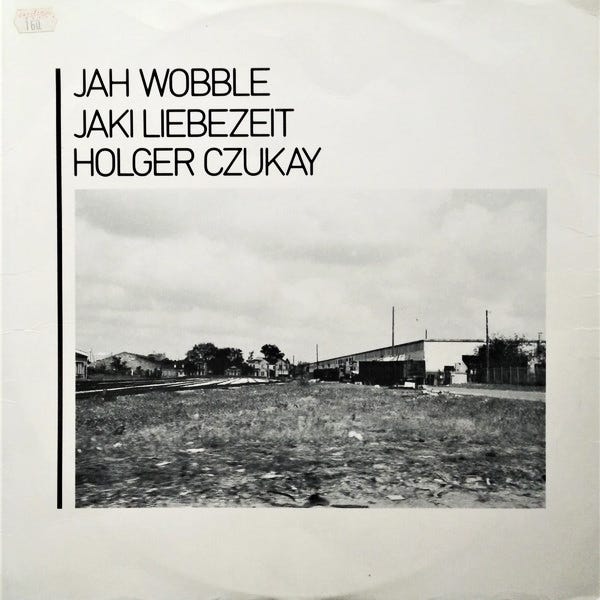
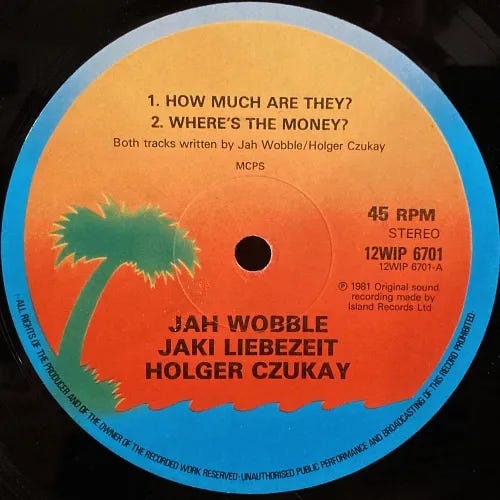
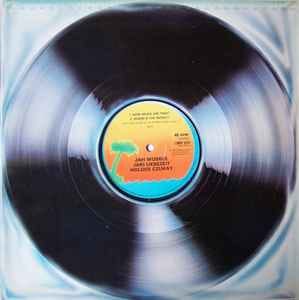
There are still a few songs I got to know simply by asking the DJ. One of them is Jah Wobble’s “How Much Are They?” The club ceased to exist a long time ago, but I still know where it was, even where I was standing when I first heard the song. I rushed to the booth, hoping to get the answer quickly so I could throw myself back onto the dancefloor. 😁
“How Much Are They?” is one of those early eighties records that leaves a lasting impression. The reason why isn’t really so hard to figure out. If post-punk and post-disco got together and had a love child, this could be it.
I was a disco kid, so I skipped punk, and I didn’t know who Jah Wobble was before this EP. I had never heard of either of the two other gentlemen. But I knew immediately that “How Much Are They?” was a record that would become and remain influential.
DJing at student parties in the early eighties meant playing this gem several times a night. If we’d had a dance chart back then, I’m sure this would have been in the top three, if not number one.
Nowadays, I do know who those three gentlemen are (or were) and how special it is that they get together to produce a dance record. Not only is the story quite peculiar, but it also illustrates how some of the best, most lasting and influential songs are sometimes the result of a spur-of-the-moment decision.
👋 Welcome, I’m Pe Dupre, thanks for stopping by.
This is The Twelve Inch, a community about the history of dance music from 1975 to 1995, told one twelve-inch record at a time.
If this landed in your inbox because a friend forwarded it, I’d love for you to subscribe so you don’t miss the weekly episodes. Each one dives into a track, its story, and the culture around it.
And if you’re already enjoying the free posts, would you consider becoming a paid subscriber? Your support helps me keep researching, writing, and unearthing the stories behind the music. And You’ll get access to the weekly B-side post: the full archive and extra Subscriber Only Posts
The Early Eighties Intersection
“How Much Are They?” sits at the intersection of several musical revolutions that would eventually reshape dance music in the 1980s and 1990s.
The early eighties are one of those periods when anything can and does happen, and experimentation isn’t just possible but almost expected.
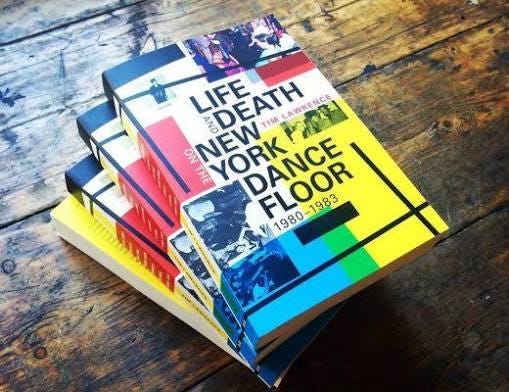
Tim Lawrence, in Life and Death on the New York Dance Floor, his important book on the early eighties, makes the point that the seventies don’t really end on 1 January 1980. Or is it the other way around? That the eighties actually begin a little earlier than that?
Whichever way you look at it, the early eighties are so interesting because what came before collides with two major developments: on the one hand, the technical possibilities offered by new and rapidly evolving electronic instruments, and on the other, the social changes taking place on both sides of the Atlantic.
When Different Music Traditions Meet
It’s in this context that we must place this week’s central song. It brings together three musicians from the British (post-)punk scene and the German experimental rock scene.

Jah Wobble, born John Joseph Wardle, is the bass player of Public Image Ltd, the post-punk band John Lydon starts after the Sex Pistols. The two Johns share an interest in world music and reggae.
Jah Wobble’s style is built on dub. He takes the Jamaican idea of the bass as the lead instrument and brings it into post-punk. But Wobble leaves Public Image Ltd after two albums.
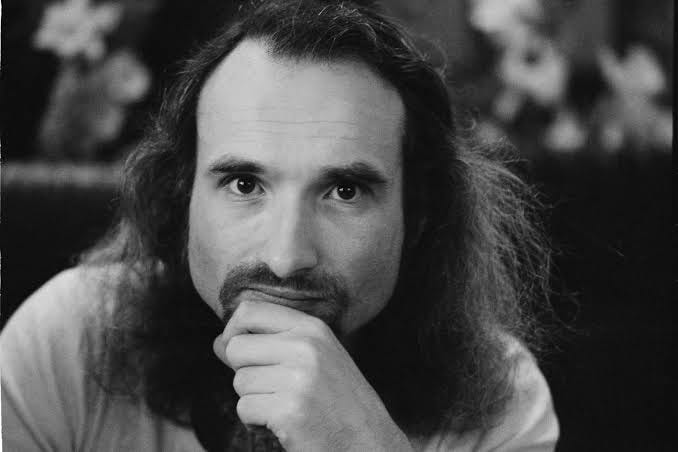
Holger Czukay and Jaki Liebezeit are the bass player and drummer of the German experimental avant-garde band Can, one of the major bands in a genre we call Krautrock.
Can is not one of the most accessible bands in the genre. They experiment quite a bit with synths, different sounds and tape cut-and-paste techniques, not always resulting in conventional songs. On the one hand, they move towards ambient music, but on the other, they also experiment with more danceable beats.
The only hit Can has outside Germany is the 1976 song “I Want More”, which is heavily influenced by disco.
So, the groundwork is laid and ready for what happens next.
The Studio, The Microphones And Two Intoxicated Girls
The story of their collaboration starts in London in late 1980, when Jah Wobble is introduced to Holger Czukay through a music journalist. As he later recounts:
Apparently, they discover that they share a sense of humour, which becomes important in the recording story of “How Much Are They?”

Their first session takes place at Gooseberry Studios, beneath a restaurant in London’s Soho. Although I also found a source claiming it wasn’t a restaurant but a dental practice. Maybe a place where you could get both? Have your teeth done and eat something afterwards. 😂
Anyway, the studio is one of the cheaper studios, primarily used by reggae and dub artists and up-and-coming pop acts to record demos.
Wobble has already developed the basic musical ideas: the bassline, rhythm, simple string parts and chords. Czukay brings his unconventional approach to recording and tape manipulation.
Then something wonderfully unexpected happens.
Two young women wander into the studio. They appear to be somewhat intoxicated and are fascinated by the recording equipment. Wobble jokingly tells them they’ve entered a microphone shop.
They want to know the price of the microphones.
“How much are they?”
Engineer Mark Lusardi and his assistant capture the exchange. Rather than treating the interruption as a nuisance, the musicians incorporate it into the recording.
That spontaneous incident gives the song its title and unique character.
Czukay later recalls the episode fondly, while Wobble describes how much he appreciated the unexpected interruption.
The Creation of “How Much Are They?”
Although Jaki Liebezeit is credited as part of the trio behind the EP, he doesn’t play drums on the original recording of “How Much Are They?”
Wobble explains that Liebezeit isn’t present at the London session. Instead, they use an old Roland rhythm box.
Czukay subsequently takes the recording to Cologne and radically reworks the tape. Mark Lusardi’s engineering helps give the track what Wobble calls a tough disco sound.
This is significant: the rhythmic precision that makes the track so suitable for dancing comes from a drum machine rather than Can’s celebrated drummer.
Part of the song’s instant appeal on the dancefloor comes from the lyrics at the start:
“Do you remember that time I sat down and you got up? / I do! / That ring of confidence will strangle when it slips.”
It sounds ominous and menacing. But “the ring of confidence” is actually part of a Colgate toothpaste campaign, claiming that Colgate gives you a lot of self-confidence, expressed by a ring appearing around your head in the commercial.
A dance record that doesn’t follow the usual rules
What makes “How Much Are They?” so interesting in 1981 is how it combines elements that generally belong to separate musical cultures.
There’s the way the bass dominates the arrangement, a technique Jah Wobble takes from dub. The repetitive groove, coming straight from funk and disco, gives the record its danceable momentum. Then there are the Krautrock elements in the repetition, combined with the drum machine Czukay uses.
And last, but not least, there’s the use of musique concrète, a method of composing with recorded sounds themselves rather than notes written for instruments.
The composer takes real-world sounds (a train, a voice, a door slamming, an instrument, the question of how much the microphones cost...), records them and then manipulates them by cutting, splicing, looping, reversing, changing speed and layering.
The record doesn’t need a conventional song structure to maintain interest. The groove provides continuity while the musicians manipulate everything happening around it.
That is an approach which would become increasingly important throughout the following decade.
Who was influenced by “How Much Are They?”
You already know that the song is big on Belgian alternative dancefloors. If you’ve read my B-side episodes on the dance charts, you know how frustrating it is that there’s no information on exactly which records are popular on Belgian (and, by extension, European) dancefloors at any given time.
It isn’t measured, or at least not organised in the same way as in the US and UK.
That said, the song doesn’t make it into the charts in either of those countries.
We do know that it’s a big hit in New York. David Mancuso plays it a lot at his Loft parties. Which, if you know a little about Mancuso and The Loft, isn’t that peculiar.
Mancuso’s musical philosophy is unusually open-minded. His selections extend beyond disco and funk into rock, experimental music, African music and anything else capable of creating a powerful communal experience.
I presume it’s also played in clubs like Danceteria. But it isn’t played everywhere, so it doesn’t make it into the Billboard dance charts.
One of the reasons I suspect its reach extends beyond The Loft is that the EP has a follow-up in the form of the 1983 Snake Charmer project. This is a collaboration between Jah Wobble, Holger Czukay and The Edge. But François K (Kevorkian) is also involved, and I see a direct line back to “How Much Are They?”
What really surprises me is that it doesn’t chart in the UK. Not on the dance chart, but not on the pop chart either.
This doesn’t mean it fails to influence a whole generation of artists. The Orb, Andrew Weatherall, Primal Scream and the whole trip-hop scene will have listened attentively to this 1981 dance track.
Whether all these artists heard the record at the time is another question. But the musical ideas it brings together in 1981 are ones we'll hear again and again throughout the following decades.
The Twelve Inch is a growing community of people who love disco, eighties, and early-nineties dance music.
If you know someone who would enjoy these stories, feel free to share this post with them or pass it along on Substack Notes. Every share helps the music, and the community, travel a little further. 💿✨
So You Wanna Hear More ?
I thought you would !
It’s fun to write about music but let’s be honest. Music is made to listen to.
Every week, together with this newsletter, I release a 1 hour beatmix on Mixcloud and Youtube. I start with the discussed twelve inch and follow up with 10/15 songs from the same timeframe/genre. The ideal soundtrack for…. Well whatever you like to do when you listen to dance music.
Listen to the Soundtrack of this week’s post on MIXCLOUD
Or on Youtube :
Next time, I’ll start a two-part series on one of the most influential singers, blessed with an extraordinary voice but somehow never quite receiving the recognition she deserves.
In part one, I’ll tell her story. In part two, we’ll explore how her voice gets stolen. And that’s where things become particularly interesting, because there are some striking parallels with today’s discussions about AI and music.
Some things haven’t changed quite as much as we’d like to think.
What a great name, Jah Wobble. Sounds like a Star Wars character! (And a snake charmer.)
Very interesting post as usual, Pe.