

Part 1:

By the time we left Part 1, Donna Summer was a star, Giorgio Moroder had assembled a formidable Munich team, and disco was booming, yet boxed in by expectations and stereotypes.
“I Feel Love” would break all of that.
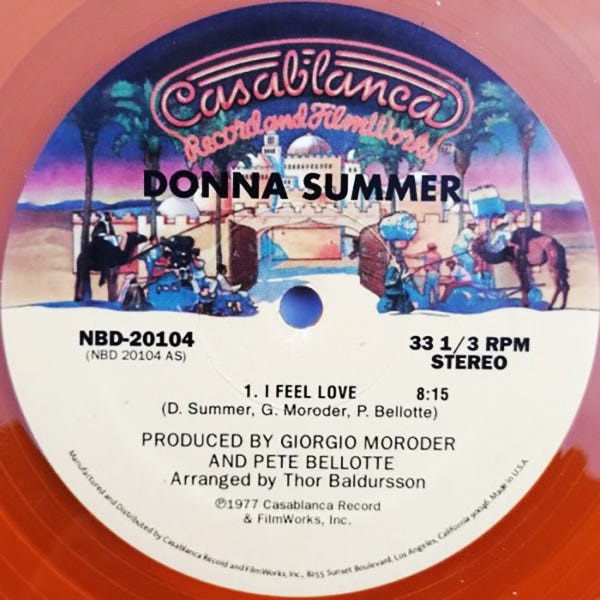
Not because anyone involved believed they were making history. Quite the opposite. It was meant as an album track, a conceptual afterthought, and initially even a B-side.
What followed was one of the most consequential chain reactions in dance music history.
Get your dancing shoes ready because you are in the finale!
👋 Welcome, I’m Pe Dupre, thanks for stopping by.
This is The Twelve Inch, my newsletter about the history of dance music from 1975 to 1995, told one twelve-inch record at a time.
If this landed in your inbox because a friend forwarded it, I’d love for you to subscribe so you don’t miss the weekly episodes. Each one dives into a track, its story, and the culture around it.
And if you’re already enjoying the free posts, would you consider becoming a paid subscriber? Your support helps me keep researching, writing, and unearthing the stories behind the music.
📚 Casablanca, Concepts & The Future Track
It is entirely possible that Giorgio Moroder’s, latent, interest in electronic music might never have fully blossomed into “I Feel Love”, without Pete Bellotte. Bellotte, responsible for lyrics, was deeply passionate about literature and preferred albums built around overarching ideas.
One such idea was an album in which each track represented a different decade of the twentieth century. Almost as an afterthought, Moroder and Bellotte decided the album, eventually titled I Remember Yesterday, should end with a song representing the future.
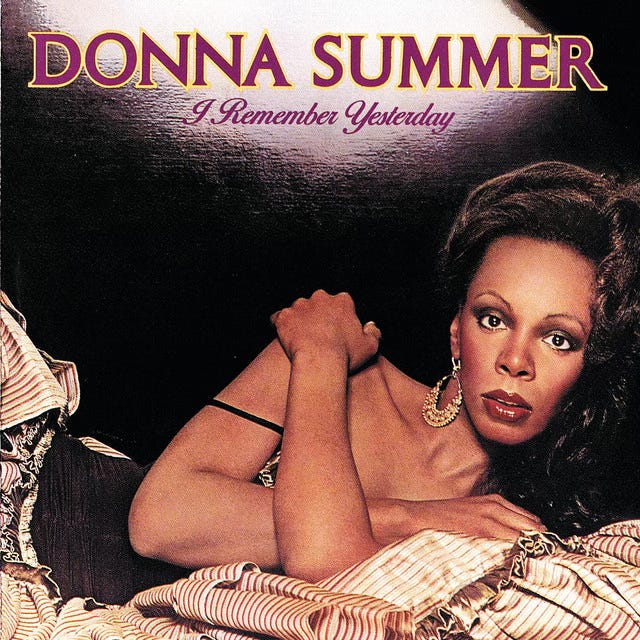
That song became “I Feel Love”.
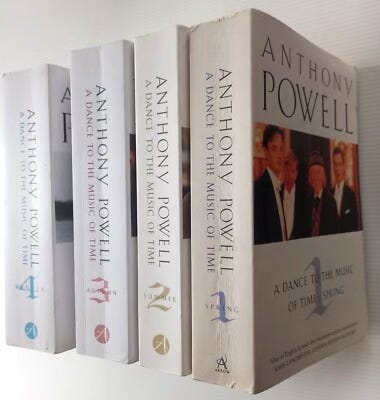
The album itself was inspired by A Dance to the Music of Time, the twelve-volume novel cycle by Anthony Powell. For Bellotte and Moroder, the future could only be expressed through synthesizers and machine-based rhythm.
⚙️ Building the Future in Munich

To realise this vision, they enlisted Robbie Wedel, an electronics wizard who had worked with composer Eberhard Schoener, and his Moog synthesizer. The Moog, together with Wedel, was rented and brought into the studio.
They began not with melody, but with rhythm, reversing Moroder’s usual working method. First the rhythm track, then the melody, and only then did Donna arrive to record vocals
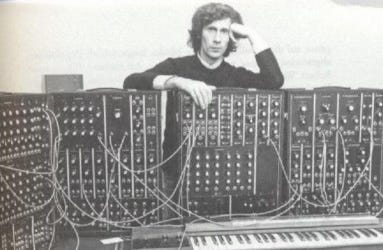
The Moog was monophonic, capable of producing only one note at a time. Every sound had to be recorded separately. This was pre-MIDI. Synchronising parts was extremely difficult.
Wedel discovered a way to lock the Moog’s timing, something so unexpected that even Bob Moog himself, was unaware it was possible. In that sense, Robbie Wedel can rightly be called the true architect of the sound of “I Feel Love”.
🔊 Stereo Tricks & Relentless Pulse
Another defining feature was the delayed bassline, split across stereo channels. One channel carried the dry bassline, the other its reverberated counterpart, a technique devised by Jürgen Koppers.
In clubs this caused issues depending on where you stood on the dancefloor, but it didn’t stop the track from becoming a sensation.
The hi-hat was created using clipped white noise, another Wedel innovation. The Moog couldn’t produce a convincing kick drum, so that fell to Keith Forsey.
Moroder recorded each drum element separately, no overheads, no room sound. So Forsey would find himself playing the kick or snare for fifteen minutes solid. He recalled, “The other guys would leave the studio and go and make a cup of tea and leave me to it”
That metronomic relentlessness made it feel like the song came from the future
👼 Donna’s Voice From Another Place
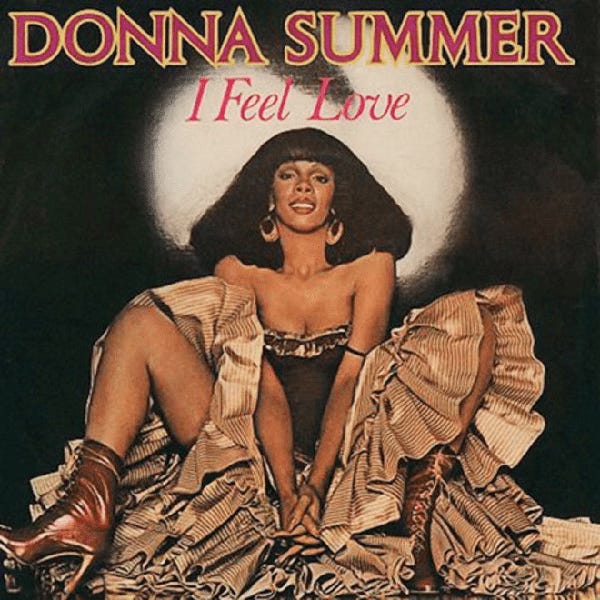
Donna Summer’s vocal took the song even further from anything she had recorded before. Where “Love To Love You Baby” was physical, “I Feel Love” was almost unearthly.
She sang in a breathy head voice, giving the track the feeling of an out-of-body experience rather than “hot between-the-sheets action”. Vince Aletti wrote, “It’s like she’s coming from some other place” Her approach owed more to musical theater than African-American soul traditions.
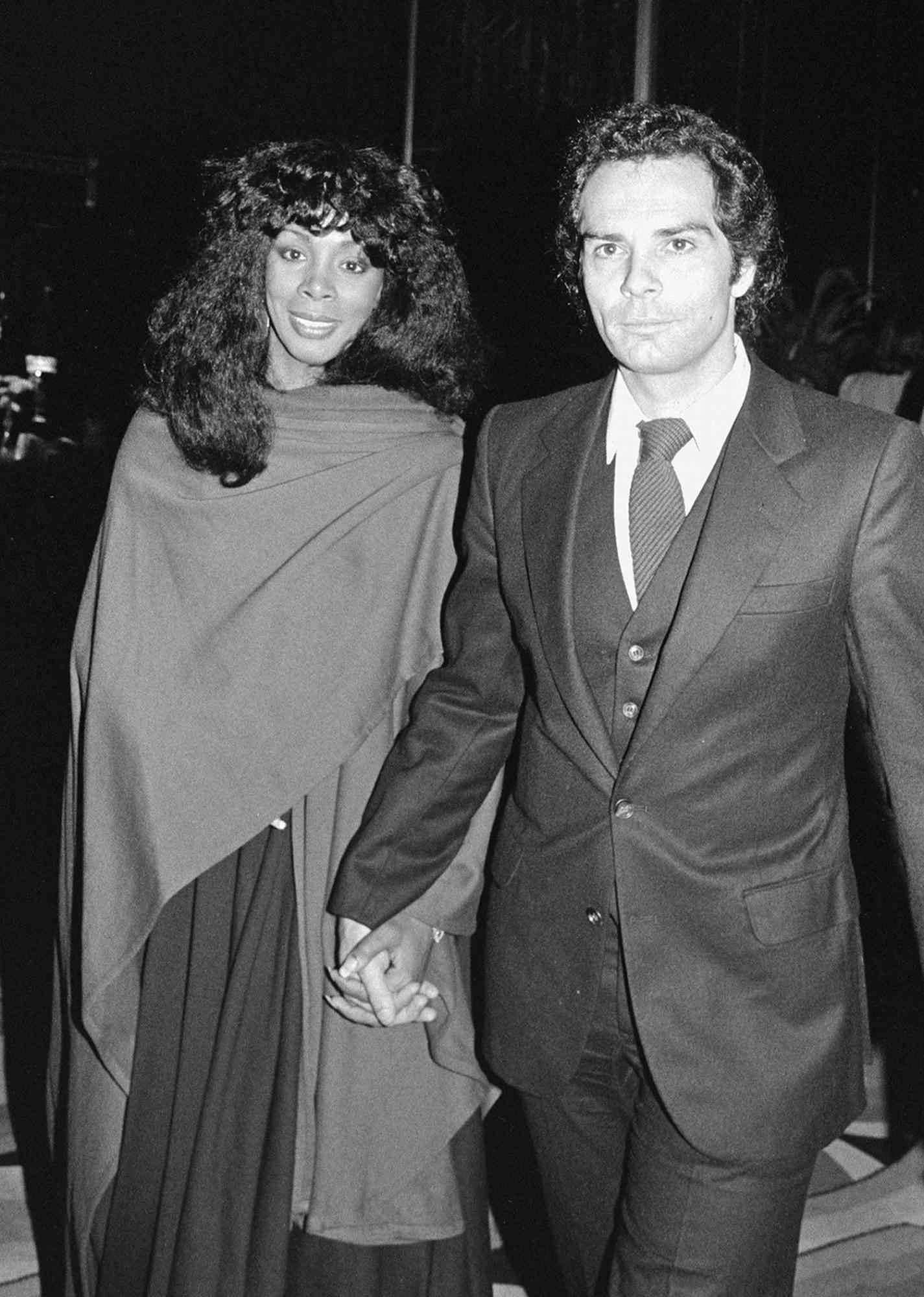
Donna Summer wrote the lyrics on the night her astrologer told her that the man she had fallen in love with, Bruce Sudano, was the man she should marry. They did marry and stayed together for the rest of Donna’s life. So when Donna flew back from Los Angeles to Munich to record the song, it was that feeling she brought into the studio. Bruce Sudano would later explain, “I remember Donna telling me they kept on writing all these lyrics and at some point she was like, no, this song has to be really really simple. The lyrics have to float over the track and that’s when she wrote the beautiful but simple lines that became I Feel Love”
⏱️ Three Hours That Changed Everything
And here comes the kicker: The primary recording took no more than three hours. Mixing took longer, but singing it was difficult. Moroder explained:
Non of its creators, thought much of I Feel Love. It was intended as an album track, nothing more. Bellotte later admitted, “It didn’t mean anything to us, in terms of us thinking we had done something special”
The irony is that Moroder and Bellotte not only failed to recognize the importance of the song, they also completely missed the frenzy it unleashed on dancefloors. Neither of them went to nightclubs. They kept regular, almost office-like studio hours, didn’t smoke, drink, or take drugs, and treated fine dining as their only indulgence. By the time clubgoers were getting ready for the night, both men were already in bed.
💿 From B-Side to Global Phenomenon
Casablanca initially chose the ballad, “Can’t We Just Sit Down (And Talk It Over)”, as the single, with “I Feel Love” on the B-side.
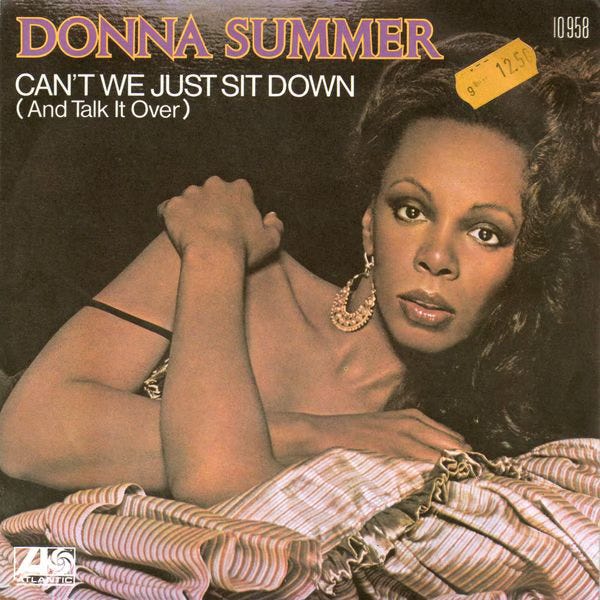
Bruce Sudano recalled, “The ballad was doing ok but it was the b-side that got the attention. Casablanca jumped on it and changed I Feel Love to be the single”
By the end of May, clubs in cities as far apart as New York City, Philadelphia, and San Francisco were reporting overwhelming demand for “I Feel Love.” By mid-June, there was scarcely a discotheque in the country where you could avoid hearing the record, and not just the edited 3.45-minute B-side version. DJs were playing the full, nearly six-minute album track, and writing in Record World, Vince Aletti could barely contain his enthusiasm. ““A brilliant combination of whipped-up synthesizer and . . . dreamy, ecstatic vocals. The pace is fierce and utterly gripping with the synthesizer effects particularly aggressive and emotionally charged.”
Faced with a record that even the influential Aletti confirmed was “unlike anything” the Summer, Moroder, Bellotte team had produced, something that was “nearly as innovative as ‘Love to Love You Baby,’” Casablanca had little choice. “I Feel Love” was elevated to the A-side of the single.
🌍 Reaction & Aftershock
“I Feel Love” was the precursor to almost everything that followed, but it was certainly the direct precursor of electronic Eurodisco. One often-heard critique was that electronic disco was “machine music”, meaning that the machines supposedly played themselves, a criticism not unlike today’s frequently voiced concerns about AI. In a 1978 interview, Giorgio Moroder responded: “Even if you use synthesisers, sequencers and drum machines, you have to set them up, to choose exactly what you are going to make them do. It is nonsense to say that we make all our music automatically”. Sometimes it was easier to get the sound you were looking for with the new technology, but as often as not, it is at least ten times more difficult to get a good synthesiser sound, than on an acoustic instrument”
The impact of “I Feel Love” on disco was immediate and immense. A wave of electronic disco hits followed, Magic Fly by Space, Supernature by Cerrone, and Automatic Lover by Dee D. Jackson, to name just a few. There was an especially strong response in the gay community.
And then there were Brian Eno and David Bowie, recording in Berlin, where Bowie was living at the time. They were famously searching for the “sound of the future”, and when Brian Eno heard “I Feel Love” for the first time, he took the record into the studio and played it for Bowie, saying, “Search no more I just found the sound of the future.”“I Feel Love” said Eno to Bowie “is going to change the club music for the next 15 years” He was right about the first part, but underestimated the reach.
Moroder later revealed that “I Feel Love” made Bowie feel depressed. When Giorgio Moroder worked with David Bowie on the 1982 soundtrack of Cat People, he explained what happened after the moment Eno played him “I Feel Love”: “David said they were depressed for a few days, because weeks and weeks they were trying to find that famous new sound which every artist wants, and especially Brian and David in Berlin, so it was definitely an acknowledgement that it is something new,”
📊 Charts, Contrast & Beauty and the Beast
Top of the charts in the UK, Australia, Austria, Belgium, Holland, Italy and on the Billboard Disco Action Top 40; number 2 in New Zealand and Switzerland; Top 5 in Canada, Germany, Spain, Sweden; number 6 in South Africa and on the Billboard Top 100 . . . incredibly and still inexplicably, the record even registered on Billboard’s Easy Listening chart,
When later asked why he thought people liked the song so much, Giorgio replied : '“I think it was the contrast between the metallic, drum machine, and then the beautiful romantic voice of Donna. Based upon the music, you would expect a robot to be singing, not Donna! It was a “Beauty and the Beast” type of thing. It was a whole new dimension that you wouldn’t expect”
🧬 Influence, Genres & Legacy
Donna Summer’s singing on this technologically supercharged track has an almost woman-machine quality. It prefigures the looped diva samples that would later define house and rave music. Listen to a track like Orbital’s Halcyon and you can clearly hear where that inspiration came from.
I’ve mentioned before the idea of seeing the seventies and the first three or four years of the eighties as a single era. But “I Feel Love” allows us to flip that perspective and argue that 1977 was, in many ways, the real beginning of the eighties. What is certain is that the eighties didn’t begin neatly on the 1st of January 1980. It was far messier than that.
“I Feel Love” blazed a path for genres such as Hi-NRG, Italo, Techno, Trance, and House. The reverberations of “I Feel Love” reached far beyond the disco floor. In the wake of “I Feel Love”, Giorgio Moroder became a top-tier producer.
There have been numerous remakes of the song. One of the most important is the version by Marc Almond and Bronski Beat, which they coupled with another cover, “Johnny Remember Me”. That release would enshrine the song’s status as a gay anthem. Giorgio Moroder later recalled, “Jimmy Somerville told me he became a singer because of “I Feel Love”. He heard that “ooooh” at the start of the song by Donna Summer and he said: That’s My Career”
Another gay musician whose path was decisively shaped by “I Feel Love” was Patrick Cowley, often described as the American Giorgio Moroder. He began his career by creating a fifteen-minute remix of the song, circulating it on acetate among DJ friends. It was finally officially released in 1982 and once again carried “I Feel Love” into the UK Top 30.
The song also served as the direct starting point for The Human League. In 1977, Martyn Ware arrived at Phil Oakey’s flat with “I Feel Love” in hand and said to him, “we can make this”. And they did. The Human League track “Dance Like A Star”, from their The Golden Hour Of The Future album, bears more than a passing resemblance to “I Feel Love”, beginning with Phil Oakey openly declaring his love for disco.
Sparks, Debbie Harry and Blondie, along with many synthpop and post-punk UK acts such as New Order, Visage, Eurythmics, and The Simple Minds, all felt the aftershock of “I Feel Love”. The first two would soon go on to work directly with Giorgio Moroder on their own projects.
❓ What If “I Feel Love” Never Existed?
Revolutionary records like “I Feel Love” carry a retrospective aura of inevitability, as if they were somehow ordained to exist. Yet, given the direction technology was taking, a track along the lines of “I Feel Love” would almost certainly have been made by someone around that time. The precise shape the song took, however, was the result of circumstance and accident. Moroder’s interest in synthesizers, Bellotte’s literary obsessions, and Donna Summer’s heightened emotional state combined to make “I Feel Love” exactly what it is.
What is striking is that Moroder only made half a dozen electronic disco tracks with Donna Summer. They never recorded a fully electronic album together. He would do that for another act, which I’ll return to in a separate episode, Suzi Lane. And of course there was his soundtrack work, as well as productions for Sparks and Blondie. But there was no sustained overload of electronic tracks.
When Giorgio Moroder was later asked whether “I Feel Love” created a roadmap for his subsequent productions, he answered: “Yes and no. I had worked with the Moog way before, back in 1971. I did it, I stopped it and then I started again. You know the soundtrack to the movie “Midnight Express” was based upon “I Feel Love.” The director Alan Parker loved the song and he wanted me to record something in that style for a very dramatic scene in the movie—the chase scene. He wanted it to have that driving bass line. So that film really opened up the idea of electronic music in movies. I think it was the first to all be done with electronics”
When the disco backlash hit the United States, Giorgio Moroder’s electro-disco phase came to an end. In total, it lasted little more than two years. In Europe, however, space disco continued to be produced without interruption.
Moroder had a fine ear for commercial music and little interest in experimentation for its own sake. Giorgio Moroder and Pete Belotte remained intent on forging a singular Musicland sound, a musical signature that could belong to no one else. But they were never devoted to electronics as an ideology. Synthesizers were simply one more weapon in the arsenal.
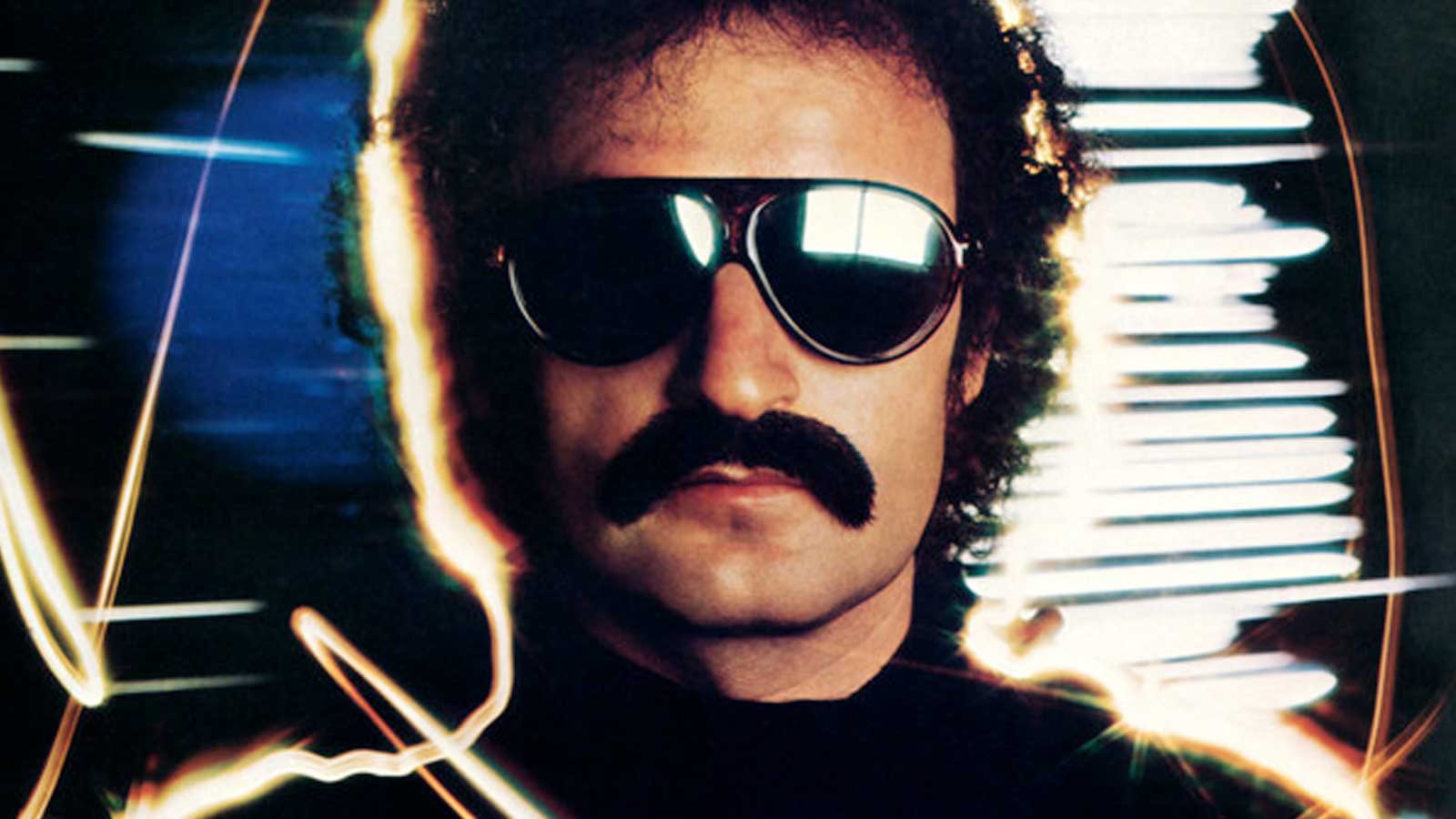
That, ultimately, was central to Moroder’s pursuit of a distinctive musical signature. Not just to make great records that sounded unlike anyone else’s, but records that were successful. Very successful. He did want critical acclaim, but he didn’t want critical acclaim alone. He wanted major hit records, and he wanted them on his own terms.
If truth be told, it was Donna Summer and the electronic disco sound of Giorgio Moroder that unequivocally ruled the airwaves. Disco may have been anathema to punk, but “I Feel Love” would arguably be the true soundtrack of 1977.
In reality, the song may have been a happy accident, but the team of Moroder, Bellotte, Summer, and Casablanca was probably the best possible group to have created that accident in the first place. They were creative, fast-moving, and responsive to what was happening in the market, with an open mind toward anything interesting or new. As Bruce Sudano remembers: “Donna, Giorgio & Pete were always looking to push the envelop. They weren’t complacent in doing the things they had just done. Donna was always excited to see what is next and what new gadget could be incorporated. That was how their minds worked”
So what if? What if “I Feel Love” had never been written or recorded, would the trajectory of dance music really have been different? By now, you’ll understand that the only honest answer is a resounding no. Given the way electronic instruments and recording techniques were evolving, it was only a matter of time before someone pushed them to their logical conclusion.
I’m convinced it would always have been a European team, simply because Europeans and Eurodisco producers were consciously aiming for the dancefloor, with the primary drive being to score hits rather than to make “serious” or canonical music. In theory, it could have been any number of European producers. What makes the combination of Giorgio, Donna, and Pete so unique, however, is that they brought together the best elements of all the traditions that had made dance music succesfull.
In that sense, it was inevitable that it would be them rather than someone else. But that inevitability does nothing to diminish the remarkable achievement of the song, the producers, or Donna Summer herself.
I’ll close with Bruce Sudano’s response when he was asked how he and his family feel about the way Donna Summer is seen today: “It Is gratifying. For all Donna’s psyches there was always an underlying struggle for a recognition that she honestly deserved”
I will return to “I Feel Love” and its connection to the disco subgenre of space disco one last time in a bonus episode, focusing on the synthesizers used in early dance music production and the genres they helped create.
💬 Call to Action
Do you hear “I Feel Love” as disco, electronic music, or something entirely outside genre?
Which artist or style do you most strongly connect back to?
And do you believe dance music history would truly look the same without it?
I’d love to read your thoughts in the comments.
Further reading (or should I say watching)
There are a number of interesting video’s/links :
So You Wanna Hear More ?
I thought you would !
It’s fun to write about music but let’s be honest. Music is made to listen to.
Every week, together with this newsletter, I release a 1 hour beatmix on Mixcloud and Soundcloud. I start with the discussed twelve inch and follow up with 10/15 songs from the same timeframe/genre. The ideal soundtrack for…. Well whatever you like to do when you listen to dance music.
Listen to the Soundtrack of this week’s post on MIXCLOUD
Or on Youtube :
So what’s in this week’s mix ?
This week’s mix goes almost full electro and space disco, with a heavy dose of Donna Summer and more than a few Giorgio Moroder productions. We open, inevitably, with “I Feel Love”, before moving seamlessly into the Midnight Express theme, “Chase” by Giorgio Moroder. Alan Parker wanted his own version of “I Feel Love” for the soundtrack, and you can clearly hear that Moroder delivered in a big way. Another Moroder track, “Utopia (Me Giorgio)”, alongside Donna Summer’s “Our Love”, completes the opening four of the mix.
And that’s not all. I’ve also included the Sparks sperm song “Tryouts For The Human Race”, one of Moroder’s finest productions, as well as his other electro diva, Suzi Lane, with “Ooh La La”.
Electrodisco takes the lead with “Magic Fly” by Space, “Ultimate Warlord” by The Immortals, and Cerrone’s “Supernature”. I close the mix with two deeper space disco cuts, The Black Devil Disco Club and Sylvia Love’s “Instant Love”.
Enjoy! 🎶
Remember the Buzzcocks? A brilliant band with a short career. Next week I’ll tell the story of what happened after the split, focusing on lead singer Pete Shelley and one of the remarkable songs he made with one of my favourite early eighties producers, Martin Rushent.
Wow! Interesting additional details! I didn't know the song was originally intended as a B-side. Also, this is the first time I've heard the Human League song. Love that band! Thanks!
Pe, your passion for all of this is truly amazing. My favorite of Gorgio is the love theme from Flashdance. I feel like that soundtrack work blended all the different aspects of his work and influences into something otherworldly.