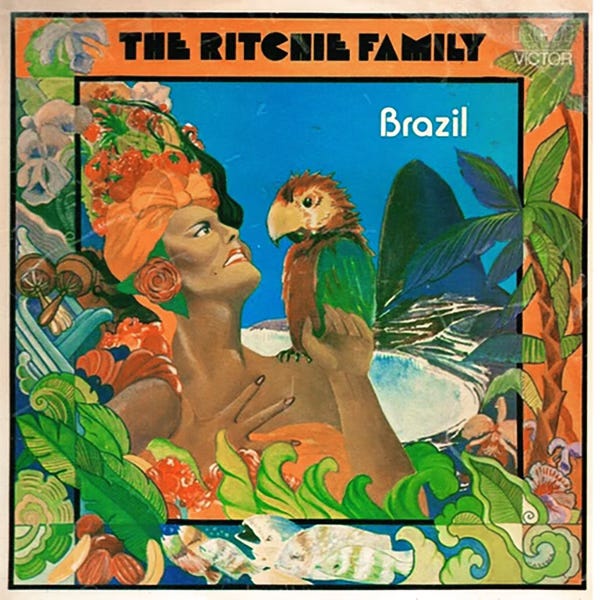
🇧🇷 From Paris to Philly: How “Brazil” by The Ritchie Family Set Disco on🔥and 🇫🇷 on It's Way to Become a Disco Powerhouse
The Twelve Inch 188 : Brazil (The Ritchie Family)
This week I’m chasing an answer to a question that’s been on my mind for a long time:
Why did French artists and producers play such a pivotal role in the birth of Eurodisco?
The list of French successes from that era feels endless, so why France, why then, and why did their influence fade so suddenly when disco began to die in the U.S.? Or… did it really fade at all?
When Saturday Night Fever turned disco from an underground movement into a billion-dollar industry, worth around $4 billion in 1978, European producers were already making their mark. The biggest dance hit of 1975 wasn’t American at all, but “Brazil” by The Ritchie Family: seven weeks at No. 1 on the Billboard disco chart and Top 20 on the Hot 100. It sounded pure Philly, recorded at Sigma Sound Studios with the MFSB/O’Jays/Harold Melvin crew.
But there was one twist: the record was produced by two Frenchmen: Jacques Morali and Henri Belolo.
This week, we’ll trace how their studio project became one of disco’s most successful acts, a “band” that changed members at will, but defined an era. We’ll also dive into the stories of Morali and Belolo themselves, and ask: what made France such a driving force in the early days of disco?
It’s dancing time, so grab your shoes, and let’s head to the dancefloor. Not in Paris just yet… but a little further south, in Casablanca, Morocco.
👋 Welcome, I’m Pe Dupre, thanks for stopping by.
This is The Twelve Inch, my newsletter about the history of dance music from 1975 to 1995, told one twelve-inch record at a time.
If this landed in your inbox because a friend forwarded it, I’d love for you to subscribe so you don’t miss the weekly episodes. Each one dives into a track, its story, and the culture around it.
And if you’re already enjoying the free posts, would you consider becoming a paid subscriber? Your support helps me keep researching, writing, and unearthing the stories behind the music.
🇲🇦 From Casablanca with Rhythm
I realise that apart from “disco”, the word you’ve probably read most often in my recent pieces is “Casablanca.”
There was my five-part deep dive into the legendary Casablanca Records, a look at Cher’s two disco albums for the label, and even a full breakdown of their 1970s release schedule.
But this week, Casablanca doesn’t refer to the record label, it’s about the actual city in Morocco.
And, as with so many stories in early dance music, and the transatlantic exchange between Europe and America, it all begins with World War II.
When the Germans sought control of North Africa, the U.S. launched Operation Torch in November 1942. General Patton captured Casablanca, then a French Vichy-controlled port city on the Atlantic coast. The result? Thousands of American GIs poured in, bringing not just troops and tanks, but American culture, music, and rhythm.
He’s the man, he’s the man with the master-plan : General Patton
Two boys born in Casablanca at that time, Jacques Morali and Henri Belolo, would grow up in that atmosphere. Immersed in American sounds from the very start, they later carried that influence into their own productions, shaping the future of disco itself.
🎹 The Frenchmen Who Fell for Philly
Henri Belolo was the elder of the two, born in 1936, and, like Jacques Morali, of Jewish Moroccan descent. He grew up surrounded by both American and African sounds before studying business in his hometown.
As Belolo himself explained:
In 1956, Belolo moved to Paris, where he met one of the titans of French music, Eddie Barclay, a familiar name from our Cerrone story. Barclay was one of the great movers and shakers of the French record business, licensing American hits for local release and building a powerhouse label (which remains a key part of Universal Music France today). It was the perfect example for Belolo and one he would follow with even greater success with his own label.
Belolo soon joined Polydor, one of France’s biggest labels, as an A&R man. There he refined his understanding of the business before eventually striking out on his own to found Scorpio Music in 1976.
Scorpio Music could fill an entire episode on its own, and perhaps it will one day. The label remains France’s No. 1 electronic and dance imprint, still run by the Belolo family under Henri’s son, Anthony Belolo. What makes Scorpio so fascinating is how it rose from the ashes of the disco backlash. While Belolo’s U.S. partners Casablanca and TK Records folded, Scorpio endured, and grew. It’s a glimpse of what might have been if Casablanca and TK had survived.
But let’s not get ahead of our ski’s. Time to meet the second protagonist.
Jacques Morali was born in 1947, also in Casablanca. He began his career working at a record shop in Paris’s Orly Airport, dreaming of stardom and launching a brief solo career as a singer while composing for other artists and orchestras.
At just 24, he became Artistic Director at Polydor, where fate, and music, brought him together with Henri Belolo.
Morali was obsessed with the sound of Philadelphia. Records by MFSB, The Three Degrees, The O’Jays, and Harold Melvin & the Blue Notes, lush orchestrations, sweeping strings, driving rhythms, all fascinated him. The magic of Sigma Sound Studios became his North Star.
Paris, of course, wasn’t just the city of lights, it was also the capital of fashion and, perhaps surprisingly, hairdressing. Many of Hollywood’s star stylists were French, including José Eber, “coiffeur” to Cher and Elizabeth Taylor. It was through Eber that Morali first heard about the Philadelphia sound, and fell under its spell.
Our man José!
So now we have two men:
one who had learned every trick of the trade and wanted to build something of his own,
and another who saw the world, not just France, as his stage, consumed by the sound of America.
You can probably guess what happens next. 😁
🏆 “Brazil”: A French Idea with a Philly Heart
The spark came one January evening in 1975, when Jacques Morali caught the film The Gang’s All Here on French television. In it, Carmen Miranda performs Ary Barroso’s 1939 samba classic “Aquarela do Brasil”, fruit-laden headdress, kaleidoscopic costumes, and all.
Morali was mesmerized. He saw it as the perfect song to give a Philadelphia-style makeover, lush strings, big rhythm section, and disco sheen, a summer hit waiting to happen.
The one, the only : Carmen Miranda (and some assorted fruits)
He called Henri Belolo, and two months later they were on a plane to Philadelphia.
At Sigma Sound Studios, Morali teamed up with local arranger Richie Rome (yep, he’s the origin of the name), a veteran of the Philadelphia International sessions. Together they blended Latin percussion, Philly strings, and a distinctly European sense of drama. The result was irresistible, sunny, seductive, and hypnotic, a 12-inch built for endless spins on the dancefloor.
And it wasn’t just a one-off experiment. Belolo quickly set up a new American production company, Can’t Stop Productions, with offices in New York and Philadelphia.
The Original
💃 The Family That Wasn’t
Despite the name, The Ritchie Family weren’t actually related, not by blood, anyway. The group was a studio creation.
When they recorded “Brazil”, and the album that followed, they didn’t envision a band with faces or personalities. The vocals came from the legendary “Sweethearts of Sigma”, Barbara Ingram, Carla L. Benson, and Evette Benton, the go-to session singers behind countless Philadelphia soul and disco records.
Only after “Brazil” became an instant success did Morali and Belolo decide to give the project a public identity. They assembled three seasoned Philly singers, Cassandra Wooten, Gwendolyn Oliver, and Cheryl Mason Jacks, to front the act.
The “family” was more concept than group, a flexible studio idea built around voices, vision, and vibe. It was a formula Morali would later perfect with his next creation: The Village People.
🌍 Why “Brazil” Became a Global Hit
“Brazil” was more than a dance record, it was an idea of escape.
In the grey aftermath of the 1973 oil crisis, people needed colour, fantasy, and light. The record delivered all three: carnival, sunshine, and pure joy pressed into vinyl.
In the U.S., disco was still taking shape, clubs were defining their sound, DJs were finding their flow. But in Europe, and especially France, producers already knew how to blend orchestral elegance with hedonistic energy.
“Brazil” became the perfect bridge between these worlds, a French-produced American record that felt equally at home in Saint-Tropez and Studio 54.
As Henri Belolo later explained:
Its success proved something crucial: disco could travel.
You didn’t need to be from Philly, Detroit, or New York to make people dance.
💡 France: The Other Disco Capital
France’s contribution to disco is often understated, yet the country played a crucial role in shaping what would become Eurodisco, and, in many ways, global disco itself.
I could list the names here, and I will, in future episodes, but the more interesting question is why France?
What made French culture, music industry, and temperament such fertile ground for the sound that would soon conquer dancefloors around the world?
First, let’s set the record straight. The idea that France briefly jumped onto the global music stage during a genre it didn’t invent, only to vanish when disco hit a wall in America, is simply wrong.
Nothing that influential ever appears out of nowhere, and nothing that deep-rooted disappears without a trace.
French artists, or rather, composers, had long shaped European popular music. France also gave us the very concept of the “discothèque”: the nightclub that replaced live bands with recorded music. Our very word “disco” comes from it. And a place built around records, of course, demanded music made for records.
Another factor was radio regulation. French stations were required to play a minimum percentage of local music, which led to countless French-language versions of international hits. As I mentioned in the Sheila & Spacer episode, this policy deeply influenced how the French industry evolved. Meanwhile, the cultural establishment remained fixated on the chanson, the lyrical, poetic song seen as the essence of Frenchness, often dismissing the idea that France could have its own authentic rock or pop tradition.
While Germany had Krautrock, a proud reinterpretation of Anglo-American rock through a European lens, France largely didn’t, at least not at the same scale. There were exceptions, of course. One was Jean-Michel Jarre, who built an international career in electronic music and proved that French composers could think, and sound, globally.
This was the big international breakthrough of the Ritchie Family and the lead single of their second album
Ironically, it was precisely this difference, France’s tendency to cherish its own musical identity, that made it such fertile ground for disco.
As Henri Belolo later explained:
In that blend of melody and rhythm, local pride and global ambition, lay the secret of the French disco sound.
🚀 After “Brazil”: Building the Disco Universe
Following “Brazil,” The Ritchie Family released a series of themed albums, “Arabian Nights,” “Life Is Music,” and “African Queens.” Each fused disco grooves with grand, exotic, or historical concepts.
My favourite Ritchie Family escapism (as I will explain in a coming episode of Vital Records)
There’s a deeper story behind those themes, and what they reveal about the diverging paths of European versus American disco, one I’ll explore in future deep dives. For now, it’s enough to say that these albums captured exactly what people craved in the mid-’70s: escape, fantasy, and glamour. Morali and Belolo understood that perfectly.
The group’s lineup remained stable for the first four albums, but as the singers began asking for more creative input, wanting to shape their image and ideas, they were swiftly replaced by three new voices.
As Cassandra Wooten later recalled:
“Over the years we were with Jacques,” says Cassandra, “ the tension had increased to a point where we didn’t have good feelings toward him and I guess he didn’t feel good about us. We didn’t know how much the situation had escalated until it was time to renew our contacts”
Everything about the project was tightly controlled. And that’s part of why The Ritchie Family is less widely remembered today than someone like Donna Summer. Constant lineup changes and the anonymity of the singers made the project feel faceless, a perfect example of how disco was often a producer’s genre more than an artist’s one.
Meanwhile, Morali’s ambitions were already shifting. In 1977, he met a young singer named Victor Willis and created The Village People, a group built entirely on fantasy, archetypes, and dancefloor spectacle, powered by the same studio system that had birthed “Brazil.”
Without “Brazil,” there might never have been “YMCA.”
The blueprint, studio singers, visual storytelling, and irresistible hooks, was born with that first French-American experiment.
🎛️ Would Eurodisco Have Happened Without Jacques Morali & Henri Belolo?
Probably not in the same way. But Jacques Morali proved that European producers could match, and sometimes even surpass, the lushness and sophistication of American disco.
What I admire most in this story is the audacity. Two Frenchmen, barely fluent in English, flying to Philadelphia to record with the best in the business, it was a bold gamble that paid off spectacularly.
.
It worked because of who they were and when they were. Their Jewish heritage, their Casablanca roots, and the postwar global outlook of their generation all helped them think outside the box. On their own, they might not have achieved it. But together, the business instinct of Henri Belolo and the flamboyant creative energy of Jacques Morali, they made magic.
And as so often happens, their success opened doors. It showed other French producers, composers, and arrangers what was possible. Success breeds success, and Morali & Belolo became key catalysts for the Eurodisco explosion that followed.
They didn’t just imitate the Philly Sound, they translated it for European ears, turning disco into a truly global language.
That leaves one last question:
Why did the French dominance seem to end when disco died in the U.S.?
It’s not an easy one to answer. Part of it lies in the economic downturn and stricter nightlife regulations that hit France in the early 1980s. But the deeper reason is cultural. The very thing that fueled France’s disco strength, its chanson tradition, its love of melody and lyricism, became a limitation when musical tastes shifted toward colder, more electronic sounds.
Yes, there was French synth-pop, but it never had the same distinct identity that French disco did a decade earlier. It would take the better part of the ’80s and ’90s before France reclaimed its place in dance music.
And when it did, the circle closed. As the late ’90s brought a new disco revival through house music, it was again the French who led the charge, Stardust, Cassius, Daft Punk, artists who proudly carried that same spark of elegance, rhythm, and audacity into a new age.
But that… is a story for another episode.
💬 What Do You Remember About “Brazil”?
Did you first hear “Brazil” in a club, on the radio, or maybe years later on a compilation? Do you remember those lush strings, that hypnotic beat, or the way the record made you feel like summer was just around the corner?
👇 Share your memories in the comments
Further reading (or should I say watching)
There are a number of interesting video’s/links :
So You Wanna Hear More ?
I thought you would !
It’s fun to write about music but let’s be honest. Music is made to listen to.
Every week, together with this newsletter, I release a 1 hour beatmix on Mixcloud and Soundcloud. I start with the discussed twelve inch and follow up with 10/15 songs from the same timeframe/genre. The ideal soundtrack for…. Well whatever you like to do when you listen to dance music.
Listen to the Soundtrack of this week’s post on MIXCLOUD
Or on Youtube :
So what’s in this week’s mix ?
This week we’re going full Philly disco. In 1975–76, the Philadelphia sound dominated dancefloors everywhere. Many of the tracks in this week’s set were recorded at Sigma Sound Studios, featuring top Philly session players like Earl Young, Norman Harris, and Ronald Baker.
Expect lush strings, bright horns, and plenty of instrumental tracks, the signature sound of the era. You’ll hear the Salsoul Orchestra, THP Orchestra, Love Unlimited Orchestra, and Armada Orchestra, alongside Faith, Hope & Charity, The Intruders, and Carol Williams.
There are two versions of the same song, “We’re On The Right Track”, first by Ultra High Frequency, then by Blue Magic. You’ll also catch Cameo’s first dancefloor hit, long before their P-Funk years, and we wrap up with an early Eurodisco gem: Belgian act Crystal Grass with “Crystal World.”
That one flows perfectly into its “inspiration”: the Isaac Hayes classic “Theme From Shaft.”
Enjoy the ride. 🎶
Next week, Mary Isobel Catherine Bernadette O’Brien takes centre stage. An English singer with one of the most beautiful blue-eyed soul voices ever, she turned Burt Bacharach’s songs into pure magic, her versions might just be the definitive ones.
She enjoyed major success on both sides of the Atlantic, but somewhere in the 1970s her career faded… until a brief and very surprising comeback in 1989, when she scored one of the biggest dance hits of the year.
Her stage name? I’ll let you guess, and if you don’t know, I’ll tell you all about her in next week’s episode.


I ❤️ NY
Totally forgot about this one! Listening to it again it really was quintessential disco - almost too much so! Cool production though.