

The audio only version:
I have always been a Donna Summer fan. She was the first artist I followed religiously, like only a teenager can follow his or her favorite artist. I wanted to know everything, listened to all her records, and even kept all the articles and photos I found of her in magazines and newspapers in a scrapbook. From an early age I was reading the liner notes on the albums, so I knew her producer’s name, Giorgio Moroder, and he was, for me, a genius.
I often wondered how I became so hooked on disco at the end of the seventies. And frankly I don’t really know what tipped me over. But it could very well have been Donna Summer.
Today we see Donna Summer and Giorgio Moroder as the talented artists they are or were, but at the time that certainly wasn’t the case. Saying to your friends that you were a fan of Donna Summer was setting yourself up for ridicule. Disco wasn’t taken seriously by my peers, and Donna Summer was the personification of everything that was supposedly wrong with disco, superficial, plastic, effeminate, and plainly wrong.
Now I’ve never been one to back down in the face of a little adversity. In fact it usually emboldens me more, which might be one of the reasons I loved Donna so much, but that’s a story for another time. But I did get angry every time I read in a newspaper or magazine, or heard on the radio, how Giorgio Moroder and Donna Summer by extension were nothing more than frauds. It was the “machines” that created the music, therefore it wasn’t worth being called good music.
I remember we had to do a speech about a chosen subject in Dutch class, and I chose Giorgio and Donna. The point I tried to make was to convince everybody of the errors of their viewpoint. I even brought my cassette recorder and presented them with “proof” in the form of small excerpts of Giorgio Moroder and Donna Summer productions. Suffice to say, I didn’t convince anybody that afternoon. But it felt good.
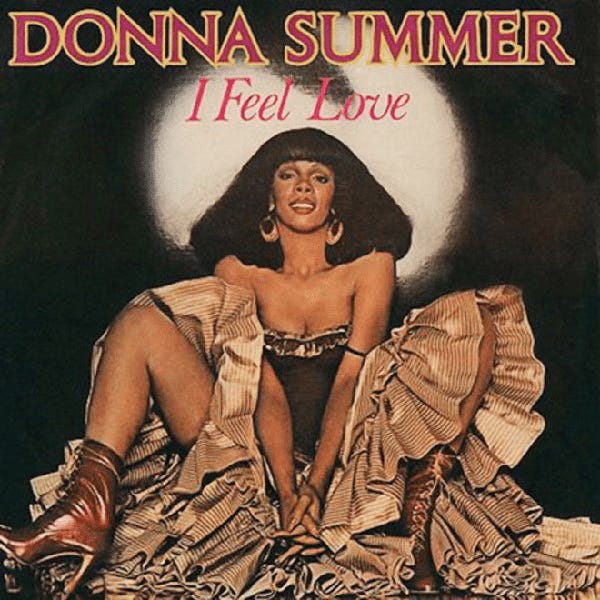
You really can’t do better than Donna Summer’s “I Feel Love” if you’re looking for a song that had the most influence on the evolution of dance music. Not only does it sound as current today as it did 49 years ago, but “I Feel Love” influenced or even kickstarted almost everything that came after it.
There’s a clear distinction to be made between the period before “I Feel Love” and the one after. Pretty strong stuff for a song that the producer and record company originally considered only good enough to be the B-side to another song nobody even remembers today.
When Brian Eno heard the song for the first time, he was recording an album with David Bowie in Berlin and told him that “he had heard the future”. And he was right.
“I Feel Love” was the brainchild of Giorgio Moroder and his team in their basement studio in Munich. It would be the final push that catapulted Donna Summer to superstardom and disco queen extraordinaire.
So episode 200 will be devoted to this phenomenon and the questions I wanted answered. Where did it come from? Was Giorgio a brilliant inventor or a keen observer? Why did “I Feel Love” reverberate so strongly and have such lasting influence? And let’s indulge in a bit of alternative history and try to answer the question, suppose “I Feel Love” hadn’t been written and recorded, would dance music have evolved differently?
We’ve got a lot to cover. Too much for one episode. So episode 200 is a two-parter. Today, part 1 and on Sunday I’ll drop the second part.
Let’s dive in.
👋 Welcome, I’m Pe Dupre, thanks for stopping by.
This is The Twelve Inch, my newsletter about the history of dance music from 1975 to 1995, told one twelve-inch record at a time.
If this landed in your inbox because a friend forwarded it, I’d love for you to subscribe so you don’t miss the weekly episodes. Each one dives into a track, its story, and the culture around it.
And if you’re already enjoying the free posts, would you consider becoming a paid subscriber? Your support helps me keep researching, writing, and unearthing the stories behind the music.
🎹 Was Electronic Dance Music Invented by Giorgio?
A lot of people assume that synthesizers first entered dance music through disco, and that “I Feel Love” started it all. But synthesizers weren’t exactly new by 1977. By then we were already familiar with Jean Michel Jarre, Tangerine Dream, and Vangelis.
Their tradition, however, was steeped in prog rock, with album-side-filling compositions, serious music for serious people. Music that was made after taking drugs to become the soundtrack for taking more drugs... Not really pop chart material. Jarre came close to pop, but most of the rest leaned toward ambient mood music and electronic space music.
At the same time in the US, synthesizers were already being used in jazz fusion by artists like Herbie Hancock and in R&B by Stevie Wonder, stories we’ll return to in future episodes.
🇪🇺 Europe, Electronics & a Blank Page
Pop music in the 1970s was an Anglo-American hegemony, but electronic space music was dominated by Europeans. The main reason was simple, most of the music was instrumental, so working in English as a second language, or singing in a native tongue, was no disadvantage at all. It was a level playing field and the Europeans took the advantage.
In Germany, Krautrock went even further by starting from a blank page instead of starting from the Anglo-American blues tradition. Various theories exist as to why West Germany became such an early trailblazer, but many converge on the idea that with their musical heritage tainted by associations with the Nazi era, and with American and British imports filling the void, young German musicians had little choice but to start again from scratch.
Krautrock’s common elements included hypnotic 4/4 rhythms, extended improvisation, and early synthesizers.
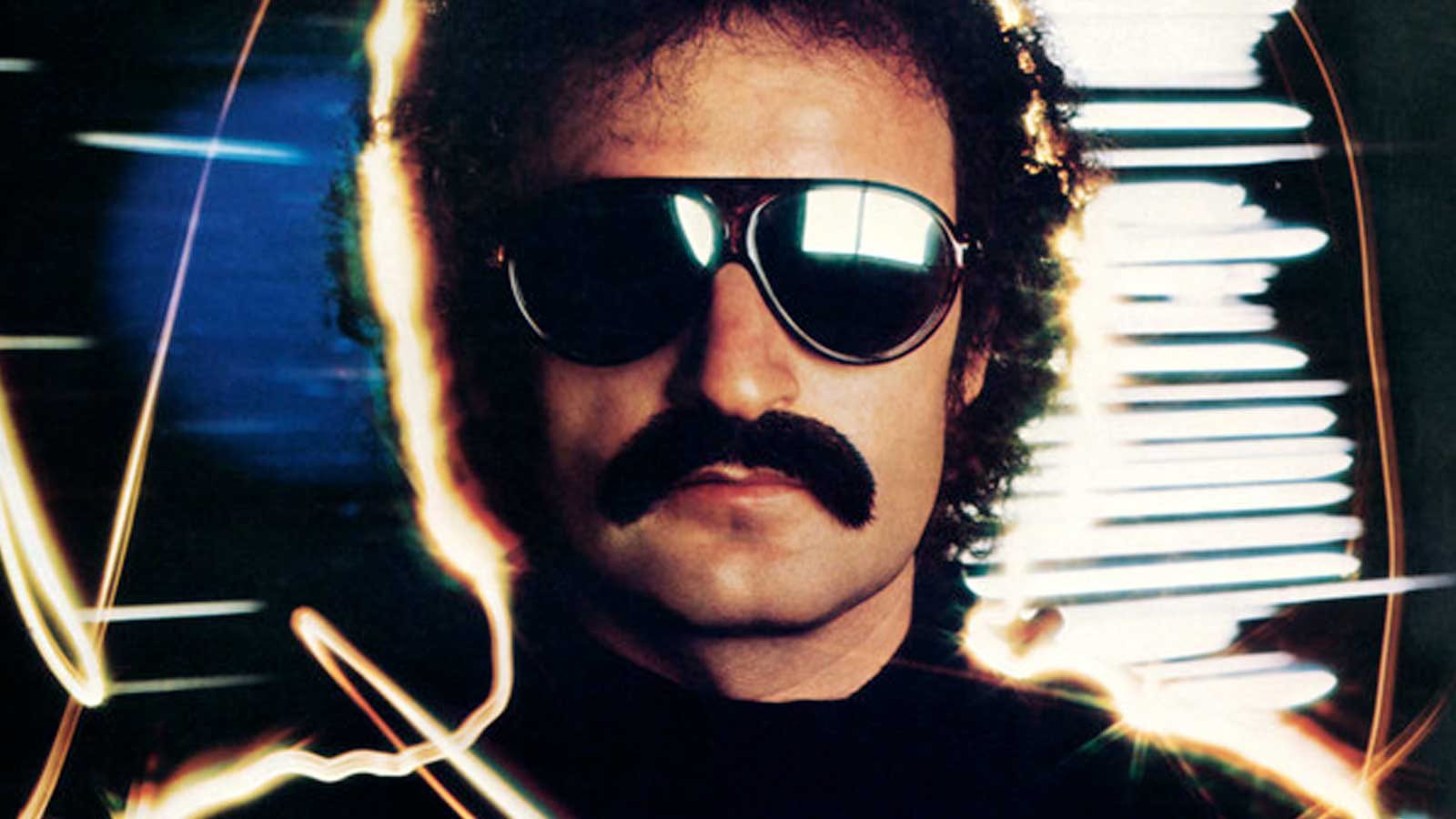
Out of this electronic strain grew both Kraftwerk and Giorgio Moroder. Writers have long noted that Moroder’s extended disco pieces for Donna Summer translated Krautrock’s hypnotic, motorik, long-form qualities into a club context, a steady machine-like pulse, gradual textural shifts, and a sense of endless forward motion reminiscent of Can and Neu!.
🎯 Hits vs Purism
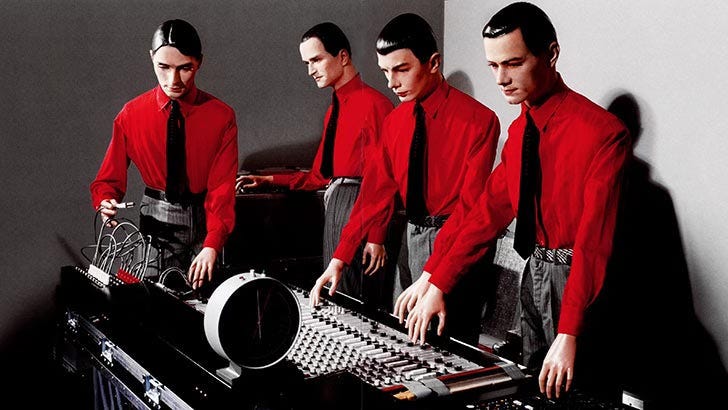
But while Kraftwerk went fully electronic to escape the morose contemplations of Tangerine Dream or the pompous pounding of Keith Emerson, Giorgio Moroder went in another direction. He wanted to score hits.
Kraftwerk were looking for new applications, new purposes, new pop. It’s probably no surprise that the two camps didn’t quite like what the other was doing.
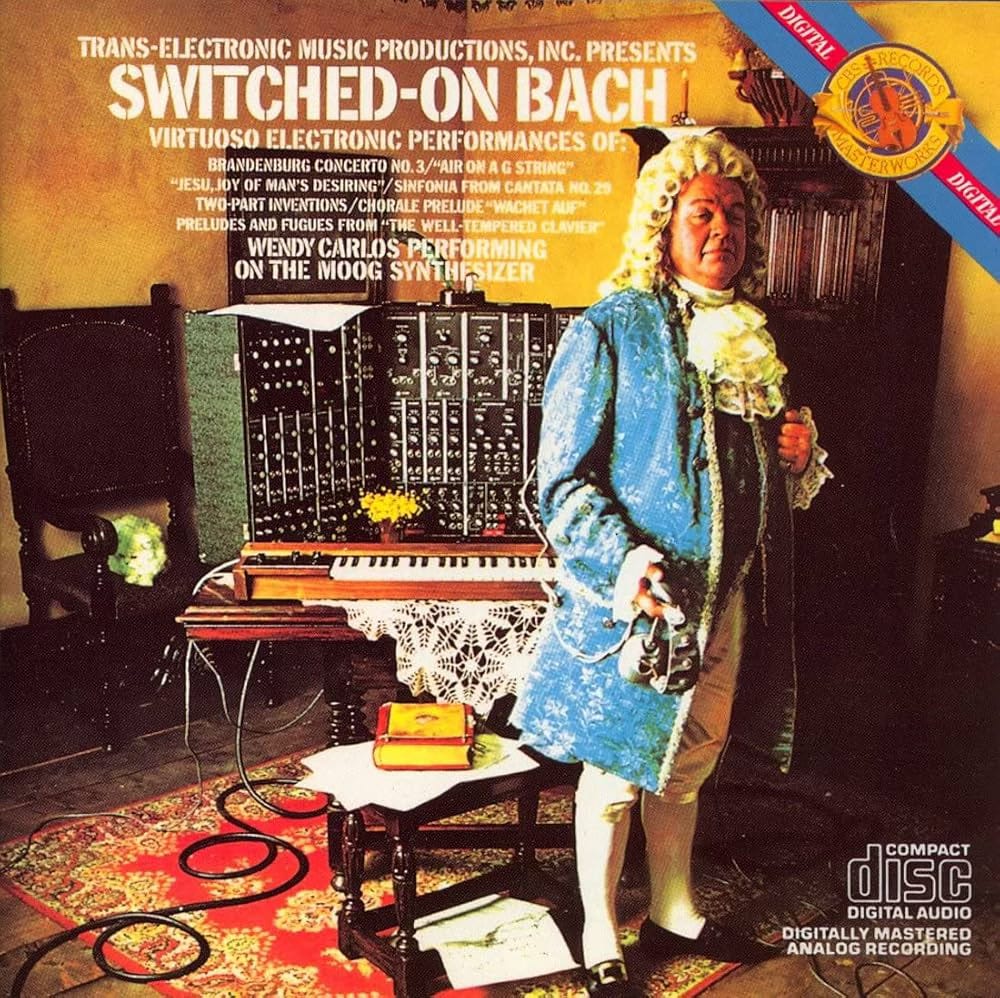
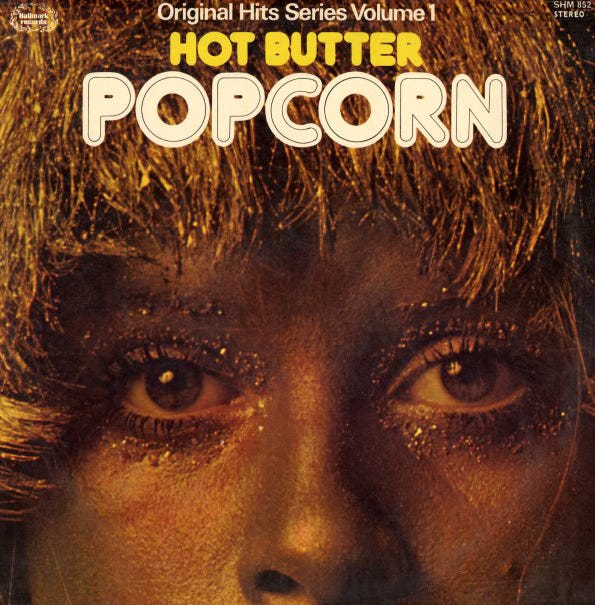
Giorgio’s love for synthesizers wasn’t a given. Like many others, he was intrigued by Wendy Carlos’ “Switched-On Bach” electronic remake of classical melodies, which led to his writing & producing “Son Of My Father”, a massive hit for Chicory Tip and the first number one single with a Moog synth in a prominent role. And there was “Popcorn”, one of the most infuriatingly catchy novelty hits ever created.
Strangely enough, none of this led to a massive adoption of synthesizers. Early Moogs were complicated and extremely expensive.
💃 Munich, Disco & Ambition
Moroder’s real interest lay in what was happening stateside, the first signs of disco. His goal wasn’t just to make records that didn’t sound like anyone else’s. They had to be successful. Very successful.
What Krautrock purists had thrown out, pop and Philadelphia-style R&B, Giorgio added back in. His emphasis was international. By calling it disco, he confirmed it.
He would say, “The disco sound is not an art or anything so serious. Disco music is made for dancing”
👤 Giorgio Moroder, The Team Builder
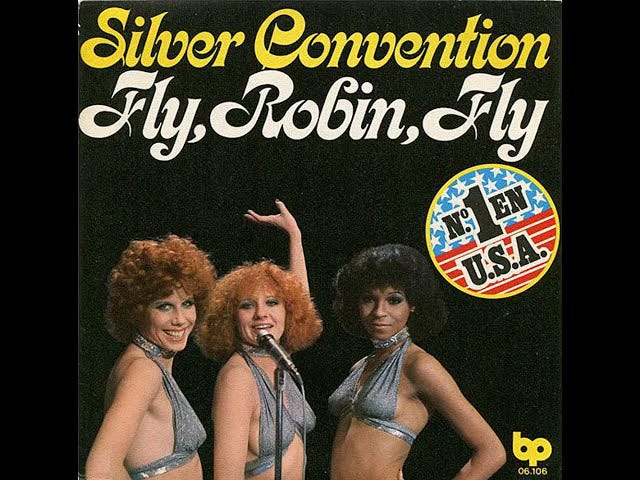
Giorgio Moroder isn’t German by birth. He’s Italian, raised in the Alpine valleys of South Tyrol. He began pursuing his own career but soon shifted toward writing and producing for others.
After time in Berlin, he settled in Munich, where he set up Musicland Studios in the basement of an apartment block. Inside was a remarkable team.

Most significant was Pete Bellotte, an English expatriate, who had toured the German nightclub circuit as a guitarist of a band that never enjoyed a breakthrough. Pete created song concepts and contributed heavily to musical and production ideas. He was the one who spotted Donna Summer’s vocal gifts.
There was man-machine drummer Keith Forsey, keyboardists Thor Baldursson and Harold Faltermeyer, engineer Jürgen Koppers, and Robbie Wedel, who understood the inner workings of the Moog synthesizer and was instrumental in shaping the sound palette of “I Feel Love”.
Keith Forsey later said, “Giorgio Moroder was great at delegating and finding talents that were compatible. But he was the leader and you had to follow”
🎤 Donna Summer, The Perfect Hybrid
Giorgio later explained how he first met Donna Summer:
That call came only months later.
You might not expect it, but Boston-born LaDonna Gaines, started her career fronting a rock group, Crow, before moving to Europe for musical work. She lived, initially, in Vienna and married an Austrian actor named Sommer, adapting the name as her artist identity.
What’s fascinating is why she chose Germany and Austria rather than London. The answer lies in her upbringing. Her father was stationed in Germany with the US military. She spent much of her youth there and spoke fluent German.
Crucially, Donna was raised outside the R&B tradition. She sang in church, yes, but her roots were as much European as American. This explains her work in rock and musical theater. So she wasn’t your typical afro American artist.
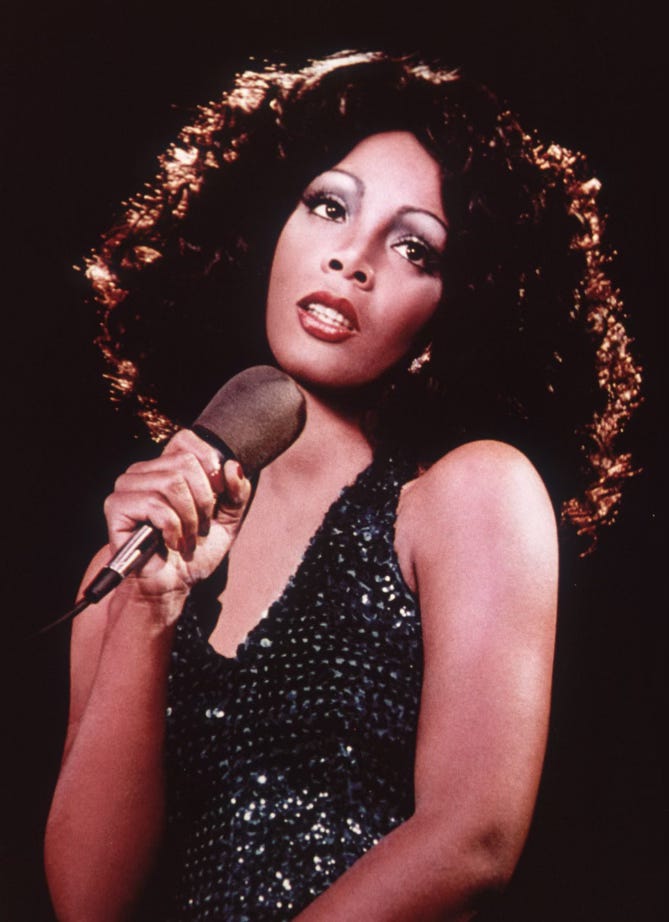
She was the ideal hybrid to front Eurodisco. I believe this is the most important element in her destined success.
💿 Early Success & A Dangerous Image
Through session work, Donna arrived at Musicland Studios and formed a partnership with Giorgio and Pete. Early releases were modest European successes.
Then came “Love To Love You Baby” in late 1975. It was huge, but it boxed Donna into the role of “queen of sex rock”, not an ideal foundation for a lasting career. The follow-ups did okay, but they were conventional. But then came the song that would set her on another trajectory…
👊The End Of Part 1
In Part 2, we go down into the Munich basement where “I Feel Love” was actually built, step by step, gadget by gadget, human by human. We’ll follow the chain reaction from Pete Bellotte’s literary concept and Robbie Wedel’s Moog wizardry to Keith Forsey’s man-machine precision, and then the moment Donna arrives and turns cold circuitry into something intimate, weightless, almost unearthly.
We’ll also track how a track that “didn’t mean anything” to its creators became a full-on dancefloor emergency, how Casablanca flipped it from B-side to A-side, and why clubland heard the future before radio did. And then, the aftershock: the “machine music” backlash, the gay dancefloor embrace, Brian Eno walking into the studio with it and telling Bowie, “Search no more I just found the sound of the future”, and the long shadow it casts over Hi-NRG, Italo, house, techno, trance, and everything that came after.
So if Part 1 was about the people and the setup, Part 2 is about the moment it all ignites, and why we’re still living in the world “I Feel Love” predicted.
Part 2 :

💬 Call to Action
When did you first hear “I Feel Love”, and did you realise at the time that it was something entirely new?
Do you remember disco being ridiculed, or defended, in your own circle?
And was Donna Summer already more than “just disco” for you at this point?
Let me know in the comments, and on Sunday we’ll continue with Part 2, where everything truly changes.
Further reading (or should I say watching)
There are a number of interesting video’s/links :
So You Wanna Hear More ?
I thought you would !
It’s fun to write about music but let’s be honest. Music is made to listen to.
Every week, together with this newsletter, I release a 1 hour beatmix on Mixcloud and Soundcloud. I start with the discussed twelve inch and follow up with 10/15 songs from the same timeframe/genre. The ideal soundtrack for…. Well whatever you like to do when you listen to dance music.
Listen to the Soundtrack of this week’s post on MIXCLOUD
Or on Youtube :
So what’s in this week’s mix ?
This week’s mix goes almost full electro and space disco, with a heavy dose of Donna Summer and more than a few Giorgio Moroder productions. We open, inevitably, with “I Feel Love”, before moving seamlessly into the Midnight Express theme, “Chase” by Giorgio Moroder. Alan Parker wanted his own version of “I Feel Love” for the soundtrack, and you can clearly hear that Moroder delivered in a big way. Another Moroder track, “Utopia (Me Giorgio)”, alongside Donna Summer’s “Our Love”, completes the opening four of the mix.
And that’s not all. I’ve also included the Sparks sperm song “Tryouts For The Human Race”, one of Moroder’s finest productions, as well as his other electro diva, Suzi Lane, with “Ooh La La”.
Electrodisco takes the lead with “Magic Fly” by Space, “Ultimate Warlord” by The Immortals, and Cerrone’s “Supernature”. I close the mix with two deeper space disco cuts, The Black Devil Disco Club and Sylvia Love’s “Instant Love”.
Enjoy! 🎶
Sunday I’ll drop the second part of this story. The stage is set. It’s time the action unfolds
Donna Summer was my first concert. I was 10 years old. My mother dragged me to see her. She was phenomenal. Never forgot that. Did not know “I Feel Love” is what shot her into stardom. Amazing. Thank you for this.
Awesome backstory on Moroder and Summer, where they came from and how they happened to end up in Germany together. Really looking forward to part 2!