

🚦The Missing Chapter In Detroit’s Music History
When researching this newsletter, I almost inevitably end up back in late seventies New York.
If you’ve been hanging around The Twelve Inch for a while, you already know why. The city sits at the center of so many musical revolutions that shaped dance music between 1975 and 1995. Disco, hip-hop, club culture, remix culture, the rise of the DJ, New York often feels like the place where everything started.
But every time I disappear into another Manhattan nightclub story or another Larry Levan rabbit hole, the same question eventually pops into my head.
What was happening everywhere else?
Because while New York may have been the epicenter, the rest of America certainly wasn’t sitting still.
We’ve already visited some of those other scenes together. Philadelphia and the Philly Sound. Miami and T.K. Records. San Francisco and Los Angeles when we explored Sylvester and Casablanca Records. Chicago keeps returning too, although usually because of one infamous moment, the Disco Demolition Night.
And then there’s Detroit.
Not Motown-era Detroit, that one falls outside the scope of this newsletter. And by the early seventies, Motown had largely moved operations to Los Angeles. And not techno-era Detroit either. We all know what would happen there in the later eighties.
But what happened in between?
How exactly did Detroit travel from Motown to techno?
That missing chapter is where this week’s story begins.
And our guide into it is a one-hit wonder you probably know, even if you don’t immediately recognize the title.
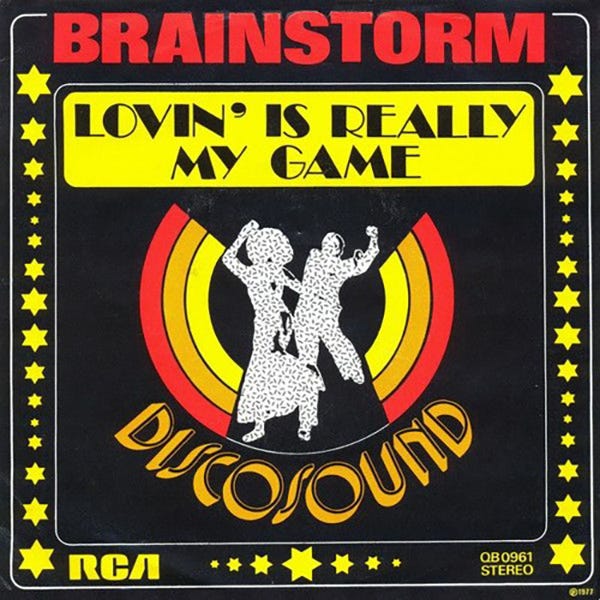
Lovin’ Is Really My Game by Brainstorm.
The kind of record that starts playing and instantly triggers recognition.
“Oh that one.”
👋 Welcome, I’m Pe Dupre, thanks for stopping by.
This is The Twelve Inch, a community about the history of dance music from 1975 to 1995, told one twelve-inch record at a time.
If this landed in your inbox because a friend forwarded it, I’d love for you to subscribe so you don’t miss the weekly episodes. Each one dives into a track, its story, and the culture around it.
And if you’re already enjoying the free posts, would you consider becoming a paid subscriber? Your support helps me keep researching, writing, and unearthing the stories behind the music. And You’ll get access to the weekly B-side post: the full archive and extra Subscriber Only Posts
💿 One Hit Wonder… Or Not Quite?

I called Brainstorm a one hit wonder in this week’s intro. That’s not entirely true.
Yes, Lovin’ Is Really My Game was by far their biggest success. But the group actually placed several singles on the R&B charts and even managed another Top 30 dance hit afterwards. The problem was that none of those records came remotely close to the impact of Lovin’ Is Really My Game.
Timing mattered. A lot.
But we’ll get to that.
Brainstorm were a large Detroit band built around founder Chuck Overton. Nine members large, they looked much more like a traditional funk or soul collective than a sleek disco studio project. A few names immediately stand out when you look at the lineup.
One is Treaty Womack. The surname instantly made me wonder if there was a connection to Bobby Womack or Womack & Womack. After some digging though, I couldn’t find any real link.
The other name is much more significant.
Deon Estus.

Yes, that Deon Estus, later bassist for Wham! and George Michael. The same Deon Estus who would briefly emerge as a solo artist in 1988 with Heaven Help Me.
Brainstorm were signed to Tabu Records, the label run by the legendary Clarence Avant (More on him in episode 177 on the S.O.S. Band and Just Be Good To Me)
🎹 Groove and Innovation: How "Just Be Good To Me" and the S.O.S. Band Helped Shape Synth-Funk

One question I’ve often asked myself is: why disco? Why did I fall for it, when nearly all my peers were pledging allegiance to rock, usually of the heavy metal variety?
At the time, Tabu was still finding its identity. In the eighties it would become one of the defining homes of sophisticated synth-funk and modern R&B through acts like The S.O.S. Band, Alexander O’Neal and Cherrelle. But in 1977, none of that existed yet.
And initially, the label didn’t seem entirely sure what to do with Brainstorm either.
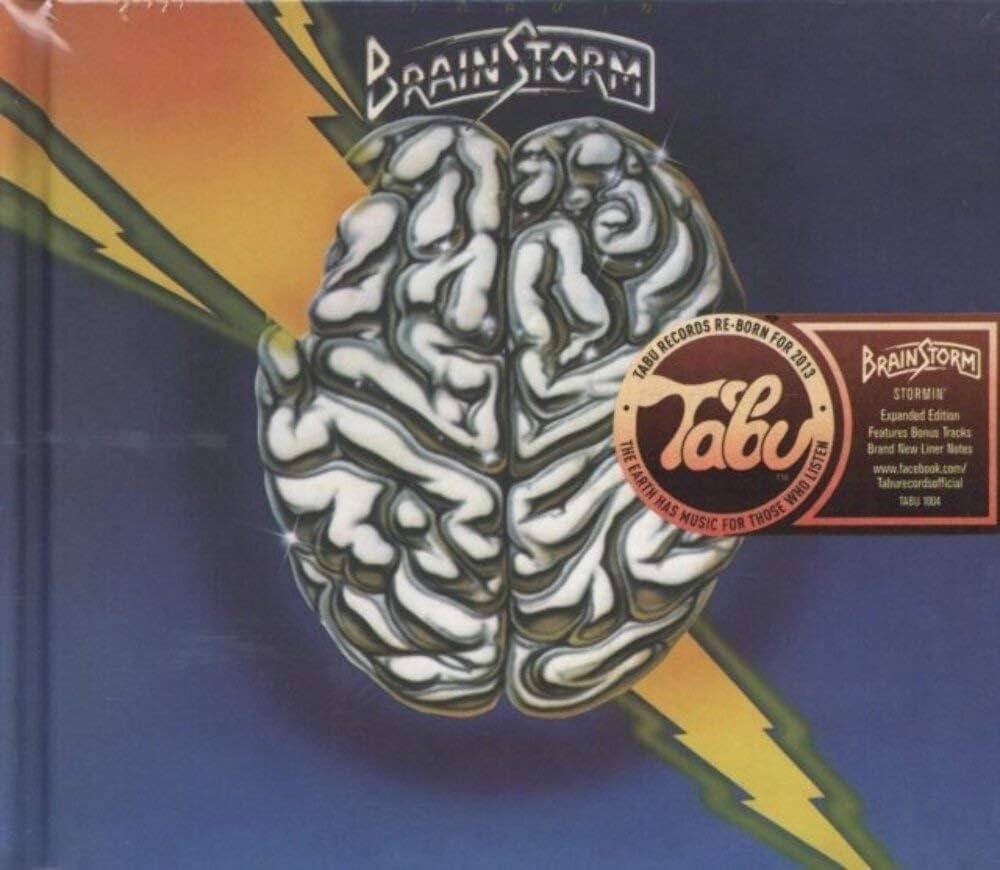
Their first single, Wake Up And Be Somebody, didn’t exactly set the charts on fire. Everything changed when Tabu released a remixed twelve-inch version of Lovin’ Is Really My Game. Suddenly, Brainstorm had a hit. And for a brief moment, it looked like the band might become one of disco’s major crossover acts.
🪩 The Moment Disco Exploded
To understand why Lovin’ Is Really My Game broke through, you have to look at when it appeared.
The second half of 1977 changed disco forever.
Saturday Night Fever exploded into popular culture and transformed disco from a thriving club movement into a gigantic mainstream industry. By 1978 disco had become a four billion dollar business.
Everybody wanted in.
Labels rushed to sign acts. Studios rushed to record disco tracks. Entire careers were redirected overnight toward the dancefloor. And once the floodgates opened, competition became brutal.
Brainstorm arrived just before the tidal wave fully hit.
That timing mattered enormously.
Lovin’ Is Really My Game had enough space to break through before the market became overcrowded with disco product from every imaginable direction. Afterwards, things became much harder, especially for smaller labels like Tabu and newer acts without massive promotional machinery behind them. Their second album already showed the problem clearly.
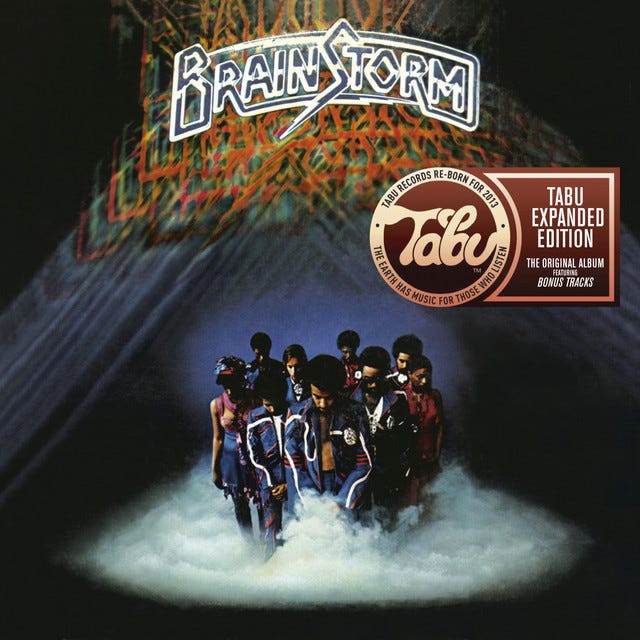
Brainstorm’s second album “Journey To The Light”
Instead of doubling down on the dancefloor, Brainstorm moved back toward pure R&B. And this brings us to something we’ve encountered several times before in The Twelve Inch. A lot of African American artists did not initially see disco as the destination.
They made soul music. Or funk music. Or R&B.
If the records also worked on the dancefloor, great. But unlike the European producers flooding the market at the same moment, many American R&B acts were not building records specifically for club culture.
That difference became crucial by 1978.
European producers increasingly approached disco almost scientifically. The dancefloor was the entire objective. Everything revolved around momentum, BPM, arrangement and physical movement. And that’s exactly where Brainstorm suddenly found themselves caught between two worlds.
⚡ Why Lovin’ Is Really My Game Worked
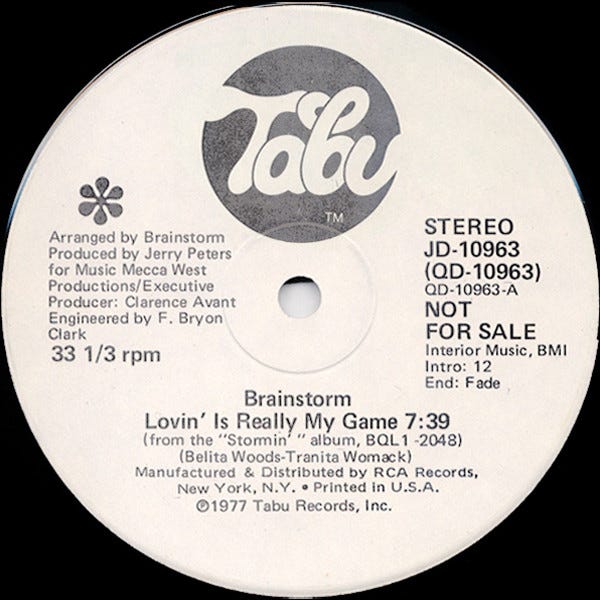
While compiling this week’s companion mix, something suddenly jumped out at me.
The BPM. (Beats Per Minute)
Lovin’ Is Really My Game runs at around 138 BPM.
That’s fast.
Very fast for an R&B-rooted disco record in 1977. And the more I listened, the more something became obvious. This record sits right on the border between American funk-driven disco and the emerging Eurodisco and Hi-NRG sound that would dominate the years afterwards.
It almost accidentally predicts where dance music was heading next.
That’s probably the real secret behind the record. It worked simultaneously in multiple club environments. It fit inside predominantly Black dance clubs because of its funk and soul roots. But it also had enough energy, drive and speed to work in gay clubs increasingly embracing more aggressive Hi-NRG rhythms.
That combination was rare.
And Brainstorm never quite found it again. Their second album lost much of that dancefloor urgency. By the time they corrected course on their third album with tracks like Hot For You, the landscape had already changed again.
Hi-NRG was becoming colder, sharper and far more electronic. The world was moving toward sequencers, synthesizers and machine-driven rhythms. Brainstorm still sounded like a brilliant live band. Unfortunately for them, disco was evolving at frightening speed.
And as The Twelve Inch keeps proving over and over again, dance music constantly reinvented itself, often by accident.
🏭 Detroit’s Forgotten Disco Story
What makes Brainstorm truly fascinating though is not just the record itself. It’s what the record reveals about Detroit. Because after Motown left for Los Angeles in 1972, Detroit’s music culture did not disappear.
It simply moved underground.
Into clubs. Into DJs. Into after-hours spaces. Into dancefloors.
Detroit followed New York’s example while developing its own variation of club culture. DJs like Ken Collier became hugely important figures in shaping local nightlife and dance music culture. Venues like The Chessmate and The Factory became laboratories for what would eventually evolve into Detroit techno.
But here’s the strange thing. This entire period is often barely discussed. Music history tends to jump directly from Motown to techno as if Detroit simply went silent for more than a decade. That couldn’t be further from the truth.
There were massive disco parties. Thriving after-hours clubs. A flourishing underground dance culture. New Wave acts passing through the city. DJs experimenting with records and rhythms in ways that would eventually influence an entire generation of future techno pioneers.
Detroit’s disco years became the missing bridge between soul and machine music. And somehow that story largely disappeared beneath the global success of techno that followed. Which is exactly why records like Lovin’ Is Really My Game matter.
Not just because they’re great dance records.
But because they reveal entire forgotten worlds hiding in plain sight.
🎧 Why This Record Still Matters
Lovin’ Is Really My Game perfectly captures a moment of transition.
It still carries the warmth of seventies funk and soul, but you can already hear dance music accelerating toward something more electronic, more European, more mechanical and eventually more futuristic. In hindsight, that makes Brainstorm sound surprisingly important.
Not because they became superstars. But because they accidentally landed in the middle of a musical crossroads.
And those crossroads are often where the most fascinating stories happen.
This Week’s B-Side 🎁
This week’s subscriber-only B-Side goes much deeper into the forgotten Detroit dance scene between Motown and techno.
We’ll explore:
The clubs and DJs shaping Detroit nightlife
The city’s overlooked disco and New Wave culture
Other Detroit dance records from the seventies
How Detroit’s underground scene laid foundations for techno
and a guided crate-digging dive through some fantastic lost Motor City dancefloor gems
Because the more I researched this story, the more it became clear that Detroit’s “missing years” may not have been missing at all.
They were simply ignored.
The B-side is where we go deeper.
It iIt’s paywalled, but for the price of 8 premium coffees, you get:
a full year of B-sides
access to 150+ deep dives
future stories across genres
And yes, payment in beans is still impractical 😁
Join the club. I’d genuinely love to have you on board.

The Twelve Inch is a growing community of people who love disco, eighties, and early-nineties dance music.
If you know someone who would enjoy these stories, feel free to share this post with them or pass it along on Substack Notes. Every share helps the music, and the community, travel a little further. 💿✨
Let’s Keep The Discussion Going 💬
I’m curious:
Do you remember hearing Lovin’ Is Really My Game back in the day?
Do you hear it more as disco, funk or early Hi-NRG?
And which American city outside New York do you think played the biggest role in shaping dance music history?
Let’s continue the conversation 👇
So You Wanna Hear More ?
I thought you would !
It’s fun to write about music but let’s be honest. Music is made to listen to.
Every week, together with this newsletter, I release a 1 hour beatmix on Mixcloud and Youtube. I start with the discussed twelve inch and follow up with 10/15 songs from the same timeframe/genre. The ideal soundtrack for…. Well whatever you like to do when you listen to dance music.
Listen to the Soundtrack of this week’s post on MIXCLOUD
Or On Youtube
That's really interesting about the BPMs positioning a song to succeed (or not) in a particular market. Great insight, Pe.
“Lovin’ Is Really My Game” sounds really familiar but I’m not convinced I’ve ever heard it before.
In a way it’s sad that they accidentally dropped into the middle of a developing genre. Not sad that they had the hit, but that when their follow up (which was presumably their typical sound) didn’t do as well, it sounds like they changed their sound on the next record to try to capture the same success but the genre had moved on. I wonder how much that one hit changed where their music would have gone organically if they hadn’t had the hit.