

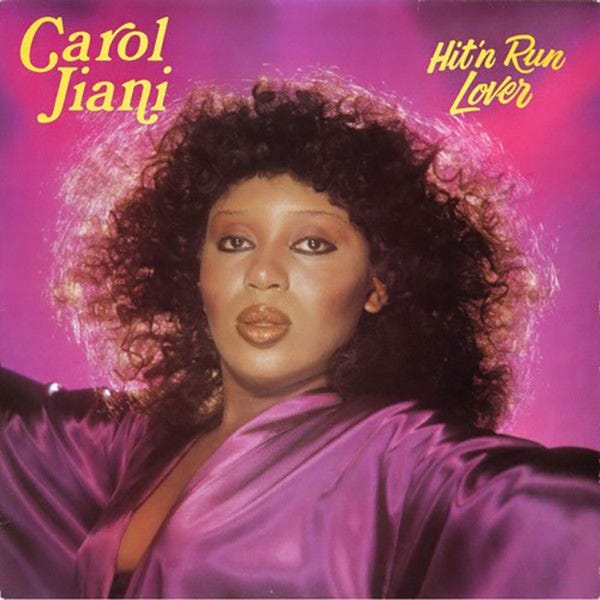
There are records you remember buying. And then there are records you remember feeling.
Carol Jiani’s Hit ’N Run Lover belongs firmly in the second category.
Let me explain.
I don’t remember exactly when I first heard it, although I’m pretty sure it was at the US Import record store in Antwerp. What I do remember is my reaction: I needed that twelve-inch.
The reason was very simple.
That beat.
It was 1981 and Hit ’N Run Lover sounded enormous. It became a major dancefloor record and even crossed into the pop charts here in Belgium, reaching the Top 10. As far as I know, we were the only country where it did that.
And I promise I had nothing to do with it. 😁 Well, apart from playing my copy rather loudly.
The Battle Across the Street
I had a fairly large bedroom at my parents’ house. Actually, it was more or less two rooms combined.
When my parents built the house, they intended to have two children, so they created enough space for two bedrooms. My sister/brother never materialised, which meant I ended up with the space of two rooms. Enough to put in two massive speakers.
My room had a big window facing the street. And directly opposite lived the son of our neighbours, whose bedroom window faced mine.
We shared a love for dance music. But more importantly, we both had two turntables, a mixing panel, amplifiers and (loud) speakers.
You can probably see where this is going. 😁
Whenever our respective parents weren’t home, the windows opened and the battle commenced.
Who had the loudest system? Who had the best records? Who could make the biggest impression on the other side of the street?
Completely silly, of course. Looking back, it still makes me smile, although I suspect the rest of the neighbourhood has slightly less nostalgic memories of two would-be DJs conducting a stereo war across the street.
They probably weren’t happy when, one day, I unveiled my “secret weapon”.
Hit ’N Run Lover.
My parents’ house was solidly built. I know this because it could withstand the bass on that twelve-inch. My speakers weren’t state of the art. They were big, which obviously seemed much more important to younger me at the time, but they certainly weren’t JBLs or anything remotely audiophile.
It didn’t matter.
When Hit ’N Run Lover started, you didn’t merely hear the bass.
You felt it.
And forty-five years later, that teenage memory actually tells us something rather important about the record. Because that bass didn’t end up on the twelve-inch by accident.
👋 Welcome, I’m Pe Dupre, thanks for stopping by.
This is The Twelve Inch, a community about the history of dance music from 1975 to 1995, told one twelve-inch record at a time.
If this landed in your inbox because a friend forwarded it, I’d love for you to subscribe so you don’t miss the weekly episodes. Each one dives into a track, its story, and the culture around it.
And if you’re already enjoying the free posts, would you consider becoming a paid subscriber? Your support helps me keep researching, writing, and unearthing the stories behind the music. And You’ll get access to the weekly B-side post: the full archive and extra Subscriber Only Posts
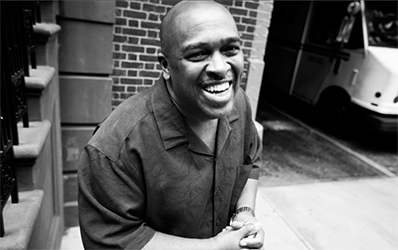
Herb Powers Jr. Enters the Story
Last week I wrote about the Bombers and the Montréal production system behind Everybody Get Dancin’. I also mentioned that some Canadian disco productions could sound a little flat compared with their American counterparts.
Certainly compared with records like Hit ’N Run Lover. And the “secret” was the mastering. This record was mastered at Frankford/Wayne Mastering Labs in New York and cut by Herb Powers Jr., one of the great (dance music) mastering engineers of his generation.
Frankford/Wayne was one of the places to go if you wanted a disco record to work on a club system. Powers cut records for labels such as Prelude and West End and knew exactly what a twelve-inch needed. Hot. Punchy. Bass.
So there I was, unknowingly testing the work of one of New York’s best mastering engineers on my parents’ house.
It passed. 😁
And this is also our first clue as to why Hit ’N Run Lover is such a perfect record for the final chapter of my Can-Con series.
It was sung by a Nigerian-born singer living in Montréal, produced in Montréal, arranged by Denis LePage, mastered in New York, remixed in San Francisco and somehow sounded as if it could just as easily have come from Europe.
If Montréal really was the transatlantic switching board I’ve been describing these past few weeks, this record is almost the perfect illustration.
But first, who was Carol Jiani?
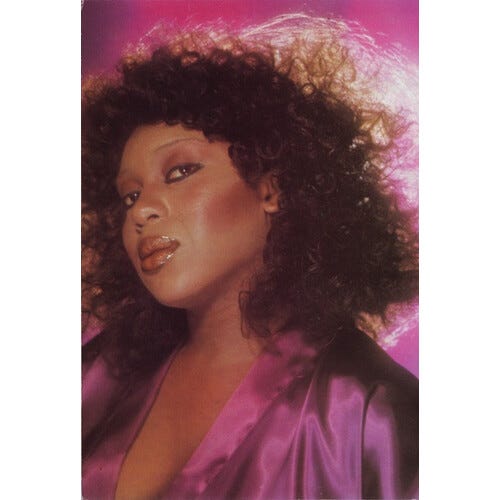
From Nigeria to Montréal
Carol Jiani wasn’t born Carol Jiani. She was born Uchenna Ikejiani in Nigeria.
Her father was a physician and, after her mother died and relations with her stepmother became difficult, she was sent to Montréal to study at Concordia University. Like most students, however, she could use some extra money. Luckily, she could sing.
Jiani began performing in piano bars while studying, and it was in one of those bars that producer Joe La Greca heard her. He asked her to sing on one of his productions.
That relationship started well before Hit ’N Run Lover. In 1979, La Greca released an album under the wonderfully imaginative project name Montréal.
Recorded in...
Wait for it...
Montréal. 😁
Salsoul picked it up for America, where, in what should by now sound very familiar to regular readers of this series, it was remixed for the US market. Jiani sang on the record under her real name, although supposedly she arrived too late for the photoshoot and someone else ended up on the cover.
Disco and album covers. There’s always an interesting story
The project didn’t do much, nor did several other studio productions to which she lent her voice. Then came Hit ’N Run Lover.
That’s when suddenly everything clicked.
Joe La Greca and the Montréal Machine

Joe La Greca is slightly more difficult to pin down.
I know he was deeply embedded in Montréal’s disco and dance industry, but I haven’t found enough reliable material about his early life to tell you whether he was Canadian-born or part of the post-war Italian immigration wave I discussed in last week’s episodes.
So I won’t pretend I know.
What I do know is much more interesting anyway. Like Pat Deserio, La Greca became involved in numerous studio projects. But two of his productions broke well beyond the specialist disco world.
Lime and Carol Jiani.
And both demonstrate what happened when Montréal disco moved into the eighties.
Hit ’N Run Lover sounds like Lime because much of the machinery behind it is the same. La Greca produced it and Denis LePage arranged it, just before Denis and Denyse LePage broke through internationally as Lime.
This is the time when the lush orchestral disco sound of the seventies was disappearing. Synthesizers and electronic rhythms were taking over. Montréal adapted remarkably quickly.
And, as we’ll explore in this week’s B-Side, while American record companies were dramatically reducing their disco output after the backlash, Montréal was already looking towards the more electronic sounds coming from Europe.
So we have the right record, coming from the right city, at the right moment.
But you still need somebody who knows what to do with it.
Enter Matra.
Matra, Moby Dick and a Slight American Mess
Matra Records was founded in Montréal in 1981 by George Cucuzzella, another familiar name from our Can-Con journey. Cucuzzella understood the club market, but he and La Greca also knew that breaking a record internationally required connections outside Canada.
And Hit ’N Run Lover certainly travelled.
It reached No. 4 on the Billboard dance chart, became a major European club hit and crossed into the pop charts in the Netherlands and, especially, Belgium.
The American release history is rather more complicated.
San Francisco Hi-NRG label Moby Dick licensed the track for a remix on Gold Standard. Ariola America then picked it up, only for that company to cease operations after making a distribution arrangement with Arista. Arista consequently became another company handling the record.
That makes three companies releasing the same song. Probably one of the reasons why the record didn’t cross into other markets.
Despite the remixing, it was the original version that everybody seemed to want. Including me. Which brings us to something very peculiar about Hit ’N Run Lover today.
Why Does Hit ’N Run Lover Sound Slightly Off?
Listen to the digital version of Hit ’N Run Lover (like on this week’s mixtape), particularly once the synths enter.
Can you hear it?
There’s a strange wavering, almost whining quality to the pitch. I’m quite sensitive to this kind of thing, but this one is noticeable. Technically it’s called wow, a slow fluctuation in pitch that can be caused by something as simple as an off-centre spindle hole.
Here’s the strange part.
My original twelve-inch doesn’t do it.
I first noticed the problem much later on a European pressing. Then, when I was working as a compilations manager at Universal and wanted to include the track on a compilation, I couldn’t find a digital source without that wavering sound.
And this is where we enter one of the less glamorous corners of the Record Industry.
Master tapes disappear. Or nobody knows where they are. Or somebody knows where they are but they contain the album version and not the twelve-inch mix you actually need.
Dance music is particularly vulnerable because remixes and alternate versions were often treated as disposable once the vinyl had been manufactured. When catalogues were digitised, the original tape wasn’t always available.
So what happened?
The used a vinyl to make a new master.
There are plenty of digital masters in circulation that were clearly sourced from vinyl. Sometimes the transfer was done beautifully. Sometimes you can still hear ticks, wow, flutter or unstable turntable speed.
Try beatmatching one of those.
I’ve seen digital files where the BPM wanders so badly that you wonder whether the turntable was sitting on a boat. My suspicion is that the currently circulating Hit ’N Run Lover master ultimately comes from vinyl, and not from a particularly good copy.
I can’t prove that without access to the master history, so let’s call it what it is, a collector’s educated suspicion. But it would explain a lot.
Jiani later re-recorded the song, presumably partly for the usual business reason of having a version she could control herself.
A Record Made Between Worlds
Hit ’N Run Lover sums up everything I’ve been trying to explain during Can-Con month. A Nigerian singer moves to Montréal. A Montréal producer discovers her in a piano bar. Denis LePage arranges the record. George Cucuzzella’s Matra releases it. Herb Powers Jr. cuts it in New York. Moby Dick gets involved from San Francisco. Europe embraces it. Belgium, for some reason, turns it into a Top 10 pop hit.
And teenage Pé uses it as heavy artillery against the neighbours across the street. 😁
You couldn’t really invent a better Montréal disco story.
Carol Jiani never had the enormous international pop breakthrough that Hit ’N Run Lover seemed to promise, but she kept making dance records, eventually working with Ian Levine and moving firmly into Hi-NRG. La Greca continued too, most famously through Lime, and remained involved in dance music for decades. He died on June 21 this year, aged 73.
But perhaps their most interesting legacy is right here, on this twelve-inch. Because Hit ’N Run Lover doesn’t sound like disco dying. It sounds like dance music figuring out what it wants to become next.
And that is exactly where we’re going in this week’s B-Side.
The Twelve Inch is a growing community of people who love disco, eighties, and early-nineties dance music.
If you know someone who would enjoy these stories, feel free to share this post with them or pass it along on Substack Notes. Every share helps the music, and the community, travel a little further. 💿✨
🎁 B-Side, Going Deeper Into The Groove
We’ll look at what happened when the 1979 disco backlash reached Canada, why Montréal reacted very differently from other Canadian cities, and how the same European connections that had helped build its disco scene left it remarkably well placed for the electronic dance music of the early eighties.
Disco supposedly died.
Montréal, apparently, didn’t get the memo.
Over To You !
If you owned Hit ’N Run Lover, I’d love to know which pressing you had. Can you hear that wavering pitch on your copy?
And more importantly, surely I wasn’t the only teenager who occasionally used a twelve-inch as a weapon in a neighbourhood stereo war? 😁
So You Wanna Hear More ?
I thought you would !
It’s fun to write about music but let’s be honest. Music is made to listen to.
Every week, together with this newsletter, I release a 1 hour beatmix on Mixcloud and Youtube. I start with the discussed twelve inch and follow up with 10/15 songs from the same timeframe/genre. The ideal soundtrack for…. Well whatever you like to do when you listen to dance music.
Listen to the Soundtrack of this week’s post on MIXCLOUD
Or on Youtube :
Omg diva yesssss. I just discovered Hit’n’Run lover like two weeks ago. I wonder if we follow the same people on MixCloud…
Another great installment in the CanCon series! This is a great song which perfectly illustrates the global crossroads story of Montreal dance music which you’ve been telling. It’s a shame this song didn’t make it much bigger because it’s fantastic!