🎶 Before Saturday Night Fever: How Tavares Mastered Disco, and Missed Its Big Moment
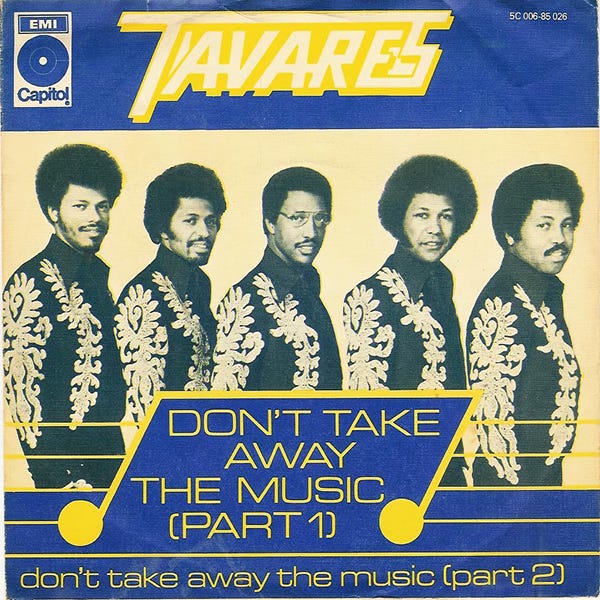
The Twelve Inch 196 : Don't Take Away The Music (Tavares)
Let’s start with a bit of housekeeping. As announced last week, from this week on I’ll be including a read-aloud version of my weekly Substack. Give me a few weeks to get the hang of it — it’s fun, but also a bit more of an uphill battle than I expected (which, to be fair, is not uncommon for me 😁).
Accent and mispronunciations aside (I’m well aware of those), I’d really appreciate any feedback if you give this first one a try.
————————————————————————————————————————————-
For the first episode of Season Two of The Twelve Inch, we dive head-first into the early disco era, a time when the music was still ruled by the direct heirs of the Philly Sound. These were the years before Saturday Night Fever, before disco hardened into an “industry,” and before formulas replaced feel.
In that period, Tavares were arguably one of the most important groups on the dancefloor. They scored a string of remarkable hits, starting with It Only Takes a Minute Girl in 1975 and ending with Whodunit in 1977. But 1976 was truly their year. Heaven Must Be Missing an Angel reached No. 1 in the Benelux, closely followed by the track at the heart of this week’s episode: Don’t Take Away the Music. Both came from their 1976 album Sky High, with its iconic green sleeve, a small, fictional tropical town, the Capitol Records building standing proudly at the centre, green hills rising behind it, and Tavares spelled out in large, Hollywood-style letters across the slope.
1976 was also the year I was in high school. In Belgium, that meant a one-week ski trip to Austria for the third grade. And where there’s skiing, there’s après-ski: parties after long days on the slopes, usually fuelled by too much alcohol and soundtracked by music you’d never willingly listen to, let alone dance to, back home. Mind you, this was a school trip, and I was 13. We had parties, but the teachers made sure everything stayed civil.
One evening, someone brought along the Sky High album. Heaven Must Be Missing an Angel and Don’t Take Away the Music became the soundtrack of that trip, forever etched into our memories. Disco was already big, and Tavares were right at the centre of it. They were perfectly positioned to reap the massive rewards that groups like the Bee Gees would enjoy later, once disco became truly omnipresent.
But they didn’t.
After Whodunit in 1977, just as everything started to explode, it was effectively “over” for Tavares. They continued recording an album almost every year and scored a few minor R&B hits, but there were no more crossovers. Certainly nothing like the success one might have expected after that extraordinary year in 1976.
Why was that? Was it the repertoire? The record company? The band itself?
The story of Tavares, and this missed opportunity, is a powerful illustration of how 1977 changed the way dance music was made, and what that shift meant for the African-American artists who had helped create disco in the first place.
Get your dancing shoes ready, and let’s dive in. 🕺🪩
👋 Welcome, I’m Pe Dupre, thanks for stopping by.
This is The Twelve Inch, my newsletter about the history of dance music from 1975 to 1995, told one twelve-inch record at a time.
If this landed in your inbox because a friend forwarded it, I’d love for you to subscribe so you don’t miss the weekly episodes. Each one dives into a track, its story, and the culture around it.
And if you’re already enjoying the free posts, would you consider becoming a paid subscriber? Your support helps me keep researching, writing, and unearthing the stories behind the music.
🧬 From Cape Verde to New Bedford: The surprising history of a Family Band.
Today, Tavares are often described as a classic example of a Black family band. The second part of that description is absolutely correct. They do share a lineage with groups such as The Jacksons, The Isley Brothers, and DeBarge. But the first part of that label is something the band themselves would have questioned. As Perry Lee (Tiny) Tavares later explained: “ I never considered myself to be a Black American. I don’t want to be called that. That’s not what I am. You know, so I would always say I was Black with Cape Verdean descent.”
The Cape Verde Islands were part of the Portuguese colonial empire. While the population is Black, the immigration history of Cape Verdeans differs markedly from that of African Americans with continental African or Caribbean roots. Most importantly, Cape Verdean migration to the United States began earlier, and it did not occur through the transatlantic slave trade. Cape Verde’s connection to the U.S. began at sea.
Situated off the coast of West Africa, Cape Verde lay directly along major Atlantic shipping routes. American whaling ships, particularly those sailing out of New England, regularly stopped there to recruit crew. Cape Verdeans, facing chronic drought and recurring famine at home, and with a long-established maritime tradition, readily signed on. Many later jumped ship in U.S. ports and settled permanently, especially in New Bedford, which became the spiritual heart of Cape Verdean America.
Within U.S. society, Cape Verdeans occupied an uneasy in-between position. They were, obviously, not considered white, but not fully accepted as Black either. They spoke Portuguese and did not share the historical background of slavery or the Southern states. That liminal status created real challenges, but it also reinforced strong community bonds, particularly in New England.
This sense of family and cohesion is even more pronounced in Tavares than in other Black American vocal families. Disagreements were not uncommon, but the family remained intact regardless of internal differences. One of the most fascinating aspects of the group is how seamlessly the brothers could rotate in and out of the lineup. Tavares originally started as a six-brother group, but during their peak success period, they were best known as a five-member band.
🏢 Capitol Records & the Art of Timing (or Luck)
The Tavares brothers, Arthur Paul, Ralph Vierra, Antone Lee, Feliciano, and Perry Lee, better known as “Pooch,” “Ralph,” “Chubby,” “Butch,” and “Tiny,” formed their first group in 1964 in New Bedford, Massachusetts, under the name Chubby & the Turnpikes. Their musical foundations were deeply rooted in family. Their grandparents taught them traditional Cape Verdean folk songs, while their older brother John introduced them to doo-wop harmony and vocal discipline.
By the late 1960s, the band was already touring extensively and performing live at a high level, experience that even took them to Europe. It was there they realised that their group name wasn’t doing them any favours and needed to change. Choosing their surname as the band name felt both practical and permanent. Tavares was born.
A record deal followed with relative ease. A stroke of luck played its part: a friend of the band had just started working as an A&R executive at Capitol Records and was able to give them a privileged introduction. But luck alone didn’t seal the deal. Years of touring and working as a tight live unit paid off, and Capitol signed them initially for a single. That song, Check It Out, climbed to No. 5 on the R&B charts. Riding that momentum, Capitol quickly upgraded the agreement to a multi-album deal.
Tavares signed to Capitol Records at exactly the right moment — and also the wrong one.
Capitol, long associated with pop and adult-oriented music, was not a disco pioneer. As I told before, Disco wasn’t called disco before 1975, but its early forms were already taking shape on the New York dancefloors. Drawing on the Motown sound from Detroit and the lush productions coming out of Philadelphia International Records, the movement was firmly rooted on the East Coast. Capitol, by contrast, was a West Coast label. Tavares became their first Black group. While Capitol had worked with African-American artists before, it was not an area of real expertise.
Capitol didn’t fully understand what was happening on the dancefloor, but they knew they needed to.
Enter Freddie Perren.
🎛️ Freddie Perren: Precision, Polish, and a Formula That Worked—Briefly
Frederick James Perren was born on May 15, 1943, and raised in Englewood, New Jersey. Music entered his life early, and he later enrolled in the music program at Howard University in Washington, D.C. It was there that he formed relationships with musicians and industry figures who would remain central throughout his career, including Fonce Mizell (covered in the episode on A Taste of Honey and the Mizell Brothers) and Larkin Arnold, who would go on to become Vice President of Capitol Records and head of its Black music division.
Perren’s major breakthrough came when he, together with Mizell and Deke Richards, wrote I Want You Back. The song was originally pitched to Berry Gordy as a potential track for one of Motown’s established acts. Instead, Gordy handed it to a brand-new signing: The Jackson 5. The result was explosive. I Want You Back became a massive hit, launched the Jackson 5 into superstardom, and marked the birth of Motown’s in-house writing and production collective known as The Corporation.
The Corporation would go on to generate a steady stream of hits, often described as “Black bubblegum”, a sound that, in the late 1960s and early 1970s, played a crucial role in laying the groundwork for what would soon become disco.
By 1976, Perren began producing for Capitol Records. That year he scored another major success with Boogie Fever by The Sylvers, yet another family group, and soon after took over production duties for Tavares’ Sky High album. It was this album that delivered Heaven Must Be Missing an Angel and the track at the centre of this week’s episode.
🔊 “Don’t Take Away The Music”: A Disco Record That Knows It’s Temporary
What made Heaven Must Be Missing an Angel and Don’t Take Away the Music so perfectly positioned for success is timing. They arrived at exactly the right moment. The groundwork had already been laid by the Philadelphia Sound, and a new generation of producers was ready to build on it. Freddie Perren was one of them. As his wife would later say: “He thought all the up-tempo songs should have the heartbeat of somebody who was dancing, and he always checked his rhythms to that” Perren was, above all, an up-tempo producer, and he would leave a lasting mark on American disco with some of the genre’s biggest hits bearing his name.
At the same time, Don’t Take Away the Music remains a very typical mid-1970s R&B record. The groove is restrained, the emphasis lies on melody rather than gimmicks, and the vocals sit front and centre, not buried beneath the beat, as would later become common in Eurodisco.
Over the course of their career, Tavares reached the No. 1 spot on the Billboard R&B chart three times. Curiously, neither Heaven Must Be Missing an Angel nor Don’t Take Away the Music was responsible for those chart-toppers. Both songs did, however, reach the top of the dance charts and proved to be major breakthroughs in several European countries. In the UK, each made the Top 5. But it was the Benelux that embraced them most enthusiastically: Heaven Must Be Missing an Angel reached No. 1, while Don’t Take Away the Music climbed to No. 3.
📉 So Why Did It Start Slipping After 1976?
I’ve written before about the difference between American, R&B-based disco and its European counterpart. Eurodisco went unequivocally for the dancefloor. American R&B disco went for the song. If people danced to it, that was a bonus, but it was never the primary objective.
When Saturday Night Fever broke through in 1977 and helped turn disco into an industry, Eurodisco suddenly had a clear advantage. Its focus on the dancefloor, combined with increasing use of electronics, meant records could be produced faster and cheaper. There was no need for complex arrangements or large orchestras.
And this is where Tavares’ story becomes particularly telling. They didn’t adapt to the changing circumstances, not because they couldn’t, but because they didn’t. Freddie Perren certainly could have led them there. He would go on to play a crucial role in peak disco with his production work for two Polydor acts: Peaches & Herb with Shake Your Groove Thing and Gloria Gaynor with I Will Survive, one of the biggest disco records of all time. Both tracks are proof that Perren was among the very best producers to have on your side at that moment.
Perren did produce the next two Tavares albums. Love Storm (1977) delivered another disco hit with Whodunit, but Future Proof (1978) proved to be anything but. By the time of Madam Butterfly in 1979 (nothing to do with Puccini 😁), the band had changed producers. Although they continued to score some R&B hits in the U.S., nothing crossed over to the pop or dance charts, and certainly not in Europe.
After three more albums for Capitol, Tavares moved to RCA. But even in the funk-driven early 1980s, they were unable to engineer any kind of meaningful comeback.
🕺Saturday Night Fever: A Hit Without Ownership
Tavares’ final major European hit came not from their own catalogue, but from the Bee Gees song More Than a Woman, which they recorded for the Saturday Night Fever soundtrack.
The opportunity came through their manager, Brian Panella. At the time, Panella knew Al Corley, then manager at Robert Stigwood’s record company, RSO Records, from their college days. Through that connection, arrangements were made for the Bee Gees to attend a Tavares concert. After the show, the Bee Gees went backstage to meet the brothers.
A few months later, the Bee Gees got back in touch and offered Tavares the song More Than a Woman. The group recorded it immediately, but with their own arrangement. That decision created problems just before the film’s release. Tavares only became aware of the issue while they were touring South America.
Commercially, the decision seemed sound. The soundtrack became a global phenomenon and even earned Tavares their only Grammy. But in the long run, it came back to haunt them. When the disco backlash hit, Saturday Night Fever, and especially its soundtrack, was suddenly seen as excessive, even toxic. Tavares were tainted by association. It did little to help their career and firmly labelled them as a “disco act,” a classification the group themselves never fully embraced.
🪞 What Did Tavares Think About Disco—and was Their Decline unavoidable?
Still, the decline was largely unavoidable. There has always been a tendency among R&B artists to view disco as something lightweight, not entirely serious. Yes, dance music had become important and could offer an easier route to crossover success, but it was never meant to be the primary goal. Tavares shared that conviction. Their later albums did include dance-oriented tracks, but not the kind that dominated club dancefloors at the time.
This suggests that Freddie Perren may never have found the right mindset within the group to fully commit to a dancefloor-first approach in their subsequent repertoire. Perren had already proven that he could do exactly that.
But there was another, equally important factor that made the outcome almost inevitable: their record company. When I wrote about A Taste of Honey, I explained how Capitol Records joined the disco movement too late and, more importantly, never fully understood what it demanded. They continued applying the same approach they used for their R&B artists, prioritising radio play over the realities of the dancefloor.
Capitol never truly repositioned Tavares for the clubs. They didn’t push extended versions, nor did they employ remixers to make the group’s dance tracks more club-friendly. By contrast, Perren’s biggest disco successes came via Polydor, the label that owned (part of) Casablanca and RSO, home to the Saturday Night Fever and Grease soundtracks. Those labels understood the value of the dancefloor and committed to it fully. The results speak for themselves.
While researching this piece, I heard one of the Tavares brothers remark in an interview that one of their biggest mistakes was leaving Capitol Records. That made me wonder if the opposite might actually be true. Not because Capitol did a poor job, far from it. Over the course of their career, Tavares placed 27 songs on the R&B charts, most of them while signed to Capitol. That is hardly a failure. But they never truly moved beyond that level, and on the rare occasions when they did, it was almost by accident.
🌍 Why “Don’t Take Away The Music” Still Resonates
In 1985, both Don’t Take Away the Music and Heaven Must Be Missing an Angel were remixed by Dutch DJ Ben Liebrand, and both songs became hits once again. And although I was never a great fan of those reworks, they do prove the timeless qualities of those Tavares songs, and of Freddie Perren’s production.
The reason they still resonate today is that they represent classic disco: music made before the excesses of the late 1970s. These are songs from a moment when craftsmanship and the dancefloor coexisted peacefully. But more than that, they endure because they are simply great songs, records that send you to the dancefloor every single time they are played.
Tavares continued performing well into the later stages of their career, and Don’t Take Away the Music was always a fixture in their setlists. As Arthur “Pooh” Tavares once said: “I don’t know what it is about that song man. Everywhere we go that’s the first song people ask for. I can’t understand it. I just can’t. There’s no way we cannot do that song when we perform.”
What I almost admire more than the great dance music created by African Americans, or, in this case, Americans of Cape Verdean origin 😁, is the sheer professionalism they brought to the stage. The dance moves are wicked, and utterly impossible for a white guy like me with two left legs. And it’s not for lack of trying. I remember some of my classmates on that ski trip I mentioned earlier could manage parts of the routine, but none of us ever pulled off the full choreography. Every time I watch the videos back, though, the band makes it look effortless, and I find myself thinking, “How difficult can it be?” 😂😂😂
Some things you will never master — and at some point, you simply have to accept your fate.
💬 Over to You
Do you remember the first time you heard “Don’t Take Away The Music”?
Was Tavares part of your disco story… or a rediscovery years later?
Were you ever able to do the dance routines? (I’m especially curious about that one, given my own “frustrations” 😂)
Let me know. Your memories are part of this history too.
Further reading (or should I say watching)
There are a number of interesting video’s/links :
So You Wanna Hear More ?
I thought you would !
It’s fun to write about music but let’s be honest. Music is made to listen to.
Every week, together with this newsletter, I release a 1 hour beatmix on Mixcloud and Soundcloud. I start with the discussed twelve inch and follow up with 10/15 songs from the same timeframe/genre. The ideal soundtrack for…. Well whatever you like to do when you listen to dance music.
Listen to the Soundtrack of this week’s post on MIXCLOUD
Or on Youtube :
So what’s in this week’s mix ?
Tavares’ “Don’t Take Away The Music” is our gateway into one of the richest moments in dancefloor history: the wave of incredible records released in 1975–1976. You’ll hear the unmistakable Philly Sound through Harold Melvin & The Blue Notes, The O’Jays, and The Trammps, alongside a strong dose of seventies Motown via The Jackson 5 and Eddie Kendricks.
But the real pleasure lies a little deeper, with (almost) forgotten gems like Ralph Carter’s “Extra Extra, Read All About It”, Benny Troy’s “I Wanna Give You Tomorrow”, or Impact’s “Happy Man.” Several of these tracks were remixed by Tom Moulton, and some were available only as promo releases at the time—made for DJs, not the charts.
You might assume that Eurodisco hadn’t yet reached US dancefloors during this period. Not true. It was already crossing the Atlantic—largely because it sounded very American. Take The Ritchie Family’s “Romantic Love”: pure Philly DNA, recorded at Sigma Sound Studios in Philadelphia.
Or Jimmy James & The Vagabonds, whose timeless “Now Is The Time” works just as effortlessly on a disco floor as it does at a Northern Soul night (or, on the European continent, a popcorn session). It still fills dancefloors today. And listen closely to the lyrics before saying again that disco was only about love, sex, and disposable thrills.
That said, this set is first and foremost about movement. So lace up your dancing shoes, and get moving.
Enjoy! 🎶
Next week, it’s time for James Bond. We’re still waiting to find out who the next Bond will be, let alone when film number 26 will finally arrive. So instead of looking forward, we’ll look back, zooming in on film number 16 and asking a simple but intriguing question: why did Bond themes always lean toward ballads and never embrace dance beats?


Amazing Pe. Heaven Must Be Missing An Angel is one of my favorite songs of all time. This was fascinating. Loved the voice over as well. Great job.
I think your “Tavares” show was genius.